Uptrend in Technical Analysis
An uptrend is a rising swing structure with higher highs and higher lows on a stated timeframe. Learn how it is identified, tested, and invalidated.
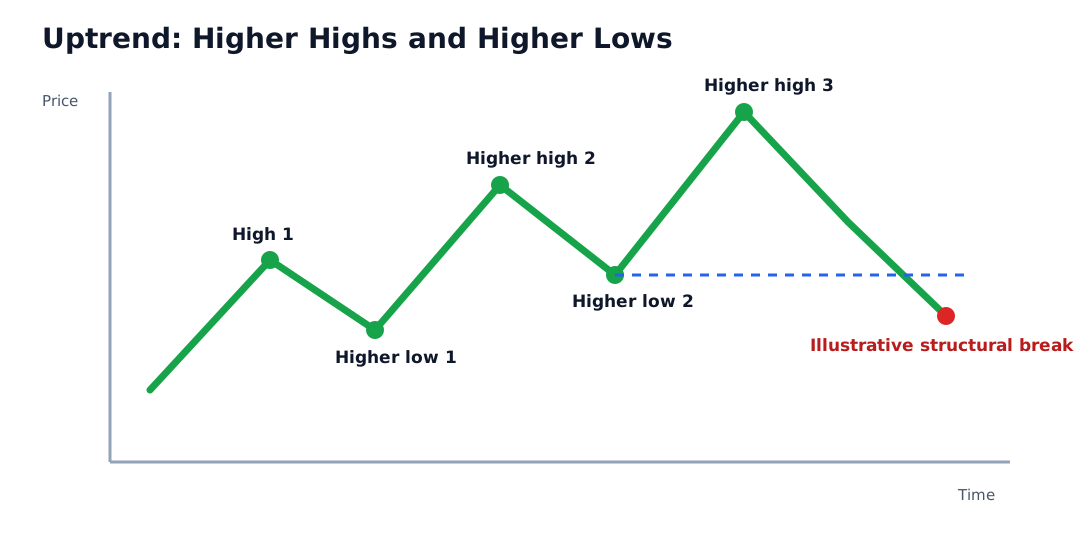
An uptrend is a rising price structure in which meaningful swing highs and swing lows generally progress upward over a stated timeframe. A common definition requires at least one higher high and one higher low after an initial swing pair. It describes observed price behavior, not a promise that the next return will be positive.
The label depends on how swings, timeframe, price field, and invalidation are defined. A daily uptrend can exist inside a weekly downtrend, and two analysts can disagree if they use different swing windows.
Key Takeaways
- Higher highs show that advances exceeded earlier swing highs; higher lows show that pullbacks ended above earlier swing lows.
- A swing becomes identifiable only after price moves away from it, creating recognition delay.
- One large gain does not necessarily form an uptrend.
- A break below the latest higher low weakens many structural definitions but does not automatically establish a downtrend.
- Trend direction, valuation, investment quality, and trade suitability are separate questions.
- Any strategy based on the label must account for signal timing, order type, spread, gaps, and loss limits.
How Higher Highs and Higher Lows Work
A swing high is a local peak surrounded by lower prices. A swing low is a local trough surrounded by higher prices. The word “meaningful” needs a rule because every chart contains small fluctuations.
Possible swing rules include:
- a fixed number of lower bars on each side of a high or higher bars on each side of a low
- a minimum percentage or volatility-adjusted reversal
- a closing-price rule rather than intraday extremes
- a manually selected hierarchy of major and minor swings
No rule is universally correct. A narrow rule reacts quickly but can classify noise; a broad rule is more stable but recognizes changes later.
Worked Example
Suppose a daily chart contains these confirmed swings:
| Swing | Day | Price | Structural role |
|---|---|---|---|
| Low 1 | 5 | $50 | Initial low |
| High 1 | 10 | $58 | Initial high |
| Low 2 | 15 | $54 | Higher low |
| High 2 | 22 | $63 | Higher high |
| Low 3 | 28 | $57 | Second higher low |
| High 3 | 35 | $66 | Second higher high |
The series supports an uptrend label under a higher-high and higher-low rule. If price later closes at $56, it has moved below the $57 latest higher low. That event weakens this specific structure.
It does not yet prove a downtrend. A downtrend definition may require a lower rebound high followed by a lower low. Price could instead recover, form a horizontal range, or create a less steep uptrend.
Swing Recognition Is Delayed
Day 28 cannot be known as a swing low at the instant its low occurs. A rule requiring two higher lows on later bars would recognize it no earlier than day 30. A backtest that assumes an entry at the exact day-28 low uses information that was not yet available.
Record:
- extreme timestamp
- confirmation timestamp
- signal timestamp
- next eligible order time
- actual or simulated fill
This separation prevents a visually obvious historical low from becoming an impossible real-time fill.
Uptrend Across Multiple Timeframes
The same price series can carry several labels:
| Observation | Possible reading |
|---|---|
| Hourly higher highs and lows | Short-term uptrend |
| Daily range | No clear intermediate trend |
| Weekly lower highs and lows | Long-term downtrend |
None automatically overrides the others. The analysis must state which timeframe controls the decision and whether a shorter move is a pullback, rally, or separate trend within the longer structure.
Uptrend vs. Related Concepts
| Concept | What it describes | Key distinction |
|---|---|---|
| Uptrend | Rising sequence of meaningful swings | Price structure on a stated timeframe |
| Rising Trend Line | Diagonal line through selected rising lows | Analyst-drawn tool, not the trend itself |
| Positive momentum | Rate or persistence of recent gains | Can weaken while price still makes higher highs |
| Bull Market | Broad, sustained market advance | Usually wider and longer in scope |
| Breakout | Price crosses a pre-defined boundary | One event, not a complete swing sequence |
An asset can be in an uptrend and still be overvalued, illiquid, volatile, or unsuitable for a particular portfolio. Trend is not a fundamental conclusion.
What Can Weaken or End the Structure?
Methods differ. Possible events include:
- close below the latest meaningful higher low
- formation of a lower high followed by a lower low
- break of a rising trend line under a stated threshold
- moving-average or price-channel rule
- failure to make a new high within a defined time
Each rule has tradeoffs. A latest-swing rule can react quickly but whipsaw. Waiting for both a lower high and lower low reacts later. A trend-line rule depends on anchor points and slope.
How an Uptrend May Affect Analysis
| Use | Legitimate question | Main limitation |
|---|---|---|
| Market description | Is price structure rising on this timeframe? | Selection of swings can change the answer |
| Risk review | Has a long position lost its prior structure? | A structural break may recover |
| Trend filter | Does a rules-based method permit long exposure? | Filters can enter late and exit after losses |
| Relative comparison | Which assets have stronger recent structure? | Direction does not equal value or future return |
These are analytical uses, not recommendations to buy, hold, or sell.
From Trend Observation to Execution
An uptrend does not specify an order. A trader still must define:
- whether action follows a pullback, breakout, close, or next-session signal
- market, limit, stop, or stop-limit order
- maximum position and loss
- response to a gap through the intended level
- transaction costs and liquidity limits
- exit if the trend definition fails
A market order prioritizes execution but not price. A limit order controls price but may not fill. The historical chart alone cannot resolve that tradeoff.
How to Evaluate an Uptrend Claim
- Identify the instrument, data source, and corporate-action adjustments.
- State the chart interval and observation window.
- Define swing highs and lows without future leakage.
- List the exact swings supporting the label.
- Specify the event that weakens or ends the trend.
- Document conflicting higher and lower timeframes.
- Separate signal recognition from the first executable price.
- Test range-bound periods and failed trends, not only sustained advances.
Risks and Common Mistakes
- Classifying one sharp rise as a complete swing trend.
- Selecting only swings that preserve the preferred label.
- Treating an unconfirmed low as known in real time.
- Switching timeframe after the trend breaks.
- Assuming a rising trend line guarantees support.
- Buying after an extended move without a loss rule.
- Confusing price direction with valuation or issuer quality.
- Ignoring gaps, spread, leverage, liquidity, and transaction costs.
Public Source Checks
- CFTC: Commodity Trading Systems Sold on the Internet warns that hypothetical trading can overstate or understate performance and may omit spreads, execution effects, and costs.
- Investor.gov: Types of Orders explains market, limit, and stop-order mechanics.
- Investor.gov: Executing an Order explains why the displayed price may differ from actual execution.
- FINRA: Risk provides broader investor education about investment risk.
Related Terms
- Market Trend: The broader framework for upward, downward, and sideways structure.
- Downtrend: A sequence of lower highs and lower lows.
- Trend Line: An analyst-drawn line through selected reaction points.
- Pullback: A decline that may occur within a broader advance.
- Breakout: A pre-defined boundary crossing.
FAQs
Does one higher high create an uptrend?
When does an uptrend end?
Can an uptrend exist inside a downtrend?
Does an uptrend mean an asset is a good investment?
This article provides general chart-reading education, not a market forecast, trading instruction, or personalized investment recommendation.