Regulated Futures Contract
A regulated futures contract is a defined Section 1256 contract whose margin follows mark-to-market and that is traded on or subject to a qualified board or exchange.
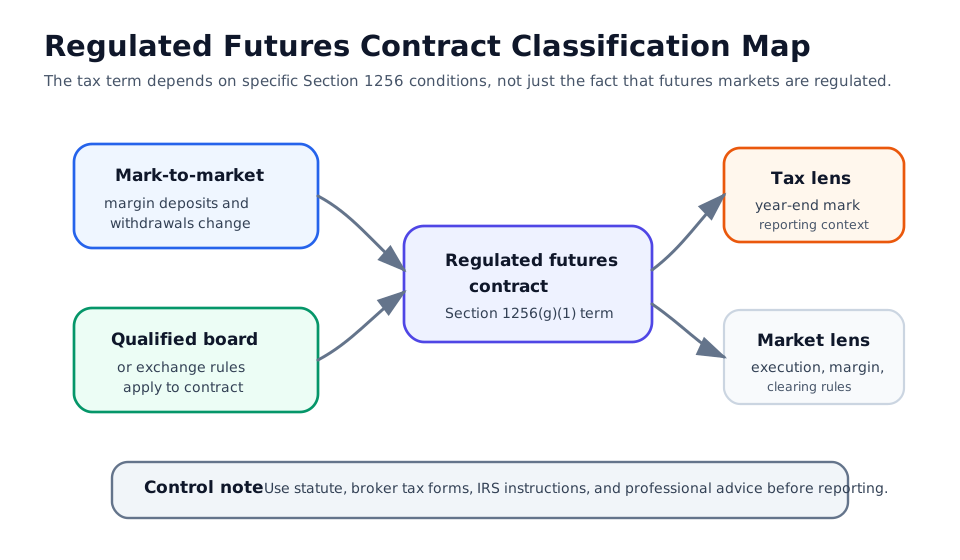
A regulated futures contract is a defined U.S. federal tax term under Internal Revenue Code Section 1256. It is a contract for which required margin deposits and permitted withdrawals depend on a mark-to-market system and that is traded on, or subject to the rules of, a qualified board or exchange.
The phrase does not simply mean “a futures contract overseen by a regulator.” It is a classification that can trigger specific year-end valuation, gain-character, and reporting rules. The exact instrument, taxpayer, transaction purpose, and current law still matter.
Key Takeaways
- Regulated futures contract is a tax definition, not a general label for every exchange-traded futures product.
- The statutory test includes mark-to-market margining and a qualified board or exchange.
- A regulated futures contract is one category within the broader group of Section 1256 contracts.
- Section 1256 positions held at year-end are generally treated as sold at fair market value on the last business day of the tax year.
- Gain or loss is generally divided 60% long-term and 40% short-term, regardless of actual holding period, subject to applicable exceptions and special rules.
- Business hedges, straddles, dealer activity, and certain securities futures can require different analysis.
- Daily clearing settlement and year-end tax mark-to-market are related ideas but different processes.
Statutory Classification
Section 1256(g)(1) defines a regulated futures contract using two requirements:
| Requirement | Practical meaning |
|---|---|
| Mark-to-market margin system | Required deposits and permitted withdrawals depend on changes in market value |
| Qualified board or exchange | The contract is traded on or subject to the rules of a market that meets the statutory definition |
The term qualified board or exchange includes categories specified in the statute, such as a domestic board of trade designated as a contract market by the CFTC. Other statutory categories and determinations can also qualify. A product name or broker description is not a substitute for checking the legal classification.
Where It Fits Within Section 1256
Regulated futures contracts are only one Section 1256 category:
| Potential Section 1256 category | Important distinction |
|---|---|
| Regulated futures contract | Must satisfy the regulated-futures definition |
| Foreign currency contract | Separate statutory definition; not every retail FX transaction qualifies |
| Nonequity option | Listed option that is not an equity option under the statute |
| Dealer equity option | Applies in a dealer context |
| Dealer securities futures contract | Applies to qualifying dealer activity |
Section 1256 also contains exclusions. For example, a securities futures contract generally is not a Section 1256 contract unless it qualifies as a dealer securities futures contract. Specified swaps and similar agreements are also excluded. A reader should not infer treatment merely because an instrument is exchange-traded, cleared, margined, or called a derivative.
Tax Mark-to-Market vs. Daily Settlement
Two separate processes are often confused:
| Process | Purpose | Timing |
|---|---|---|
| Futures clearing mark-to-market | Moves gains and losses through margin and variation settlement | Commonly daily and sometimes intraday |
| Section 1256 tax mark-to-market | Treats an open qualifying contract as sold at fair market value for tax measurement | Generally the last business day of the tax year |
Daily settlement affects account cash and carrying value throughout the trade. Tax mark-to-market determines the gain or loss recognized for the tax year and requires an adjustment so the same amount is not taxed again when the contract is later terminated.
General 60/40 Treatment
Section 1256 generally characterizes gain or loss as:
60%long-term capital gain or loss; and40%short-term capital gain or loss.
This allocation generally applies without regard to the actual holding period, but it is not a universal statement about every futures-related transaction. Hedging transactions, mixed straddles, dealer positions, entity-specific rules, and other elections or exceptions can alter the result or reporting.
Hypothetical Year-End Example
Assume a taxpayer holds a qualifying Section 1256 regulated futures contract with an $8,000 unrealized gain on the last business day of the tax year.
Under the general rule, the contract is treated as sold at fair market value for tax purposes:
| Component | Hypothetical amount |
|---|---|
| Recognized year-end gain | $8,000 |
| 60% long-term component | $4,800 |
| 40% short-term component | $3,200 |
The tax basis or tax carrying amount is adjusted for the gain already recognized. If the position is actually closed in the next tax year, only the additional change after the year-end mark is generally measured at that time, subject to the applicable rules.
This example assumes the general Section 1256 treatment and ignores fees, state taxes, straddles, hedging treatment, loss carrybacks, entity rules, and other adjustments.
Hedging and Straddle Complications
A business futures hedge can receive ordinary rather than capital character when it meets the applicable hedging rules and identification requirements. A transaction cannot be classified from the futures contract alone; the purpose, underlying business exposure, timing, and records matter.
Straddles can trigger loss-deferral, capitalization, identification, and mixed-straddle rules. Form 6781 covers both Section 1256 contracts and straddles, but the presence of a broker-reported Section 1256 amount does not resolve every adjustment.
Documents to Review
Before reporting a transaction, gather:
- The exact contract name, exchange, product code, and tax year.
- Broker Form
1099-Band year-end realized/unrealized gain information. - Trade confirmations and daily statements.
- Evidence that the contract and venue meet the relevant definition.
- Hedge identification and business-purpose records, if applicable.
- Records for offsetting positions or straddles.
- Prior-year marks and adjusted tax basis.
- Current Form
6781, Schedule D, and IRS instructions.
Do not assume that financial-statement fair value, broker margin treatment, and federal income-tax classification are identical.
Common Mistakes
- Treating every listed futures contract as a regulated futures contract without checking the definition.
- Assuming “regulated” refers only to CFTC market oversight.
- Applying 60/40 treatment to a nonqualifying instrument.
- Ignoring open positions at year-end.
- Taxing the same pre-year-end gain again after the position closes.
- Overlooking business-hedge character or identification requirements.
- Ignoring straddle rules when offsetting positions exist.
- Using an old publication or form for the current tax year.
Authoritative References
The official 26 U.S.C. Section 1256 text defines Section 1256 contracts, regulated futures contracts, qualified boards or exchanges, year-end mark-to-market, and the general 60/40 character rule. IRS Publication 550 explains the individual-taxpayer framework, including regulated futures contracts, hedging transactions, and reporting. The IRS Form 6781 page provides the current form and instructions for Section 1256 contracts and straddles.
This page is for general financial education and does not provide tax or legal advice. U.S. federal and state treatment depends on current law and specific facts. Use current IRS materials and a qualified tax professional for filing decisions.
Related Terms
- Futures Contract: Broader futures contract concept.
- Mark to Market: Daily value adjustment concept central to Section 1256 treatment.
- Tax Straddle: Offset-position rules that can complicate Section 1256 reporting.
- Initial Margin: Performance bond required to establish a futures position.
- Futures Trading: Market mechanics separate from tax classification.