Trend Line in Technical Analysis
A trend line connects selected reaction highs or lows on a price chart. Learn how anchors, slope, scale, tolerance, and break rules affect the result.
A trend line is a straight line drawn through selected reaction highs or reaction lows on a price chart and extended through time. A rising line commonly connects higher lows, while a falling line commonly connects lower highs. It is an analyst-defined reference, not a market-guaranteed support or resistance price.
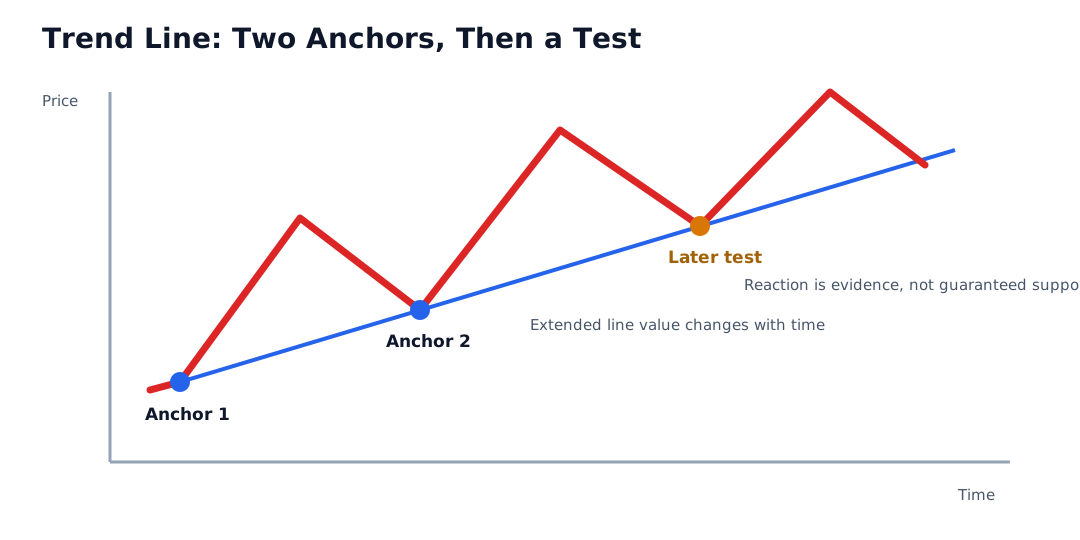
Two points determine a line mathematically. A later reaction can test whether that line remains descriptively useful, but no number of touches guarantees that price will react again.
Key Takeaways
- Anchor selection, timeframe, price field, chart scale, and adjustments determine the line.
- Two anchors define the line; a later point is a test rather than another input to the original two-point construction.
- A sloped line has a different price value on each bar or timestamp.
- Intraday crossing, closing-price, percentage-filter, and multi-bar break rules can give different results.
- A trend-line break shows that price crossed the selected line. It does not automatically prove a trend reversal.
- The line is separate from an order, fill, valuation, or investment recommendation.
How to Draw a Trend Line
Choose the Analytical Unit
Record the instrument, venue, adjusted or unadjusted series, chart interval, and observation window. A daily line through split-adjusted stock prices is not directly comparable with an intraday line through unadjusted trades.
Identify Reaction Points
For a rising line, select meaningful reaction lows. For a falling line, select reaction highs. Define how a swing is recognized, such as a fixed number of surrounding bars or a minimum reversal threshold.
Select the Price Field
Possible conventions include:
- intraday highs and lows
- closing prices
- candle bodies
- a tolerance zone containing several nearby extremes
Switching among these after seeing a break makes the result difficult to reproduce.
Extend the Line
The line’s slope determines its value for later bars. The extension is an analytical reference only; no standing order or market obligation exists at that value.
Worked Example: Calculate a Rising Line
Suppose a daily chart uses these two reaction-low anchors:
- anchor 1: $50 on day 5
- anchor 2: $56 on day 15
The arithmetic slope is:
Slope = ($56 - $50) / (15 - 5) = $0.60 per trading day
The line value on day 25 is:
$50 + (25 - 5) x $0.60 = $62
Suppose day 25 trades as low as $61.60 and closes at $62.20:
| Pre-declared rule | Result |
|---|---|
| Any intraday trade below $62 | Break |
| Close below $62 | No break |
| Close at least 1% below $62 | No break; threshold is $61.38 |
The statement “the trend line broke” is incomplete without the day-specific line value and crossing rule.
Two Anchors vs. a Later Test
If a third low on day 25 forms around $62, it is evidence that price reacted near the original line. It should not be used retroactively to move either anchor and then be described as an independent confirmation.
For systematic analysis:
- Fix anchors 1 and 2.
- Calculate the line forward.
- Define a tolerance around the calculated value.
- Evaluate later observations without redrawing the original line.
- Record failures as well as reactions.
This process reduces hindsight, although the initial choice of anchors can still be subjective.
Arithmetic vs. Logarithmic Scale
An arithmetic chart gives equal vertical space to equal price changes. A move from $10 to $20 occupies more vertical distance than a move from $100 to $110 because the dollar changes differ.
A logarithmic chart gives equal vertical space to equal percentage changes. A doubling from $10 to $20 is visually comparable with a doubling from $100 to $200.
Long histories or assets with large percentage changes can produce materially different lines under the two scales. The scale should be disclosed and held constant during a test.
Rising and Falling Trend Lines
| Line | Common anchors | Observed structure | Typical break question |
|---|---|---|---|
| Rising trend line | Higher reaction lows | Rate at which lows have advanced | Did price fall below the date-specific line value? |
| Falling trend line | Lower reaction highs | Rate at which highs have declined | Did price rise above the date-specific line value? |
| Flat line | Similar highs or lows | Horizontal support or resistance | Did price leave the selected price zone? |
A very steep rising line can break during a slowdown while the broader Uptrend remains intact. A shallow falling line can break while price remains below major prior highs.
Trend Line vs. Related Tools
| Tool | Construction | Main distinction |
|---|---|---|
| Trend line | Straight line through selected reaction points | Contains analyst judgment about anchors |
| Market Trend | Direction inferred from price structure | Trend is the observed condition, not the line |
| Horizontal Line | Fixed price across time | Value does not change by bar |
| Moving Average | Formula applied to a rolling series | Reproducible when inputs and period are fixed |
| Ascending Channel | Trend line plus roughly parallel opposite boundary | Describes a corridor rather than one reference |
What Counts as a Touch or Break?
A touch can mean exact contact, entry into a tolerance zone, or a reversal within a stated distance. A break can mean:
- any trade through the line
- a close through the line
- a close beyond a percentage or volatility buffer
- multiple closes beyond the line
- a crossing followed by a failed retest
No definition is universally best. A wider tolerance may absorb ordinary volatility but recognize change later. An exact rule reacts quickly but can be sensitive to one print.
Does a Break Mean the Trend Reversed?
No. The break establishes only that price crossed the selected line under the chosen rule. Afterward, price may:
- resume the prior trend at a slower slope
- form a horizontal range
- create a false break and reclaim the line
- form the opposite swing structure
- gap because of new information
A reversal rule should identify additional evidence, such as a lower high and lower low after a rising-line break. Even then, future direction remains uncertain.
From Chart Line to Order
A calculated line value is not necessarily an executable price. Market, limit, stop, and stop-limit orders have different fill tradeoffs.
For example, a sell stop placed near a rising line can trigger during a gap and execute below the line. A stop-limit order can restrict price but remain unfilled. The line, trigger, quote, and fill should be stored as separate data.
How to Evaluate a Trend-Line Claim
- Identify the instrument, adjustment method, interval, and window.
- Define how reaction points become observable.
- Record the two anchors and chosen price field.
- State arithmetic or logarithmic scale.
- Calculate the line value for the exact observation time.
- Define touch, tolerance, break, and invalidation rules.
- Separate signal recognition from order and fill.
- Include lines that failed to produce later reactions.
Risks and Common Mistakes
- Choosing anchors only because they fit the later move.
- Moving an anchor after a violation while calling it the same line.
- Mixing highs, lows, bodies, and closes without a rule.
- Ignoring chart scale or corporate-action adjustments.
- Saying a sloped line broke without calculating its current value.
- Treating repeated reactions as guaranteed support or resistance.
- Treating a line break as automatic reversal confirmation.
- Assuming an order fills at the calculated line.
Public Source Checks
- CFTC: Commodity Trading Systems Sold on the Internet warns that hypothetical system results can omit execution conditions, spreads, costs, and losses.
- Investor.gov: Types of Orders explains market, limit, and stop-order mechanics.
- Investor.gov: Executing an Order explains why displayed prices and actual executions can differ.
- FINRA: Risk provides broader investor education about risk.
Related Terms
- Market Trend: The upward, downward, or sideways structure a line may help visualize.
- Uptrend: Rising swing structure often paired with a line under higher lows.
- Downtrend: Falling swing structure often paired with a line above lower highs.
- Support and Resistance: The broader framework for interpreting reaction areas.
- Breakout: A crossing through a pre-defined chart boundary.
FAQs
How many points define a trend line?
Should a trend line use candle wicks or closes?
Does a broken trend line confirm a reversal?
Why does chart scale matter?
This article provides general chart-reading education, not a market forecast, trading instruction, or personalized investment recommendation.