Commodity Contract
A commodity contract defines the quantity, quality, price, timing, delivery, settlement, margin, and default terms for physical or financial commodity exposure.
A commodity contract is an agreement that defines how a physical commodity or commodity-price exposure will be bought, sold, delivered, or financially settled. It may be a spot purchase, private forward, exchange-traded future, option, swap, or longer-term supply agreement.
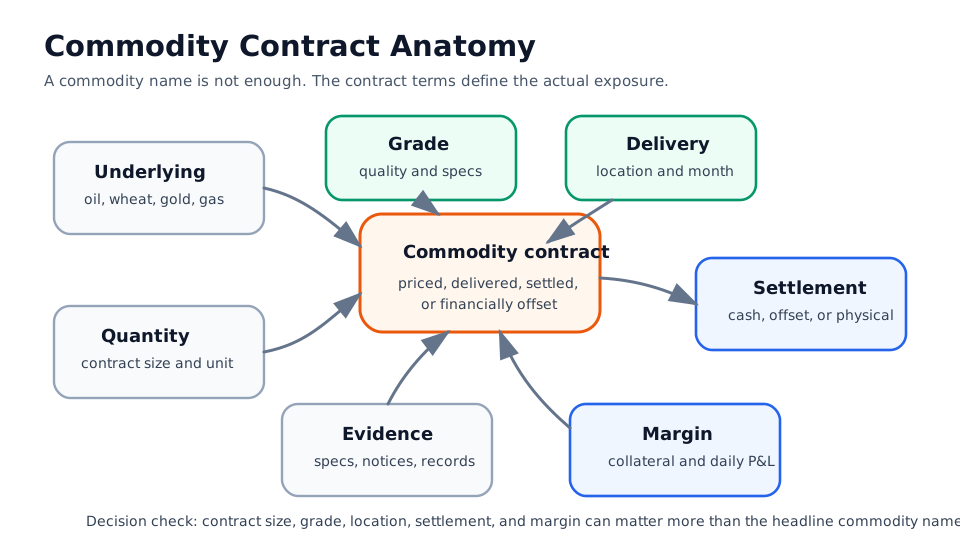
The commodity name is not enough. Contract value and risk depend on quantity, unit, grade, quality, location, timing, price formula, settlement method, margin or collateral, and default rights.
Key Takeaways
- Physical commodities vary by grade, purity, location, and delivery date, so contracts must define what qualifies.
- Futures are standardized and exchange-traded; forwards and supply agreements can be customized.
- Standardization supports fungibility and liquidity but can leave a mismatch with the commercial exposure being hedged.
- Delivery terms matter even when a futures position is offset before delivery because they connect the contract to the cash market.
- Notional value is not the same as initial margin, market value, or maximum loss.
Commodity Contract Anatomy
| Contract term | Question to answer |
|---|---|
| Underlying | Which commodity, benchmark, index, or futures contract determines value? |
| Quantity and unit | How many barrels, bushels, tonnes, ounces, or other units? |
| Grade and quality | Which purity, class, moisture, sulfur, assay, or other standard applies? |
| Price | Fixed price, floating benchmark, differential, average, formula, or option payoff? |
| Delivery location | Which terminal, warehouse, pipeline point, port, or approved facility? |
| Timing | Trade date, pricing period, delivery month, notice date, and final settlement date? |
| Settlement | Physical delivery, cash settlement, offset, or another mechanism? |
| Credit support | Exchange margin, clearing guarantee, collateral, credit limit, or unsecured exposure? |
| Disruption terms | What happens after force majeure, delivery failure, benchmark disruption, or default? |
Main Contract Types
| Type | Trading and settlement model | Typical use |
|---|---|---|
| Spot cash transaction | Current cash-market transaction with prompt physical delivery at a stated spot price | Immediate procurement or sale |
| Forward | Private agreement for future delivery or settlement | Customized commercial hedge or purchase |
| Future | Standardized exchange contract cleared and margined under exchange rules | Hedging, speculation, price discovery, and risk transfer |
| Option | Right, but not obligation, tied to a commodity or futures contract | Price floor, ceiling, or directional exposure |
| Swap | OTC cash flows linked to a commodity price or index | Customized price-risk management |
| Supply or offtake agreement | Commercial purchase or sale across multiple deliveries | Procurement, production financing, and long-term sales |
What “Standardized Commodity” Means
A standardized commodity is not a separate financial asset. It is a commodity defined by uniform contract specifications so acceptable units can be treated as interchangeable for trading and delivery.
For a physically settled future, the exchange may specify:
- contract size and quotation unit
- par or basis grade
- other deliverable grades and price differentials
- approved delivery locations or facilities
- delivery months and notice procedures
- inspection, warehouse receipt, or shipping-certificate requirements
Standardization improves fungibility: a market participant does not need to negotiate every term for every trade. It does not make every physical unit identical. A grade or location outside the contract specification may trade at a premium or discount in the cash market and may not be deliverable.
Futures Standardization vs. Forward Customization
| Feature | Futures contract | Forward or supply contract |
|---|---|---|
| Terms | Standardized by the exchange | Negotiated between counterparties |
| Trading | Exchange market | Usually over the counter |
| Credit model | Clearinghouse and margin | Bilateral credit and collateral terms |
| Offset | Standardized positions can generally be closed with an opposite trade | Opposite contracts may create two separate obligations |
| Commercial fit | Liquid but may not match exact grade, location, or date | Can be tailored to the physical exposure |
| Main mismatch risk | Basis between the contract and actual commodity | Counterparty, documentation, and liquidity risk |
Worked Example
Assume a hypothetical metal future specifies 100 units of a stated purity at an approved warehouse during a named delivery month. A manufacturer expects to buy 95 units of a slightly different grade at another location.
The future may still reduce broad price risk, but the hedge is not exact:
- contract quantity exceeds the expected physical purchase
- grade differs from the manufacturer’s input
- warehouse location differs from the supply location
- delivery timing may not match the purchase date
Those differences create basis risk. A standardized contract can be highly liquid while remaining an imperfect commercial hedge.
Risks and Limitations
- Price risk: the commodity or derivative can move sharply.
- Basis risk: grade, location, timing, or benchmark differences can weaken a hedge.
- Margin risk: futures losses can require cash before an offsetting physical gain is realized.
- Counterparty risk: an OTC party may fail to perform.
- Delivery risk: storage, transport, inspection, notice, and operational obligations may be material.
- Liquidity and rollover risk: a position may be costly to close or replace.
- Optionality: quality, timing, or location choices granted to one party can affect value.
- Legal and force-majeure risk: contract wording determines remedies and performance obligations.
What to Review
- Read the exchange specification, confirmation, or signed supply agreement.
- Match quantity, grade, location, benchmark, currency, and date to the underlying exposure.
- Identify physical-delivery, cash-settlement, offset, and notice mechanics.
- Measure margin, collateral, funding, storage, transport, and credit needs.
- Stress price, basis, liquidity, counterparty, and delivery disruption.
- Confirm accounting, tax, regulatory, and legal treatment separately.
Related Terms
- Commodity Futures: Standardized futures contracts on physical commodities.
- Futures Contract: Standardized exchange-traded contract, including market, clearing, margin, offset, and settlement mechanics.
- Basis Risk: Risk that the contract and commercial exposure do not move together.
- Hedging: Use of an offsetting position to reduce a defined exposure.
- Brent Crude: A major benchmark and contract complex.
Authoritative Sources
- The CFTC Futures Glossary defines contract grades, delivery terms, fungibility, futures, and forwards.
- The CFTC’s economic purpose of futures markets explains standardized contract terms, clearing, offset, delivery, and convergence.
- The CFTC’s policy statement on delivery points and grade differentials explains how specifications affect convergence, congestion, and manipulation risk.
Educational Use
This article explains commodity-contract mechanics and does not recommend a physical purchase, derivative, hedge, or commodity investment. Contract rights and obligations depend on the current exchange rules or signed agreement.