Naked Option
Option written without owning the underlying asset or a fully offsetting hedge, creating large assignment and margin risk.
A naked option is an option contract sold without owning the underlying asset or holding a fully offsetting hedge. It is also called an uncovered option.
The buyer owns the right. The naked option writer owns the obligation. That obligation can become expensive when the underlying asset moves sharply through the strike price.
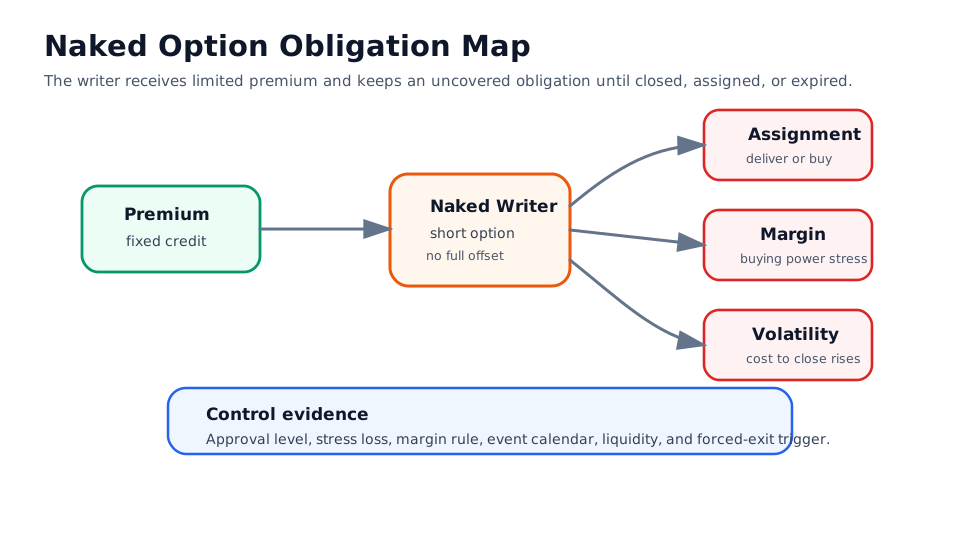
The diagram frames the position as an uncovered obligation: premium is fixed at entry, while margin, assignment, volatility, and liquidity can change quickly after the underlying moves.
Why Naked Options Matter
Naked options matter because the premium received is limited, while the loss can be much larger than the initial credit.
The term is most important when reviewing:
- brokerage approval and margin requirements
- assignment exposure near expiration
- short-volatility strategies
- stress losses during gaps or fast markets
- whether an option-writing strategy is covered, cash-secured, spread-defined, or uncovered
Naked Call vs. Naked Put
| Position | What the writer sells | Main obligation if assigned | Loss profile |
|---|---|---|---|
| Naked call | Call option without owning the underlying | Deliver or short the underlying at the strike | Theoretically unlimited if the underlying rises |
| Naked put | Put option without a short underlying hedge or cash-secured plan | Buy the underlying at the strike | Large downside loss if the underlying falls toward zero |
Both positions collect premium up front. Neither should be evaluated by premium income alone.
How It Differs From Covered or Spread-Defined Writing
A covered option has a built-in asset position that changes the risk. A spread-defined short option has another option leg that limits the payoff range. A naked option has no complete offset, so margin, volatility, and assignment risk become central.
The practical question is not simply “will the option expire worthless?” It is whether the account can withstand the adverse path before expiration.
Example
Suppose a trader sells a call option for a $3 premium with a $100 strike and does not own the stock.
If the stock finishes at $98, the option may expire worthless and the trader keeps the premium. If the stock jumps to $140, the writer may have to close the option at a large loss or deliver stock above the strike. The $3 premium does not cap the loss.
For a naked put, the mirror problem is downside. A writer who sells a $50 put for $2 may be forced to buy shares at $50 even if the stock falls much lower.
Public Source Checks
Use regulatory and clearing sources before treating naked-option writing as ordinary income generation.
- The OCC Characteristics and Risks of Standardized Options explains option-writer obligations, exercise, assignment, and listed-option risks.
- FINRA’s options overview explains that option sellers accept obligations if buyers exercise.
- FINRA’s assignment overview explains why assignment can require action even when a trader holds a multi-leg strategy.
- The SEC’s Leveraged Investing Strategies bulletin warns that some option writers can face unlimited potential losses.
Risk Controls
Before writing a naked option, document:
- approval level, margin rule, and buying-power effect
- maximum intended position size and stress loss
- underlying price level that forces a close, roll, or hedge
- event risk before expiration, such as earnings or macro releases
- liquidity, bid-ask spread, and open interest
- whether early assignment is possible
- whether the trade remains valid after volatility rises
Related Terms
- Naked Call Options Strategy: A short call without owning the underlying asset.
- Naked Put: A short put without a full hedge or cash-secured plan.
- Option Writer Strategies: The broader family of strategies that sell option premium.
- Call Option: The contract type that creates upside delivery risk when sold uncovered.
- Put Option: The contract type that creates downside purchase risk when sold uncovered.
- Margin Account: The account structure often required for uncovered option writing.