Outright Futures Position
An outright futures position is one unpaired long or short contract exposure whose P&L primarily follows the selected futures price.
An outright futures position is an unpaired long or short position in one futures contract. It is not offset by another contract month, related commodity, option, or documented cash-market exposure. Its profit and loss therefore depends primarily on the price movement of the selected futures contract.
“Outright” describes the position structure, not the trader’s motive. A directional speculation is outright, but an operational exposure may also appear outright if its offsetting cash position is omitted from the analysis.
Key Takeaways
- A long outright position benefits from a rise in the selected futures price; a short benefits from a decline.
- The position has linear P&L: each price unit has the same dollar effect, subject to the contract multiplier.
- Margin is collateral and does not limit the loss to the amount initially posted.
- An outright position has no second futures leg to offset broad directional movement.
- The exact contract month, multiplier, liquidity, and settlement rules control the economic exposure.
- Stops and planned exit levels are risk controls, not guaranteed execution prices.
- A position that appears outright in one account may be part of a broader hedge at the portfolio or business level.
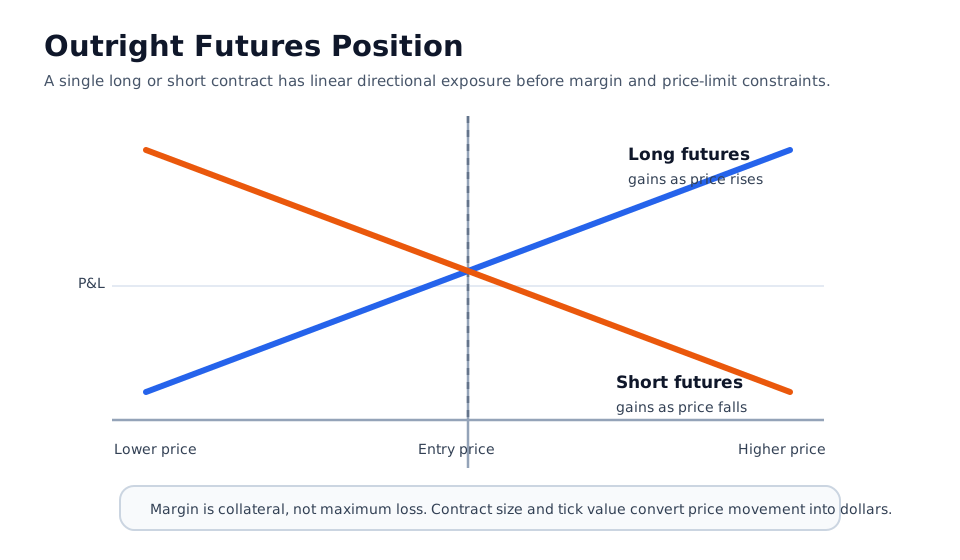
Long vs. Short Outright Futures
| Position | Opening trade | Benefits when | Loses when | Expiration obligation if not offset | |—|—|—| | Long outright | Buy the futures contract | Futures price rises | Futures price falls | Cash settlement or potential delivery receipt, depending on contract | | Short outright | Sell the futures contract | Futures price falls | Futures price rises | Cash settlement or potential delivery obligation, depending on contract |
Selling a futures contract to open a short does not require borrowing the underlying asset as an equity short sale usually does. The short position instead creates a contractual obligation under futures and clearing rules.
P&L Formulas
For \(N\) long contracts:
For \(N\) short contracts:
where \(M\) is the contract quantity or dollar multiplier appropriate to the quote. Fees and execution costs are excluded.
Worked Example
Assume an index future has a $20 multiplier. A trader buys two contracts at 4,500 and later exits at 4,535.
The initial notional exposure was:
If the contract instead fell 35 points, the position would lose $1,400. The account may have posted substantially less than $180,000 as margin, but the full notional exposure drives the price sensitivity.
Daily Cash Flow
The formula describes total economic P&L between two prices. Futures clearing generally realizes that change through daily or intraday mark-to-market:
| Event | Account effect |
|---|---|
| Favorable settlement move | Variation gain is credited |
| Adverse settlement move | Variation loss is debited |
| Equity below required margin | Additional funds or liquidation may be required |
| Margin requirement increases | More collateral may be required even without a new position |
| Position is closed | Final difference to exit is settled, plus fees |
A trader can be correct about the eventual direction and still be forced out by interim cash demands. Liquidity for variation margin is therefore separate from the trade thesis.
Outright vs. Spread, Hedge, or Option
| Structure | Main exposure | What is offset | |—|—| | Outright futures | Direction of one contract | No paired futures or cash leg | | Calendar spread | Price difference between two months | Part of broad underlying-price movement | | Intercommodity spread | Relationship between two related markets | Some common market movement | | Cash-market hedge | Combined cash and futures result | Specified physical or financial exposure | | Option on futures | Nonlinear payoff linked to futures | Loss may be limited for the option buyer to premium, subject to contract terms |
A spread can still be risky. Correlation can change, one leg can become illiquid, and delivery or settlement rules can affect the two months differently. “Less outright exposure” does not mean “low risk.”
Position Sizing Framework
Sizing should start with dollar exposure and plausible adverse movement, not with the maximum number of contracts allowed by available margin.
One planning calculation is:
Suppose a contract is worth $20 per point and a risk plan uses a 20-point adverse-move assumption. The planned price loss is $400 per contract before slippage, gaps, commissions, and fees. A $1,000 risk budget would arithmetically support two contracts under that narrow assumption, not three.
That result is not a recommendation and does not cap the loss. A stop may fill beyond its trigger, a market can gap or lock at a price limit, and volatility can exceed the planning range. The trader must also test notional exposure, normal daily movement, stress scenarios, and margin liquidity.
Scenario Analysis
Before opening an outright position, calculate the dollar result under several paths:
| Scenario | Question |
|---|---|
| Normal adverse day | Can the account absorb a routine unfavorable move? |
| Large gap | What if the market opens beyond the planned exit? |
| Locked limit | What if an offsetting trade cannot execute today? |
| Margin increase | Can the account fund a higher requirement? |
| Liquidity migration | What if volume moves to a later contract month? |
| Delivery window | What happens if the position remains open near notice or final settlement? |
Stress tests should use current contract specifications and market behavior. A fixed percentage move does not create the same dollar risk across contracts with different multipliers.
When an “Outright” Position Is Actually a Hedge
Classification depends on the full economic exposure:
- A producer short futures against expected output may have a hedge, not a speculative outright short.
- A portfolio manager short index futures against equities may have a portfolio hedge.
- A commodity consumer long futures against a planned purchase may be hedging input-price risk.
- A trader long one futures month and short another has a spread even if the legs are booked separately.
Evaluate positions at the appropriate account, portfolio, and business level. Accounting hedge designation, regulatory classification, and risk-management treatment can require documentation beyond economic intent.
Risks and Common Mistakes
- Calculating risk from margin posted instead of notional exposure.
- Using the wrong multiplier, tick value, or contract month.
- Assuming the short side has limited risk because the quote cannot fall below zero in ordinary conditions.
- Treating a stop trigger as a guaranteed fill.
- Ignoring daily variation-margin liquidity.
- Overlooking overnight gaps, price limits, and thin order books.
- Calling a position outright without checking related cash, option, or futures exposures.
- Failing to close or roll before the delivery or final settlement window.
- Scaling multiple correlated outright positions as though they were independent.
Evaluation Checklist
- Confirm whether the position is truly unpaired at the portfolio and business level.
- Identify the exact contract, month, multiplier, tick value, and settlement method.
- Calculate notional exposure and P&L per tick, point, and plausible daily move.
- Compare the position with available initial and variation-margin liquidity.
- Check volume, open interest, spread, price limits, and trading hours.
- Define the entry thesis, review condition, and intended exit or roll date.
- Stress gaps, non-execution, margin increases, and delivery exposure.
- Aggregate correlated positions before judging total directional risk.
This page is educational and does not recommend taking a long or short futures position. Futures are leveraged, can generate losses beyond initial margin, and may create rapid funding or settlement obligations.
Authoritative References
The CFTC Futures Glossary defines long, short, margin, margin call, and mark-to-market. The CFTC’s Futures Market Basics explains hedging and speculation and warns that losses can exceed initial funds. CME Group’s lesson on calculating futures profit or loss shows how price movement, contract size, tick size, and contract count determine dollar P&L.
Related Terms
- Futures Trading: Contract selection, margin, execution, and settlement mechanics.
- Futures Price: Quoted contract price driving P&L.
- Long Position: Exposure that benefits from price increases.
- Short Position: Exposure that benefits from price decreases.
- Position Sizing: Translating a risk budget and adverse-move assumption into exposure.