Box Spread
A box spread combines options spreads to create a synthetic lending or borrowing payoff tied to expiration value.
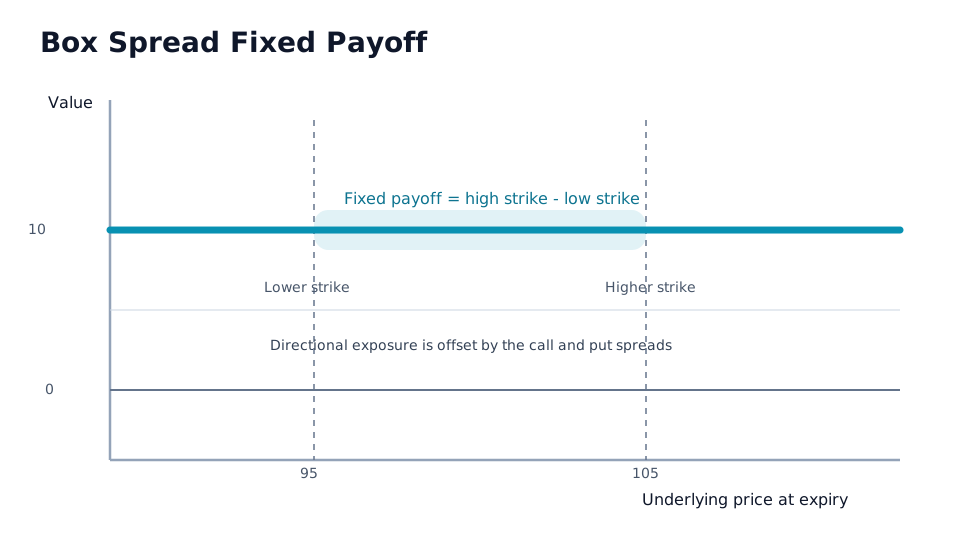
A box spread is a four-leg options structure that combines a bull call spread and a bear put spread using the same two strike prices and the same expiration date. In theory, the position creates a fixed payoff at expiration equal to the distance between the strikes.
Because the expiration payoff is fixed, box spreads are usually analyzed as synthetic lending, synthetic borrowing, or arbitrage. They are not ordinary directional trades.
How the Structure Works
A standard long box spread can be built with:
- buy lower-strike call
- sell higher-strike call
- buy higher-strike put
- sell lower-strike put
The call spread and put spread offset directional exposure. If priced cleanly and held to expiration, the combined payoff should equal:
- box payoff = higher strike - lower strike
The economic question is whether the net cost of the box is attractive relative to that fixed payoff, time to expiration, funding rates, commissions, exercise style, margin, and execution quality.
Payoff Shape
The diagram shows why a box spread is not a normal bullish or bearish strategy: below, between, or above the strikes, the expiration value is designed to stay fixed.
Worked Example
Assume a stock trades near $100 and a trader builds a $95 / $105 long box:
- buy 95 call
- sell 105 call
- buy 105 put
- sell 95 put
The strike width is $10, so the expiration payoff is designed to be $10.
If the box costs $9.70 before commissions and financing, the apparent gross difference is $0.30. That difference is not free profit by itself. The trader must compare it with transaction costs, financing, margin, early exercise risk, tax treatment, and whether all four legs can actually be executed at the assumed prices.
Synthetic Financing Lens
Box spreads are often evaluated like a loan:
| Position framing | Cash flow today | Expiration payoff | Economic interpretation |
|---|---|---|---|
| Long box | Pay net debit | Receive fixed strike-width value | Synthetic lending |
| Short box | Receive net credit | Owe fixed strike-width value | Synthetic borrowing |
| Mispriced box | Price differs from discounted payoff | Potential arbitrage before costs | Requires execution and financing proof |
This framing is why box spreads can become dangerous when traders focus only on payoff diagrams and ignore margin, assignment, and financing mechanics.
Public Source Checks
Use primary or regulatory sources before treating a box spread as risk-free.
- The OCC Characteristics and Risks of Standardized Options explains standardized option contract mechanics, exercise, assignment, and option-writer obligations.
- FINRA’s options overview explains option approval, risk, exercise, assignment, and why options are not appropriate for every investor.
- The Investor.gov introduction to options explains option premiums, calls, puts, and basic investor risks.
- For a real trade, verify all four legs, exercise style, settlement type, margin treatment, transaction costs, tax treatment, and broker rules before treating the payoff as fixed.
Risk Controls
Before entering or reviewing a box spread, document:
- lower strike, higher strike, expiration, and contract multiplier
- net debit or credit and implied financing rate
- exercise style and whether early exercise can disrupt the economics
- bid-ask spread and executable liquidity for all four legs
- margin requirement, collateral treatment, and broker restrictions
- commissions, fees, taxes, and financing assumptions
- close, exercise, or hold-to-expiration plan
Related Terms
- Spread Strategy: The broader family of multi-leg option structures.
- Bull Spread: One directional spread component used in box-spread construction.
- Call Option: One of the two option types used in a box spread.
- Put Option: The other option type used in a box spread.
- Iron Condor: Another four-leg structure, but with range-bound risk instead of a fixed synthetic-financing payoff.
Review Checklist
Before relying on a box-spread analysis, document:
- underlying, expiration, lower strike, higher strike, option style, and contract multiplier
- all four legs, premiums, order type, and intended execution method
- net debit or credit, fixed expiration payoff, and implied financing rate
- transaction costs, fees, taxes, and funding assumptions
- margin, collateral, early-exercise, and assignment treatment
- settlement and corporate-action adjustment risks
- exit, close, exercise, or hold-to-expiration plan