Iron Butterfly Strategy
An iron butterfly is a limited-risk options spread that profits most when the underlying finishes near the middle strike.
An iron butterfly strategy is a four-leg options spread that usually receives a net credit and profits most when the underlying finishes near the middle strike at expiration. It is a defined-risk, defined-reward volatility strategy.
The common short iron butterfly combines:
- a short at-the-money call
- a short at-the-money put
- a long out-of-the-money call above the middle strike
- a long out-of-the-money put below the middle strike
The two short options create the income and the two long options cap risk.
How the Strategy Is Built
Assume a stock trades near $100. A short iron butterfly might use:
- buy 90 put
- sell 100 put
- sell 100 call
- buy 110 call
All four options usually have the same expiration date. The short put and short call share the middle strike. The long put and long call are the wings.
Mathematically, the structure can be shown as:
where \(K\) is the middle strike and \(h\) is the wing distance.
Payoff Shape
The payoff shape is sharply centered: maximum profit occurs near the middle strike, and losses are capped outside the wings.
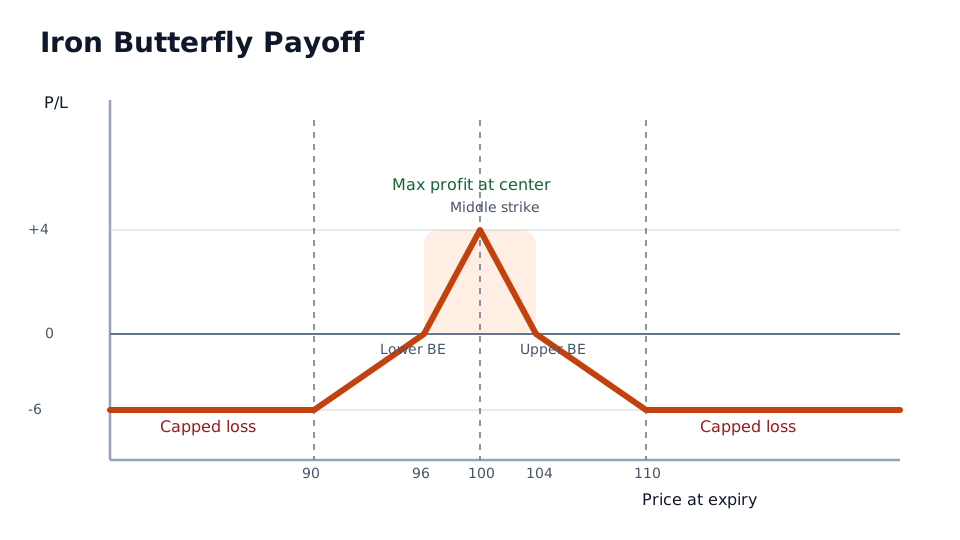
For a short iron butterfly opened for a net credit:
- maximum profit = net credit received
- maximum loss = wing width - net credit received
- lower breakeven = middle strike - net credit received
- upper breakeven = middle strike + net credit received
The strategy has a narrower profit zone than an iron condor, because both short options are at the same middle strike.
Worked Example
Suppose the stock trades near $100 and the trader opens this short iron butterfly:
- buy 90 put
- sell 100 put
- sell 100 call
- buy 110 call
- net credit received =
$4
Then:
- maximum profit is
$4 - maximum loss is
$10 - $4 = $6 - lower breakeven is
$96 - upper breakeven is
$104
The trade works best if the stock finishes close to $100. It can lose if the underlying moves too far in either direction.
Iron Butterfly vs. Iron Condor
Both strategies sell premium and cap risk, but they place the short strikes differently.
| Feature | Iron butterfly | Iron condor |
|---|---|---|
| Short strikes | Same middle strike | Separate out-of-the-money put and call strikes |
| Profit zone | Narrower, centered near one price | Wider range between short strikes |
| Typical credit | Often higher | Often lower |
| Main risk | Underlying moves away from the middle strike | Underlying breaks outside the range |
| Best fit | Strong view that price will pin near a level | Range-bound view with more room for movement |
Public Source Checks
Use primary or regulatory sources before treating an iron butterfly as a simple income trade.
- The OCC Characteristics and Risks of Standardized Options explains standardized option contract mechanics, exercise, assignment, and option-writer obligations.
- FINRA’s options overview explains option approval, risk, exercise, assignment, and why options are not appropriate for every investor.
- The Investor.gov introduction to options explains option premiums, calls, puts, and basic investor risks.
- For a real trade, verify all four legs, quote depth, open interest, expiration, contract multiplier, exercise style, margin effect, and corporate-action adjustments through the broker or exchange data source used for execution.
Risk Controls
Before entering an iron butterfly, document:
- middle strike, wing strikes, wing width, and net credit
- maximum profit, maximum loss, and both breakevens
- expected price range through expiration
- event dates that could move the underlying away from the middle strike
- liquidity and acceptable slippage across all four legs
- assignment and early-exercise risk on the short options
- exit, roll, or adjustment rule if the underlying moves toward a breakeven
Related Terms
- Iron Condor: Similar defined-risk strategy with a wider range between short strikes.
- Covered Call: A simpler income strategy built from stock plus a written call.
- Protective Put Strategy: A downside-protection strategy that buys optionality instead of selling it.
- Box Spread: Another four-leg strategy, usually analyzed for synthetic financing or arbitrage rather than range income.
- Option Premium: The net credit that drives maximum profit and breakevens.
Review Checklist
Before relying on an iron butterfly analysis, document:
- underlying, expiration, four strikes, contract multiplier, and option style
- net credit, wing width, maximum profit, maximum loss, and breakevens
- implied volatility context and expected volatility path
- bid-ask spread, volume, open interest, and multi-leg execution method
- earnings, dividend, macro, or product events during the holding period
- assignment, exercise, and margin treatment of the short legs
- exit, roll, or adjustment rule before expiration