Naked Call Options Strategy
Short call strategy written without owning the underlying asset, creating limited premium income and theoretically unlimited upside loss.
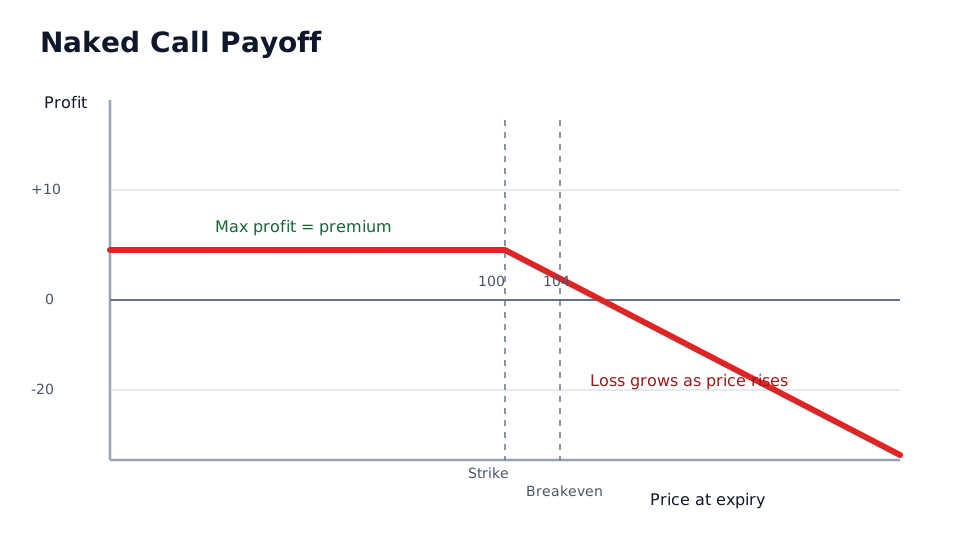
A naked call options strategy sells a call option without owning the underlying asset. The seller receives premium up front but accepts the obligation to deliver the underlying if assigned.
The strategy has limited maximum profit and theoretically unlimited loss because the underlying price can keep rising.
Payoff at Expiration
The naked-call payoff diagram shows the core problem: the seller earns only the premium if the underlying stays below the strike, but losses grow as the underlying rises above breakeven.
At expiration, approximate net profit for one short call before transaction costs is:
where:
- \(S_T\) is the underlying price at expiration
- \(K\) is the strike price
Example
Suppose a trader sells one call with a $100 strike for a $4 premium and does not own the shares.
| Stock price at expiration | Option result | Approximate profit or loss |
|---|---|---|
$95 | Call expires worthless | +$4 premium |
$104 | At breakeven | $0 before costs |
$120 | Call is $20 in the money | -$16 before costs |
$160 | Call is $60 in the money | -$56 before costs |
The premium is fixed. The potential loss is not.
Why Traders Use It
Naked calls are usually used by experienced traders who believe the underlying will stay flat or fall and who want to collect premium. The position may also appear inside more complex short-volatility books, but once it is unhedged the risk must be monitored as an uncovered obligation.
Reasons a trader might consider it include:
- high implied volatility relative to expected movement
- a bearish or neutral view on the underlying
- confidence that liquidity is sufficient to close quickly
- willingness and approval to carry high margin exposure
Those reasons do not make the strategy conservative.
Main Risks
The largest risks are:
- theoretically unlimited loss if the underlying rallies sharply
- margin calls or forced liquidation during adverse moves
- early assignment, especially around dividends for equity options
- short-squeeze or gap risk
- volatility expansion that makes the option more expensive to close
- poor liquidity in the short option series
A stop order does not fully solve the risk because options can gap, spreads can widen, and assignment can occur under contract rules.
Naked Call vs. Covered Call
| Feature | Naked call | Covered call |
|---|---|---|
| Underlying held? | No | Yes, usually shares owned |
| Maximum profit | Premium received | Premium plus stock appreciation up to the strike |
| Main adverse move | Underlying rises sharply | Underlying rises above strike and shares may be called away |
| Loss profile | Theoretically unlimited | Mostly tied to the owned asset falling, not upside delivery risk |
| Typical approval | Higher option approval and margin | Often lower than uncovered calls |
A covered call can still lose money if the underlying falls, but it does not have the same uncovered upside-delivery problem as a naked call.
Public Source Checks
- The OCC Characteristics and Risks of Standardized Options describes option-writer obligations, exercise, assignment, and standardized-option risk.
- FINRA’s options overview explains that a call seller may be obligated to sell the underlying if assigned.
- FINRA’s assignment overview explains why assignment can require action even when the trader expected to manage the trade later.
- The SEC’s Leveraged Investing Strategies bulletin specifically warns about naked call option risk.
Risk Controls
Before selling a naked call, document:
- maximum tolerated loss and forced-exit level
- account approval, margin requirement, and buying-power effect
- whether assignment is possible before expiration
- dividend, earnings, and event calendar
- implied-volatility level at entry
- bid-ask spread, open interest, and closing liquidity
- whether a defined-risk spread would be a better structure
Related Terms
- Naked Option: The broader uncovered option-writing concept.
- Option Writer Strategies: Premium-selling strategies with different risk controls.
- Call Option: The option contract being sold.
- Covered Call: A call-writing strategy backed by owned shares.
- Strike Price: The price at which the call writer may have to deliver the underlying.
- Implied Volatility: A major driver of the premium received and the cost to close.