Head and Shoulders Pattern
A head and shoulders pattern is a three-peak chart structure evaluated around a neckline break; it is a possible reversal signal, not a prediction.
A head and shoulders pattern is a multi-swing chart formation with three peaks: a left shoulder, a higher head, and a right shoulder below the head. Analysts draw a neckline through the two reaction lows and watch for price to break below it after an advance. The inverse form uses three troughs and a neckline through reaction highs after a decline.
Head and shoulders is not a candlestick pattern and does not predict a reversal by definition. The structure can be drawn differently by different analysts, remain incomplete, fail after a neckline break, or become visible only with hindsight.
Key Takeaways
- The standard pattern has three peaks; the inverse pattern has three troughs.
- A candidate structure is usually not considered complete until price satisfies a defined neckline-break rule.
- Shoulders need not be identical, but vague tolerances make pattern selection subjective.
- A neckline can be horizontal or sloped; slope alone does not make a signal stronger or weaker.
- The head-to-neckline distance can be projected from the break as an illustrative measured move, not a guaranteed target.
- Volume, momentum, and a retest can add evidence but do not eliminate false-breakout risk.
- Entry, stop, sizing, exit, costs, and execution timing are separate from recognizing the chart shape.
Pattern Anatomy
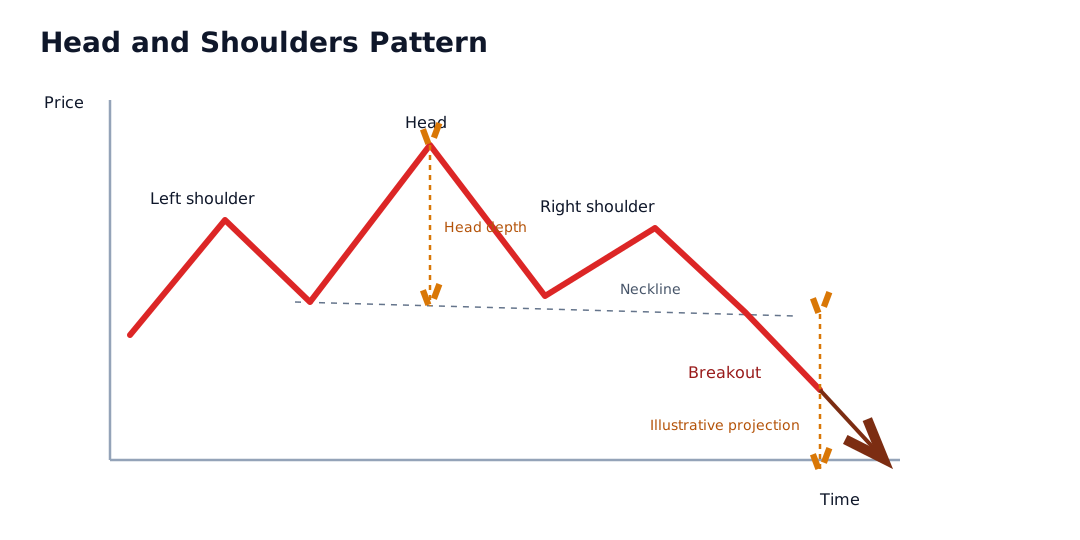
| Component | Standard top | Inverse pattern |
|---|---|---|
| Prior context | Advance or rising trend | Decline or falling trend |
| Left shoulder | Peak followed by reaction low | Trough followed by reaction high |
| Head | Higher peak | Deeper trough |
| Right shoulder | Peak below head, often near left shoulder | Trough above head, often near left shoulder |
| Neckline | Line or zone through reaction lows | Line or zone through reaction highs |
| Common completion rule | Price closes below neckline | Price closes above neckline |
| Common interpretation | Possible bearish reversal | Possible bullish reversal |
“Often near” needs a numerical tolerance in systematic research. Requiring perfect symmetry can omit plausible structures, while accepting any three swings can create patterns almost everywhere.
Worked Example: Standard Pattern
Assume a stock advances and forms these swing points:
| Swing point | Price |
|---|---|
| Left shoulder high | $110 |
| First reaction low | $98 |
| Head high | $125 |
| Second reaction low | $100 |
| Right shoulder high | $112 |
| Neckline value on breakout date | $101 |
| Breakout-period close | $99 |
The three peaks meet a reasonable shoulder-head-shoulder ordering, and the reaction lows define a slightly rising neckline. If the pre-defined completion rule requires a close below the neckline, the $99 close satisfies it because the neckline is $101 on that date.
Before that close, the formation was only a candidate. An intraday move to $100 followed by a close at $103 would not satisfy the same closing-break rule.
The Measured-Move Projection
A common chart calculation measures the vertical distance from the head to the neckline near the head, then projects that distance from the neckline break.
Using a simplified neckline value of $99 near the head:
Head depth = $125 - $99 = $26.
If the breakout reference is $101, the downward projection is:
$101 - $26 = $75.
$75 is an illustrative projection, not expected value, fair value, a guaranteed exit, or proof that shorting offers acceptable risk. Price can reverse above the neckline, pause before the projection, gap below it, or never reach it.
The calculation also depends on where the analyst measures a sloped neckline. Different drawing rules can produce different projections from the same chart.
Standard vs. Inverse Head and Shoulders
The inverse formation mirrors the standard top. It appears after a decline, with a central trough below the two shoulder troughs. Analysts watch for an upward neckline break.
| Question | Standard top | Inverse pattern |
|---|---|---|
| Direction of possible reversal | Uptrend to downtrend | Downtrend to uptrend |
| Neckline role before break | Support | Resistance |
| Break direction | Down | Up |
| Main execution risk | Short entry after a downward gap or false breakdown | Long entry after an upward gap or false breakout |
Neither version becomes reliable merely because it looks symmetrical. Market, timeframe, liquidity, and testing evidence still matter.
How to Draw the Neckline
The standard neckline connects the reaction lows between the left shoulder and head and between the head and right shoulder. The inverse neckline connects the corresponding reaction highs.
Analysts must decide whether to use:
- intraperiod highs and lows or closing prices;
- a precise line or a wider support/resistance zone;
- two points or a best-fit approach with more reactions;
- arithmetic or logarithmic price scaling; and
- adjusted or unadjusted data.
These choices can change the slope and break date. A line drawn after seeing the outcome is vulnerable to hindsight bias.
What Counts as a Break?
Possible rules include:
- any trade through the neckline;
- an end-of-period close beyond it;
- a minimum percentage or volatility-adjusted distance;
- a break accompanied by defined volume; or
- a break followed by a failed retest of the neckline.
Each rule changes signal timing and false-break frequency. A retest is not required by the definition and may never occur. Waiting for one can avoid some false breaks but can also miss a continuing move.
Volume and Momentum
Some analysts look for lower volume on the right shoulder and higher volume on the neckline break. Others examine momentum divergence. These are optional filters, not universal components.
Volume from fragmented venues, foreign exchange, or digital-asset markets may be incomplete or non-comparable. Multiple indicators derived from the same price series do not provide independent confirmation merely because their names differ.
Pattern Failure
A standard pattern can fail when price breaks below the neckline and then quickly closes back above it, exceeds the right shoulder, or resumes the prior advance. An inverse pattern can fail in the opposite direction.
Failure matters for two reasons:
- it can create losses for positions entered on the initial break; and
- it demonstrates that the pattern is a conditional setup rather than a completed causal explanation.
A strategy should define failure before entry. Changing the line, timeframe, or pattern label after an adverse move makes the result impossible to evaluate honestly.
How to Evaluate a Head and Shoulders Claim
- Identify the instrument, venue, data source, timeframe, and price adjustment.
- Define the prior trend and swing-point detection rule.
- Record shoulder and head prices and the permitted symmetry tolerance.
- Specify how the neckline is drawn and its value on each date.
- Define the exact completion, entry, invalidation, and exit rules.
- Distinguish an intraday break from a closing break.
- Include spreads, gaps, fees, market impact, short-borrow costs, and stop slippage.
- Test all qualifying patterns, including incomplete and failed formations.
- Compare results with a simpler trend or passive benchmark on later data.
Risks and Common Mistakes
- Calling head and shoulders a candlestick pattern.
- Treating three vaguely similar peaks as a completed reversal.
- Declaring completion before the neckline break rule occurs.
- Saying neckline slope mechanically strengthens or weakens the signal.
- Presenting the measured move as a profit target or valuation estimate.
- Drawing swing points and the neckline only after seeing the decline.
- Assuming a stop above the right shoulder guarantees that execution price.
- Ignoring short-sale borrow, leverage, gaps, and unlimited-loss risk.
- Reporting only clean textbook examples.
Public Source Checks
- CFTC Futures Glossary defines technical analysis using price, volume, and open-interest patterns.
- Investor.gov: Types of Orders distinguishes chart levels from market, limit, and stop-order instructions.
- FINRA: Stop Orders in Volatile Markets explains why a stop’s execution price can differ from its trigger.
Related Terms
- Neckline in Technical Analysis: The line or zone through the pattern’s reaction points.
- Breakout: Price movement through a pre-defined support, resistance, or pattern boundary.
- Double Top: A two-peak reversal setup with related neckline questions.
- Support and Resistance: The broader framework for interpreting the neckline.
- Golden Cross and Death Cross: Lagging moving-average transitions rather than swing-pattern geometry.
FAQs
When is a head and shoulders pattern complete?
Must the two shoulders be the same height?
Is the measured move a guaranteed target?
Can the pattern fail after a neckline break?
This article provides general chart-reading education, not a market forecast, short-sale instruction, or personalized investment advice.