Strike Price
Strike price is the fixed exercise price that defines an option's intrinsic value, moneyness, and payoff profile.
A strike price is the fixed exercise price in an option contract. It is the price at which a call holder can buy the underlying asset or a put holder can sell the underlying asset if the option is exercised.
The strike is not just a label in the option chain. It determines whether the option is in the money, at the money, or out of the money, and it is one of the main inputs in the option’s premium, breakeven, delta, and exercise risk.
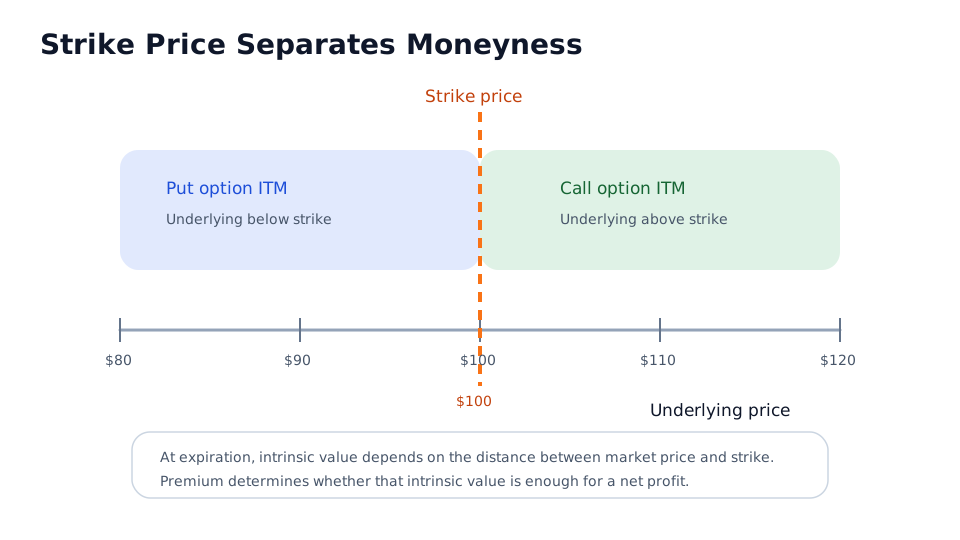
Why Strike Price Matters
The strike price answers a practical question: what price level must the underlying reach before the option’s exercise right has intrinsic value?
For a call option, a lower strike is more valuable because the holder has the right to buy at a cheaper price. For a put option, a higher strike is more valuable because the holder has the right to sell at a better price.
Strike selection affects:
- the option premium paid or received
- the breakeven price at expiration
- the probability that the option finishes in the money
- the amount of intrinsic value already embedded in the contract
- the sensitivity of the position to moves in the underlying
- the assignment or exercise risk near expiration
Two options on the same stock, with the same expiration date, can behave very differently if their strikes are different.
Calls Versus Puts
| Position | When the strike has intrinsic value | Basic expiration payoff before premium |
|---|---|---|
| Long call | Underlying price is above the strike | Underlying price - strike price |
| Long put | Underlying price is below the strike | Strike price - underlying price |
The option premium still matters. An option can finish in the money and still lose money overall if the intrinsic value is smaller than the premium paid.
Moneyness and Strike Choice
Moneyness compares the current underlying price with the strike price:
- In the money: exercise would create intrinsic value before considering premium.
- At the money: the underlying price is close to the strike.
- Out of the money: exercise would not create intrinsic value.
Example: if a stock trades at $100, a $90 call is in the money, a $100 call is roughly at the money, and a $110 call is out of the money. For puts, the direction flips: a $110 put is in the money, a $100 put is roughly at the money, and a $90 put is out of the money.
Cost, Probability, and Leverage
Strike choice is a tradeoff between cost, probability, and payoff shape.
| Strike choice | Typical premium | Typical probability of finishing ITM | Typical use |
|---|---|---|---|
| Deep in the money call | Higher | Higher | Stock substitute, higher delta exposure |
| At the money call | Moderate | Balanced | Directional view with meaningful time value |
| Out of the money call | Lower | Lower | Higher-risk speculation or spread construction |
| Deep in the money put | Higher | Higher | Strong downside protection or bearish exposure |
| Out of the money put | Lower | Lower | Cheaper tail protection or bearish speculation |
A cheap out-of-the-money option is not automatically attractive. It may require a large and fast move just to break even. A deep in-the-money option is not automatically safer either, because the larger premium creates more capital at risk.
Worked Example
Assume a stock is trading at $100 and an investor compares two one-month calls:
| Contract | Strike | Premium | Breakeven at expiration |
|---|---|---|---|
| Call A | $95 | $8 | $103 |
| Call B | $105 | $3 | $108 |
Call A costs more, starts closer to intrinsic value, and needs a smaller move to break even. Call B is cheaper and offers more percentage leverage, but the stock must rise further before the trade becomes profitable at expiration.
For a long call:
For a long put:
Authority Sources
Use public sources to verify the contract mechanics before treating a strike as decision-grade evidence:
- OCC Characteristics and Risks of Standardized Options explains standardized option terms, exercise mechanics, settlement, and risk disclosures.
- FINRA’s options overview frames listed options as rights that depend on the underlying asset, strike, premium, and expiration.
- Investor.gov’s options bulletin is a useful investor-facing check on basic option risks and terminology.
For an actual trade, the public source is only background. The controlling evidence is the option symbol, option chain, trade confirmation, broker exercise rules, expiration calendar, and account-level margin or assignment policy.
Risk Controls
Before selecting a strike, document:
- the maximum premium at risk for a long option
- the assignment exposure for a short option
- the breakeven price after premium and commissions
- the bid-ask spread and open interest near the chosen strike
- the exit rule if the underlying does not move fast enough
- the margin requirement and exercise handling if the position is short or near expiration
Strike price matters most when it changes the actual payoff, not when it merely changes how the trade is described.
Related Terms
- Call Option: Gives the holder the right to buy at the strike price.
- Put Option: Gives the holder the right to sell at the strike price.
- Expiration Date of Options: The deadline that determines when the strike is tested.
- Option Premium: The market price paid or received for the option.
- At The Money: A moneyness state where the underlying is close to the strike.
- Deep In The Money Options: Options whose strikes create substantial intrinsic value.
Review Checklist
- Identify the exact option symbol, underlying asset, strike, expiration date, and contract multiplier.
- Compare the strike with the current underlying price to classify moneyness.
- Calculate breakeven after premium, not just intrinsic value.
- Check whether liquidity is concentrated at nearby strikes.
- Confirm whether the position could create exercise, assignment, margin, or settlement exposure.
FAQs
Does a lower strike always mean a better option?
Can an option finish in the money and still lose money?
$100 call bought for $5 is in the money at $102, but it still loses money because the breakeven is $105.