At The Money
At the money describes an option whose strike price is at or very near the current price of the underlying asset.
At the money (ATM) describes an option whose strike price is at or very near the current price of the underlying asset.
An ATM option usually has little or no intrinsic value, but it can have substantial extrinsic value because a small move in the underlying can quickly turn the option in the money or out of the money.
The ATM zone is the narrow area where the strike and underlying price are close enough that small price moves can quickly change moneyness, delta, and expiration outcome.
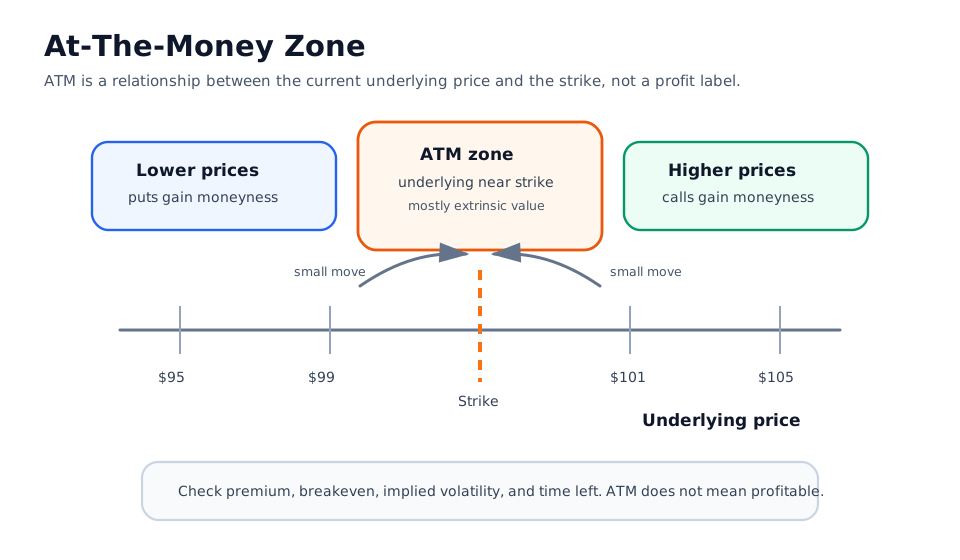
How ATM Works
For a call option, at the money means the underlying price is close to the call strike. For a put option, it means the underlying price is close to the put strike. In practice, traders often say “near the money” because the underlying price moves continuously while listed strike prices are fixed in increments.
If a stock trades near $100, both the $100 call and the $100 put are generally considered at the money. If the stock moves to $103, the $100 call becomes in the money and the $100 put becomes out of the money.
The intrinsic value formulas are:
where S is the underlying price and K is the strike price. When S is close to K, intrinsic value is small, so the premium is mostly time value and volatility value.
Why ATM Options Matter
ATM options are often the center of the option chain because they are usually among the most actively traded strikes. They matter because they tend to have:
- high sensitivity to changes in implied volatility
- meaningful gamma because small price moves can change moneyness
- high time decay compared with deeper in-the-money options
- bid-ask spreads that are often tighter than far out-of-the-money or deep in-the-money strikes
- useful pricing signals for straddles, strangles, collars, and volatility trades
For many strategies, the ATM strike is where the market’s view of near-term uncertainty is easiest to observe.
ATM Is Not A Profit Guarantee
At the money does not mean fairly priced, low risk, or likely to profit. It only describes the relationship between the strike and the current underlying price.
Example: a stock trades at $100, and a trader buys a one-month $100 call for $4. The call is at the money at entry. At expiration, the stock must finish above $104 before the trade is profitable before fees. If the stock finishes at $102, the call is in the money, but the buyer still loses money overall.
Greeks and Volatility
ATM options often carry the most visible Greek exposure:
| Greek | ATM behavior | Practical implication |
|---|---|---|
| Delta | Often near +0.50 for calls and -0.50 for puts, but not guaranteed | The option can quickly gain or lose directional exposure |
| Gamma | Often high relative to nearby strikes | Delta can change rapidly after small underlying moves |
| Theta | Often meaningful because premium is mostly extrinsic value | Holding the option requires the thesis to work before time decay dominates |
| Vega | Often important | Implied volatility changes can move the option even if the underlying is flat |
Dividends, interest rates, skew, settlement style, and time to expiration can make actual deltas differ from simple rules of thumb.
Authority Sources
Use public sources for the basic option framework before relying on ATM terminology:
- OCC Characteristics and Risks of Standardized Options is the core disclosure source for standardized listed option mechanics and risks.
- FINRA’s options overview explains option rights, strike prices, premiums, expiration, and common expiration types.
- Investor.gov’s options bulletin is a plain-language investor source for option basics and risks.
For a specific trade, confirm the option chain, timestamp, underlying price, bid-ask spread, implied volatility, expiration date, and contract specifications.
Related Terms
- Strike Price: The price level used to classify option moneyness.
- In-the-Money Options: Options with intrinsic value before premium is considered.
- Deep In The Money Options: Options whose strikes are far favorable relative to the underlying price.
- Expiration Date of Options: The date when final moneyness and settlement are determined.
- Option Premium: The market price paid or received for the option.
- Delta: A measure of option price sensitivity to the underlying.
Review Checklist
- Confirm the current underlying price and the timestamp used to define ATM.
- Compare the strike with nearby strikes, not just the nearest listed strike.
- Separate intrinsic value from premium and breakeven.
- Check implied volatility, bid-ask spread, and open interest before trading.
- Model what happens if the underlying stays near the strike until expiration.