Deep In The Money Options
Deep in the money options have substantial intrinsic value because the strike price is strongly favorable relative to the underlying price.
Deep in the money (DITM) options are in-the-money options with substantial intrinsic value. A DITM call has a strike price far below the current underlying price. A DITM put has a strike price far above the current underlying price.
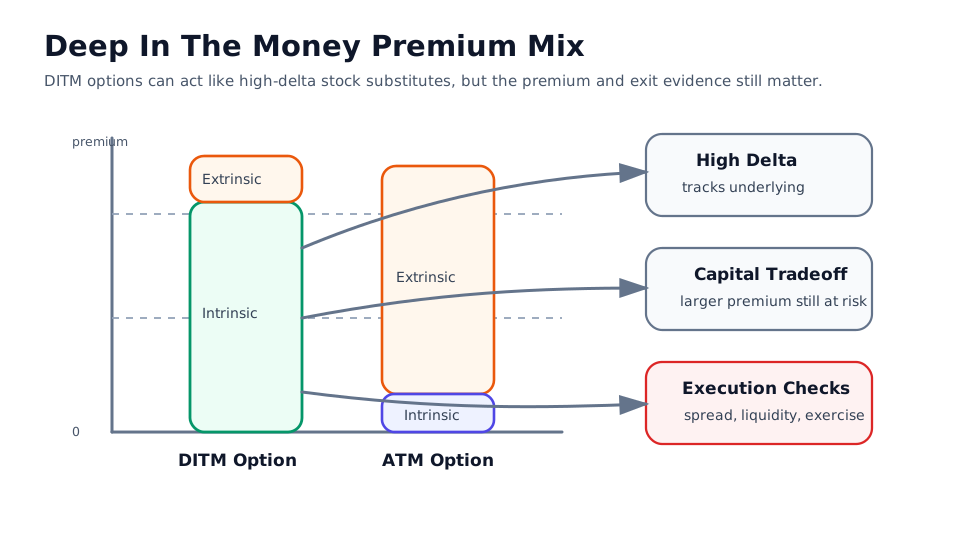
There is no universal percentage threshold for “deep.” The practical question is whether most of the option’s premium is intrinsic value and whether the option behaves more like the underlying asset than a typical at-the-money option.
How DITM Works
The same intrinsic value formulas apply:
where S is the underlying price and K is the strike price.
Example: if a stock trades at $150, a $100 call is deep in the money because the call already has $50 of intrinsic value. A $200 put on the same stock is deep in the money because the holder has the right to sell at $200 when the market price is $150.
The diagram shows why DITM options often behave more like the underlying than at-the-money options: intrinsic value dominates the premium, while remaining extrinsic value and liquidity still need separate review.
Why Traders Use DITM Options
DITM options are often used as a stock substitute or high-delta hedge. They can provide directional exposure with less capital than buying or shorting the underlying outright, while still retaining defined premium risk for the long option buyer.
Common uses include:
- long calls as a leveraged stock replacement
- long puts as stronger downside protection
- rolling an option position while preserving intrinsic value
- spread construction where one leg should behave close to the underlying
- reducing sensitivity to time decay relative to out-of-the-money options
The tradeoff is that DITM options cost more. A buyer can lose a large premium if the underlying reverses or if the exit market is illiquid.
DITM Versus ATM and OTM
| Moneyness | Premium mix | Typical delta behavior | Main risk |
|---|---|---|---|
| Deep in the money | Mostly intrinsic value | High absolute delta | Large premium at risk, liquidity, assignment/exercise handling |
| At the money | Mostly extrinsic value | Delta changes quickly | Time decay and volatility changes |
| Out of the money | All or mostly extrinsic value | Lower probability of finishing ITM | Premium can expire worthless |
DITM options may look safer because they have intrinsic value, but the dollar risk can be higher because the premium is larger.
Liquidity and Exercise Issues
Some DITM strikes trade less actively than at-the-money strikes. Wide bid-ask spreads can make entry and exit expensive, especially in less active underlyings or longer expirations.
Exercise and assignment also matter. A DITM short call may face assignment risk, especially near expiration or around dividends. A long DITM option may be exercised automatically at expiration unless the trader gives contrary instructions through the broker.
Authority Sources
Use public sources to check standardized option mechanics and risks:
- OCC Characteristics and Risks of Standardized Options explains exercise, assignment, settlement, and standardized listed option risks.
- FINRA’s options overview summarizes option rights, obligations, premiums, expiration, and in-the-money status.
- Investor.gov’s options bulletin gives a plain-language investor overview of option products and risks.
For a specific DITM trade, verify the option symbol, current underlying price, strike, expiration, implied volatility, bid-ask spread, open interest, margin impact, and exercise instructions.
Related Terms
- In-the-Money Options: The broader category of options with intrinsic value.
- At The Money: Options whose strike is close to the underlying price.
- Strike Price: The fixed exercise price that determines moneyness.
- Expiration Date of Options: The date when final moneyness and settlement are determined.
- Delta: DITM options usually have higher absolute delta.
- Liquidity: Deep strikes can be harder to enter or exit cleanly.
Review Checklist
- Calculate intrinsic value and compare it with the quoted premium.
- Check whether the remaining extrinsic value is worth paying.
- Review bid-ask spread, volume, and open interest at the strike.
- Model exercise, assignment, and settlement exposure before expiration.
- Compare the DITM option with owning the underlying or using a vertical spread.