Stocks vs. Commodities
Stocks are ownership claims on companies, while commodity exposure comes from physical goods, derivatives, funds, or businesses affected by commodity prices.
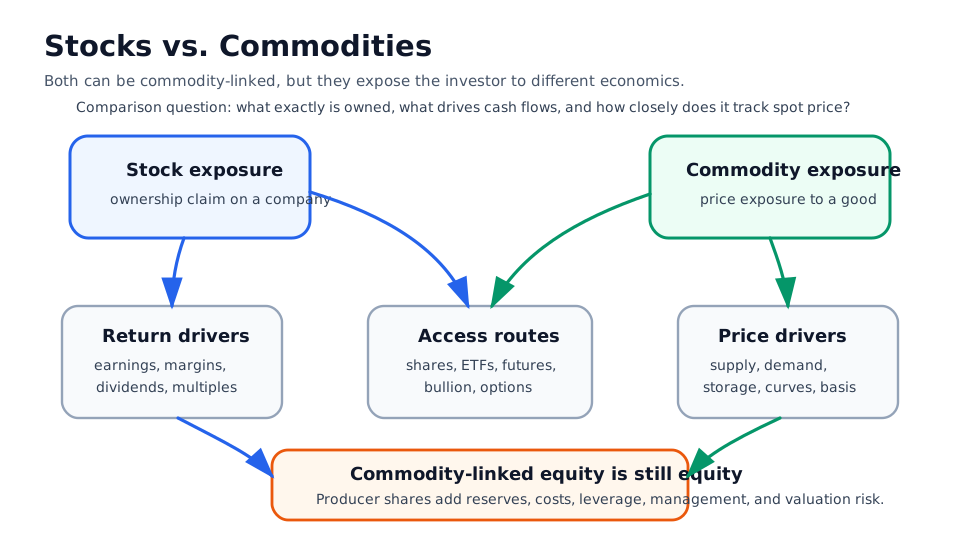
Stocks vs. commodities compares equity ownership with exposure to physical goods and commodity prices. A stock is a claim on a company’s residual value and earnings. A commodity is a physical good such as crude oil, gold, wheat, copper, or natural gas, although investors often access its price through futures, funds, or exchange-traded products.
A commodity producer’s stock is still an equity, not the commodity itself. Its return reflects commodity prices plus costs, production, financing, taxes, hedging, management, and stock-market valuation.
Key Takeaways
- Stocks represent company ownership; commodities are physical goods or contracts linked to their prices.
- Commodity-linked stocks can diverge sharply from the commodity because company-specific factors matter.
- Futures-linked products can diverge from spot prices because contracts must be rolled.
- Physical holdings, futures, funds, ETPs, and producer stocks have different rights, costs, risks, and tax treatment.
- Neither stocks nor commodities are universally safer or better diversifiers; the result depends on the instrument, price paid, horizon, and market conditions.
Core Differences
| Feature | Stocks | Commodities |
|---|---|---|
| Economic claim | Residual ownership in a business | Physical good or price exposure |
| Main return drivers | Earnings, growth, margins, dividends, financing, management, valuation | Supply, demand, inventories, weather, geopolitics, storage, transport, and futures curves |
| Cash flow | May pay dividends or support buybacks | Physical commodity normally has no inherent income |
| Common access | Shares, equity funds, ETFs, options | Physical holdings, futures, options, swaps, funds, ETPs |
| Main structural risks | Business, financial leverage, governance, dilution, valuation | Volatility, margin, roll, storage, delivery, benchmark, and product structure |
Commodities in the Stock Market
Commodity prices reach the stock market through several channels:
| Equity or fund channel | Main exposure | Why it may diverge from spot commodity prices |
|---|---|---|
| Producer stock | Revenue and reserves linked to oil, metals, crops, or another commodity | Production volume, costs, debt, taxes, hedging, project execution |
| Commodity consumer | Input costs for airlines, manufacturers, utilities, or food companies | Pricing power, inventory policy, efficiency, and hedging |
| Sector equity fund | Portfolio of energy, mining, materials, or agriculture businesses | Company weights, diversification, fees, and equity-market sentiment |
| Physical commodity trust or ETP | Custodied metal or another eligible physical holding | Fees, custody, market premium or discount, and product terms |
| Futures-linked fund or ETP | Rolling commodity futures exposure | Futures curve, collateral return, roll process, leverage, and fees |
The phrase “commodity stock” usually means a company whose economics are sensitive to a commodity. It does not mean that the shareholder owns a proportional quantity of the physical good.
Worked Comparison
Suppose gold prices rise. A gold producer’s revenue per ounce may improve, but its stock can still fall if:
- production misses guidance
- labor, energy, or equipment costs rise faster
- mine reserves or grades disappoint
- debt or new equity financing increases
- political, permitting, or operational problems emerge
- the company previously hedged much of its output at lower prices
Conversely, a well-run producer might outperform gold if production grows or costs fall. The stock embeds operating and financial leverage that a physical gold holding does not.
How Commodity Exposure Is Obtained
| Route | What the holder owns | Important risks |
|---|---|---|
| Physical commodity | The good itself or a custody claim | Storage, insurance, authenticity, transport, dealer spread |
| Futures or option | Derivative contract | Leverage, margin, expiration, basis, liquidity, delivery |
| Commodity fund or ETP | Fund or note interest | Fees, structure, tracking, roll, counterparty, premium or discount |
| Producer stock | Equity claim on a business | Commodity price plus operational, financing, governance, and valuation risk |
| Consumer stock | Equity claim on a commodity user | Input cost, pricing power, hedging, and demand risk |
The legal structure matters. An ETF holding producer stocks, an ETP holding metal, and a commodity-pool product trading futures can all use a commodity label while creating different exposure.
Portfolio and Analysis Questions
Investors and analysts may compare stocks and commodities for inflation sensitivity, diversification, business-cycle exposure, or tactical positioning. A useful review asks:
- What security or contract is actually owned?
- Does return track spot price, futures return, producer earnings, or a sector index?
- Is leverage embedded in the instrument or underlying company?
- Are storage, collateral, roll, financing, or management costs material?
- How did the exposure behave in stress periods rather than only on average?
- What liquidity, custody, counterparty, and tax rules apply?
Risks and Common Mistakes
- Treating a mining or energy stock as a direct commodity proxy.
- Comparing spot-price history with a futures-linked fund that incurs roll effects.
- Assuming commodities always rise with consumer inflation.
- Ignoring leverage in futures, inverse products, or geared ETPs.
- Treating a commodity allocation as diversified when it is concentrated in one sector or contract.
- Overlooking company debt, dilution, hedging, reserves, and operating jurisdiction.
- Assuming a fund label reveals whether it holds physical goods, futures, notes, or equities.
Related Terms
- Equity: Ownership claim on a company.
- Commodity ETF: A fund route whose structure determines the underlying exposure.
- Commodity Futures: Standardized derivative exposure.
- Spot Price: Current cash-market pricing for specified physical-market terms.
- Precious Metals: Commodity group often accessed through physical holdings, futures, funds, and mining equities.
Authoritative Source
FINRA’s Futures and Commodities guide compares physical commodities, futures, mutual funds, ETPs, and commodity-related businesses. It also explains leverage, roll, tracking, geopolitical, and product-structure risks.
Educational Use
This comparison is general education, not a recommendation to buy stocks, commodities, futures, funds, or exchange-traded products. Confirm the instrument’s current disclosure, legal structure, costs, liquidity, and tax treatment.