Limit Up, Limit Down
Limit up and limit down are exchange-defined futures price boundaries, including daily, expanded, and variable price-limit mechanisms.
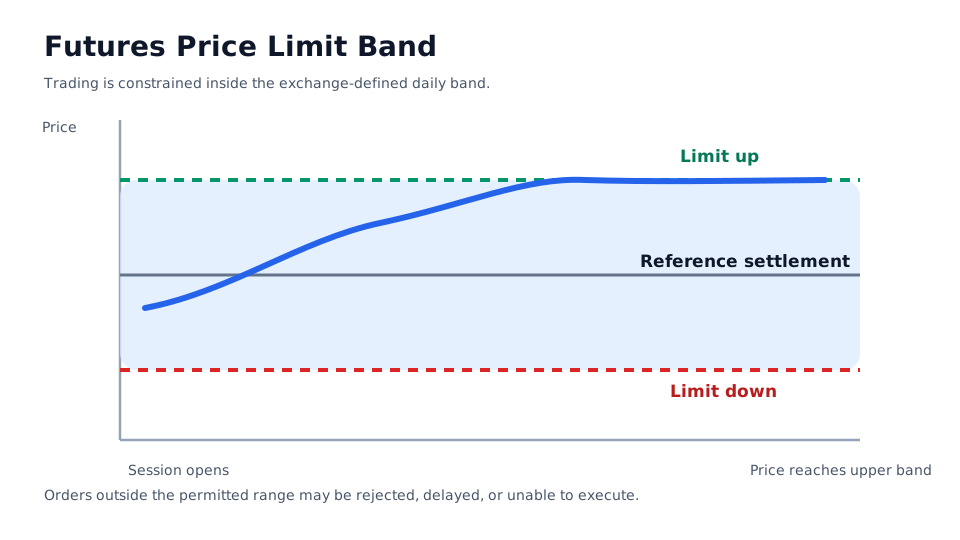
Limit up and limit down are the upper and lower price boundaries a futures contract may reach under an exchange’s price-limit rules. A daily price limit, sometimes called a fluctuation limit, defines the permitted move for a session. If price reaches the upper boundary, the contract is limit up; if it reaches the lower boundary, it is limit down.
Reaching a boundary does not always stop trading. Depending on the product and session, trading may continue within the band, become locked at the limit, pause, reopen with a wider range, or stop for the day.
Key Takeaways
- Futures price limits are product- and rule-specific; one formula does not apply to every contract.
- A limit-down condition is the lower boundary, not a guarantee that every order can execute there.
- A fluctuation limit or daily price limit describes the permitted range around an exchange-defined reference.
- Variable or expanded price limits can widen, reset, or otherwise change after specified triggers.
- A stop order cannot guarantee an exit when a market gaps, locks at a limit, or has insufficient liquidity.
- Futures limits, securities Limit Up-Limit Down rules, circuit breakers, dynamic bands, and order-price bands are related but distinct mechanisms.
Core Terminology
| Term | Meaning in futures markets |
|---|---|
| Daily price limit | Maximum permitted advance or decline during a trading session under exchange rules |
| Fluctuation limit | Common label for the allowed daily price range |
| Limit up | Upper permitted contract price or move |
| Limit down | Lower permitted contract price or move |
| Locked limit | Market has reached the boundary and cannot trade through it; executable liquidity may be one-sided or absent |
| Expanded limit | Wider range activated after rule-defined conditions |
| Variable price limit | Schedule that permits the allowed range to change under exchange rules |
| Dynamic circuit breaker | Moving intraday range that can trigger a temporary pause |
| Price banding | Order-control mechanism that rejects orders too far from a reference range |
The exact definitions and consequences come from the applicable rulebook. Do not infer the active limit from a news headline or a previous session.
Basic Limit Calculation
If a hypothetical contract uses a symmetric percentage limit around reference price \(P_{\text{ref}}\):
where \(L\) is the permitted percentage move.
Hypothetical Example
Assume:
- reference settlement price:
$100; - daily limit:
7%.
Then:
The example illustrates the arithmetic only. Actual contracts may use fixed dollar, cent, tick, percentage, tiered, asymmetric, or time-dependent limits. The reference may also differ from a simple prior settlement.
What Happens at Limit Up or Limit Down?
| Possible outcome | Practical effect |
|---|---|
| Trading continues within the band | Orders can execute, but never outside the permitted range |
| Market becomes locked limit | Orders accumulate at the boundary with little or no opposite-side interest |
| Temporary pause | Trading stops for a rule-defined period |
| Expanded limit activates | A wider range permits additional price discovery |
| Trading stops for the session | Positions remain exposed until the market reopens |
| Related contracts continue trading | Options, spreads, cash markets, or other venues may imply a value outside the constrained price |
A displayed limit price is not necessarily a fully clearing market price. If sellers remain at limit down with no buyers, a long holder may be unable to exit even though the screen displays the lower boundary.
Why Limit Down Is Operationally Important
Limit-down risk is most dangerous when a participant assumes an order instruction guarantees execution:
- A stop order becomes eligible only after its trigger; it still needs an executable market.
- A market order can fill at the worst available permitted prices and may remain unfilled.
- A limit order may protect the price but not ensure execution.
- A hedge may be delayed while the commercial exposure continues moving.
- Margin requirements and cash demands can change before the position can be closed.
The same execution problem can occur at limit up for a short position or for a commercial buyer trying to establish a long hedge.
Fixed, Expanded, and Variable Price Limits
| Feature | Fixed daily limit | Expanded or variable limit |
|---|---|---|
| Initial range | One defined band | Begins with an initial band |
| Change during or after a trigger | May remain fixed | Can widen, reset, or follow a staged schedule |
| Main benefit | Clear maximum session range | Allows additional price discovery after extreme movement |
| Main risk | Market can remain locked | Active range and trigger status can be misunderstood |
| Evidence needed | Current contract rule and reference price | Rulebook, limit table, trigger status, and exchange notice |
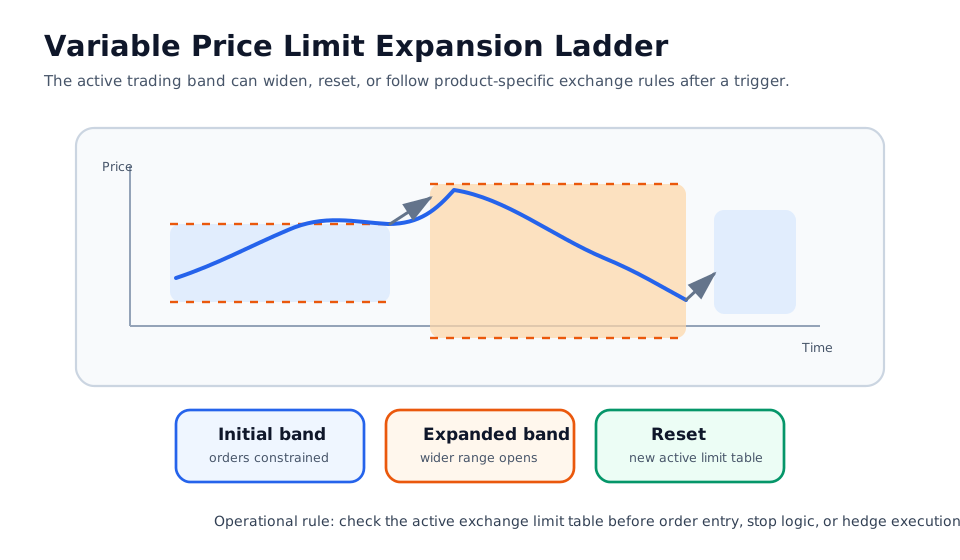
The CFTC describes a variable price limit as an exchange-determined schedule permitting movement beyond the normally allowed daily range. The schedule may apply on the same session or a later session depending on the product. Never assume “variable” means continuous intraday widening.
Daily Limits vs. Dynamic Circuit Breakers
A hard daily limit and a dynamic circuit breaker control different dimensions of price movement:
- A daily limit generally anchors the permitted session range to a settlement or other rule-defined reference.
- A dynamic circuit breaker uses a moving lookback range and can pause trading after a rapid move.
- A traditional circuit breaker may introduce successive price levels and trading pauses.
- Price banding can reject an individual order outside a dynamic range without establishing the day’s final high or low.
- Velocity logic focuses on movement that occurs too far, too quickly.
Products can use more than one safeguard. Check the exchange’s current product table and rule chapter rather than relying on a generic market-wide description.
Futures Limits vs. Securities LULD
In U.S. securities markets, Limit Up-Limit Down (LULD) commonly refers to the national plan that constrains trading in individual stocks and exchange-traded products around price bands. Futures markets use contract-specific exchange rules, including daily limits and circuit breakers.
The terms sound similar, but the governing authority, reference calculation, trading pause, reopening, and product scope differ. For cash equities or ETFs, use the applicable securities-market rules; for futures, use the contract’s exchange rulebook.
Who Is Affected?
| Participant | Limit-event exposure |
|---|---|
| Producer or consumer hedger | May be unable to enter, lift, or resize a hedge |
| Directional trader | Stop-loss and liquidation assumptions can fail |
| Spread trader | One leg may be constrained while the other continues moving |
| Clearing member or broker | Margin, liquidation, and customer-deficit risk can rise |
| Risk manager | Model prices may diverge from executable prices |
| Valuation analyst | Last trade or settlement may not reflect unconstrained clearing value |
Risks and Common Mistakes
- Execution risk: An order may be rejected, delayed, partially filled, or not filled.
- Gap risk: The next tradable price can be materially beyond the previous session’s limit.
- Margin liquidity: Cash demands can rise while an exit remains unavailable.
- Basis risk: Physical or related markets can keep moving while the futures contract is constrained.
- Model risk: Using the limit price as fair value can understate the likely clearing move.
- Rule-version risk: Limits can change through scheduled resets or exchange notices.
- Contract-month risk: Spot or delivery months may follow different limits or exemptions.
- Cross-product confusion: Equity, commodity, rate, energy, and crypto safeguards can operate differently.
- Order-type confusion: Limit up/down is a market boundary, not the same as a customer’s limit order.
What to Verify
- Identify the exact exchange, product, contract month, and trading session.
- Find the current price-limit table, rule chapter, and exchange notices.
- Confirm the reference price and calculation method.
- Determine whether the active mechanism is hard, expanded, variable, traditional, or dynamic.
- Check what happens at the boundary: continued trading, pause, expansion, or closure.
- Review order handling and broker-liquidation procedures during a limit event.
- Stress the next permitted price, margin requirement, and unavailable-exit scenario.
- Distinguish the futures rule from securities LULD or market-wide circuit breakers.
Authoritative References
The CFTC Futures Glossary defines daily price limit, limit up or down, locked limit, and variable price limit. CME Group’s current price-limits page provides product-level information, while its price-limits and circuit-breakers explainer distinguishes daily limits, traditional and dynamic circuit breakers, velocity logic, and price banding.
This page is for financial education only. It does not recommend a futures position, hedge, order type, or liquidation plan. Price limits can delay execution and do not cap the ultimate loss on a futures position.
FAQs
Does limit down mean trading always stops?
Can a stop order guarantee an exit during a limit move?
Are variable price limits the same for every contract?
Related Terms
- Circuit Breaker: A broader guide to trading halts, bands, and volatility controls.
- Liquidity: The ability to trade without materially moving price.
- Margin Account: The account where futures losses and collateral requirements create cash demands.
- Futures Contract: The standardized exchange-traded contract governed by the limit rules.
- Price Discovery: The process price limits seek to preserve while controlling disorderly movement.