Options Market
Marketplace for listed and OTC option contracts, where buyers and writers trade option rights, premiums, volatility exposure, and hedging strategies.
The options market is the marketplace where buyers and writers trade option contracts. An option gives the holder the right, but not the obligation, to buy or sell an underlying asset at a specified strike price during or at the end of a defined period. The writer receives a premium and takes on the related obligation if the option is exercised or assigned.
Most retail and institutional references to the options market mean standardized listed options traded on regulated exchanges and cleared through the Options Clearing Corporation (OCC). Larger institutions may also trade over-the-counter options with customized terms, counterparty exposure, and collateral arrangements.
The diagram separates the market layers that a listed-options trade can touch: contract terms, trading venue, clearing, data, brokerage, and risk controls.
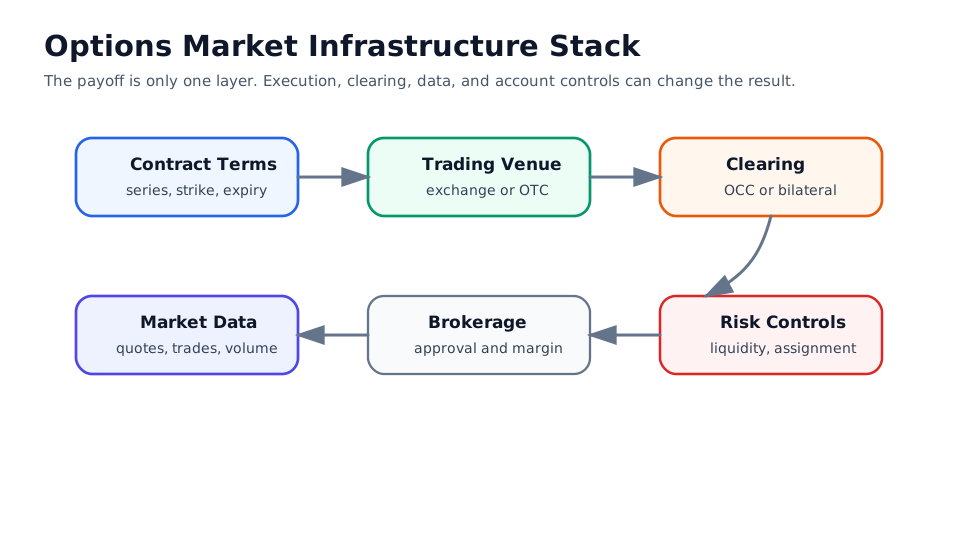
Core Market Layers
An options trade touches several layers of market structure. Confusing those layers is a common source of bad analysis.
| Layer | What it does |
|---|---|
| Contract terms | Define the underlying asset, strike, expiration, exercise style, settlement, and deliverable. |
| Trading venue | Matches or routes orders for listed options; OTC markets negotiate bilaterally. |
| Clearing | Novates and manages listed-option obligations through OCC. |
| Market data | Distributes quotes, last-sale prices, volume, and related information through systems such as OPRA. |
| Brokerage and margin | Controls account approval, order entry, suitability processes, margin, and exercise instructions. |
| Risk management | Monitors liquidity, volatility, assignment, concentration, and stress loss. |
The basic building blocks are Call Option, Put Option, Strike Price, Expiration Date, and Option Series.
Option margin is account support for obligations and potential losses, not the option premium and not a fixed measure of maximum risk. Requirements depend on the position, hedge, underlying, market conditions, broker, clearing rules, and applicable regulation. A covered or spread position can receive different treatment from a naked written option.
Why Traders And Hedgers Use It
Options are used for hedging, income generation, directional exposure, volatility exposure, and structured payoff design. A stock investor may buy a protective put to limit downside, sell a covered call to collect premium, or use a spread to define risk more tightly than a naked short option.
The same flexibility creates risk. Option prices can change because of the underlying price, implied volatility, time decay, interest rates, dividends, liquidity, and the approach of expiration. Short options can create assignment and margin risk even when the premium received looks small.
Listed Options Versus OTC Options
| Feature | Listed options | OTC options |
|---|---|---|
| Terms | Standardized by exchange and clearing rules. | Negotiated between counterparties. |
| Clearing | Usually cleared through OCC in the U.S. listed market. | May be bilateral or centrally cleared depending on product and agreement. |
| Price transparency | Exchange quotes and trades are distributed through market-data infrastructure. | Pricing is usually dealer-quoted or model-supported. |
| Flexibility | Lower customization but easier comparison across option series. | Higher customization but more legal, collateral, and counterparty analysis. |
| Main risk focus | Liquidity, volatility, margin, assignment, and execution quality. | Model risk, counterparty credit, collateral, close-out, and documentation. |
Source Checks
Use official and primary sources when an options-market fact affects a trade, policy, or explanation:
- OCC ODD page for standardized listed-options disclosures.
- OIC for options education and learning materials.
- OPRA for consolidated U.S. listed-options quotation and last-sale market-data context.
- Current exchange and broker documents for order handling, margin, product specifications, exercise, and assignment procedures.
Related Terms
- Derivative: Broader instrument category whose value is derived from an underlying asset or reference.
- Options Disclosure Document (ODD): Formal standardized-options risk disclosure.
- Options Industry Council (OIC): Education resource for listed-options concepts and strategy behavior.
- Options Price Reporting Authority (OPRA): Consolidated market-data system for U.S. listed-options quotes and trades.
- Volatility: Key driver of option premiums and strategy risk.