Futures Price
A futures price is the quoted market price for a specified futures contract month, not the contract's total value or a guaranteed spot-price forecast.
The futures price is the quoted market price for a specific futures contract and delivery or settlement month. It is the price used to enter, value, and exit that contract now. It is not the contract’s total notional value and is not a guaranteed forecast of the future spot price.
For a hedger, the futures price helps establish the futures leg of an expected purchase or sale. For a trader, it is the entry, settlement, or exit level for a leveraged position. For an analyst, the relationship among futures months and the spot market can reveal carry, funding, inventory, dividend, interest-rate, and delivery effects.
Key Takeaways
- A futures price always belongs to an exact contract month and specification.
- The displayed quote must be combined with the contract quantity or multiplier to determine notional value and dollar P&L.
- The daily settlement price can differ from the last traded price.
- Futures above spot do not automatically mean the market expects spot to rise; carrying costs and asset income can explain the difference.
- Futures below spot do not automatically predict a decline; convenience yield, dividends, interest-rate differences, and market constraints can matter.
- Comparable spot and futures prices tend to converge as settlement approaches when delivery or final-settlement mechanisms work effectively.
Quote, Notional Value, and Tick Value
Suppose a hypothetical commodity futures contract:
| Contract input | Value |
|---|---|
| Quoted futures price | $72.50 per unit |
| Contract quantity | 1,000 units |
| Minimum tick | $0.01 per unit |
The notional value is:
The tick value is:
If the quote rises from $72.50 to $73.30, the move is $0.80, or 80 ticks. One long contract gains $800 and one short contract loses $800, before fees:
The quoted price is therefore $72.50, the notional value is $72,500, and the minimum dollar movement is $10. Confusing these three measures can cause major sizing errors.
Futures Price vs. Related Prices
| Price | What it represents |
|---|---|
| Spot or cash price | Price for customary prompt purchase and delivery in a specified cash market |
| Futures trade price | Price at which a buyer and seller execute a specified futures month |
| Bid and ask | Best displayed buying and selling prices, which may not be executable for the required size |
| Settlement price | Exchange-determined daily value used for clearing and mark-to-market |
| Final settlement price | Value used to settle an expiring cash-settled contract or determine final obligations |
| Fair value estimate | Model-based price using spot, carry, income, and time assumptions |
The last trade is not necessarily the official settlement price. Exchanges use product-specific procedures, and those procedures can change around thin markets, limit conditions, or contract expiration.
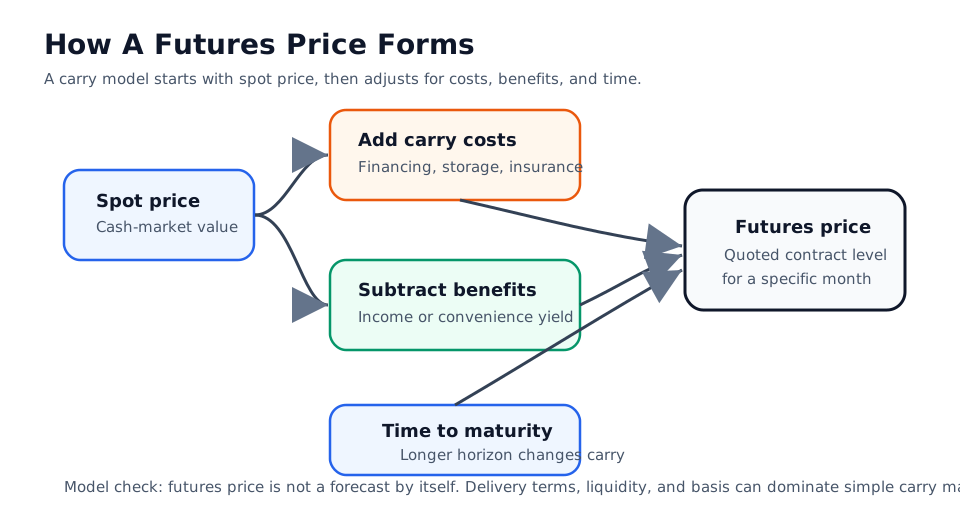
Cost-of-Carry Framework
For a storable commodity, a simplified continuously compounded relationship is:
where:
- \(F\) is the futures price
- \(S\) is the spot price
- \(r\) is the financing rate
- \(u\) is storage, insurance, and other physical carry cost
- \(y\) is convenience yield
- \(T\) is time to maturity
For a financial asset that pays income, the income yield replaces or offsets part of carry. A simplified equity-index relationship is often written:
where \(q\) represents the expected dividend yield over the relevant horizon.
| Underlying | Important pricing inputs |
|---|---|
| Storable commodity | Spot, financing, storage, insurance, loss, convenience yield, and delivery options |
| Equity index | Spot index, financing, expected dividends, and time |
| Currency | Spot exchange rate, domestic and foreign interest rates, and quote convention |
| Bond or interest-rate instrument | Financing, accrued income, deliverable assets, conversion factors, and embedded delivery options |
These formulas describe a no-arbitrage framework under simplifying assumptions. Actual futures prices can differ from an analyst’s fair-value estimate because inputs are uncertain, financing and storage are not available to everyone, quotes may be non-executable, and delivery or balance-sheet constraints can block arbitrage.
Is a Futures Price a Forecast?
A futures price is a tradable market-clearing price. Expectations can influence it, but so can:
- financing and asset income;
- storage and insurance;
- inventory scarcity and convenience yield;
- hedging demand and risk premia;
- contract delivery options;
- liquidity and balance-sheet capacity; and
- position limits or market stress.
For example, an equity-index future can trade above spot because financing exceeds expected dividends. That premium does not by itself predict that the index will rise by the amount of the premium. As time passes, financing and dividend carry are earned or paid and the futures-spot difference tends to shrink.
The Futures Curve
A single futures price answers only one maturity question. A futures curve compares prices across listed contract months.
| Curve observation | What to investigate |
|---|---|
| Deferred months above nearby months | Financing, storage, inventory capacity, seasonality, and expected supply |
| Deferred months below nearby months | Immediate scarcity, convenience yield, seasonality, or delivery constraints |
| Sudden kink in one month | Contract-specific delivery, benchmark, liquidity, or event risk |
| Large change after rolling | Calendar-spread movement rather than only an outright market move |
Contango and Backwardation describe curve shape. They do not, by themselves, measure the total return of a futures strategy.
Convergence and Basis
Futures basis is commonly calculated as cash minus futures in commodity markets. As a deliverable contract approaches expiration, the futures price and a comparable deliverable cash price tend to converge. Cash-settled contracts converge toward the specified final-settlement reference through their benchmark methodology.
Convergence does not mean every local cash quote equals the futures price. Grade, location, timing, freight, quality, delivery options, and transaction costs can leave valid differences. The correct comparison must match the contract specification.
How to Evaluate a Futures Quote
- Identify the exchange, product code, and exact contract month.
- Read the contract quantity, multiplier, quote convention, and minimum tick.
- Convert the screen price into notional value and dollar value per tick.
- Determine whether the displayed number is a trade, bid, ask, indicative value, or settlement price.
- Check trading hours, timestamp, volume, open interest, and bid-ask spread.
- Compare the contract with the correct spot price, grade, location, and time.
- Separate carry, expected income, convenience yield, and delivery effects.
- Confirm the settlement method and key expiration or notice dates.
- Use the current exchange specification rather than an old example.
Risks and Common Mistakes
- Treating the futures price as a forecast instead of a tradable market price.
- Confusing quoted price, notional value, margin requirement, and tick value.
- Ignoring contract month, delivery point, grade, and settlement rules.
- Comparing a futures price to the wrong cash-market quote.
- Treating the last trade as the official settlement price.
- Using a theoretical fair value without executable financing, storage, or inventory access.
- Ignoring bid-ask spread, market depth, and a locked price-limit condition.
- Using front-month futures as a hedge for a later physical exposure without checking basis risk.
Futures are leveraged and can produce losses larger than initial margin. This page is for financial education only and does not predict a future price or recommend a contract, trade, or hedge.
Authoritative References
The CFTC Futures Glossary defines futures price, settlement price, basis, convergence, margin, and mark-to-market. The CFTC’s guide to the economic purpose of futures markets explains price discovery, standardization, clearing, and daily settlement. CME Group’s contract notional value lesson shows how contract size and quote produce notional exposure, while its FX spot and futures pricing discussion illustrates quote convention, cost of carry, and convergence.
Related Terms
- Spot Price: Current cash-market price used as the starting point for carry analysis.
- Cost of Carry: Net financing, storage, income, and ownership economics connecting spot and futures.
- Contango and Backwardation: Futures-curve shapes compared with spot or nearby futures.
- Futures Chain: Quotes across available contract months.
- Mark to Market: Daily conversion of futures price changes into account gains and losses.