Commodity Futures
Commodity futures are standardized contracts for hedging or trading agricultural, energy, metal, livestock, and other commodity price exposure.
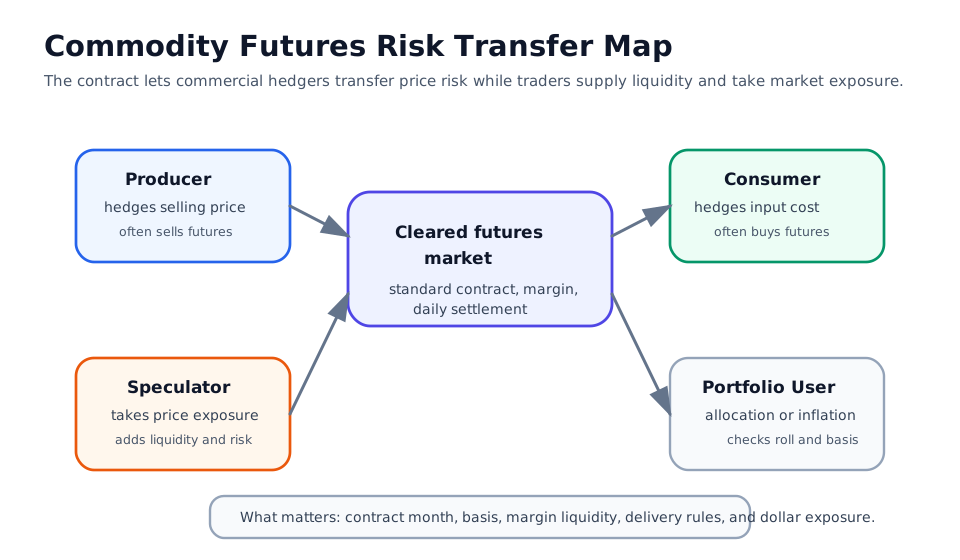
Commodity futures are standardized, exchange-traded contracts to buy or sell a specified commodity exposure at a future date under defined terms. Each contract identifies the commodity, quantity, quality or benchmark, delivery month, price unit, settlement method, and other obligations. Producers and commercial users employ commodity futures to transfer price risk, while other participants use them for market-making, relative-value strategies, or directional exposure.
A commodity futures position is not the same as owning the physical commodity. The trader posts margin and receives daily gains or losses, while the contract’s delivery or cash-settlement rules determine what happens if the position remains open through expiration.
Key Takeaways
- Commodity futures are contracts, not warehouse inventory or ownership of the physical commodity.
- Standardization makes contracts easier to trade but can create basis risk when the contract differs from the actual commodity exposure.
- Contract size converts a quoted price move into dollar profit or loss; margin is collateral, not the contract’s total value or maximum loss.
- Physical-delivery terms matter even when a trader expects to close or roll before delivery.
- The exact contract month, grade, location, settlement method, tick value, and last trading day must be checked in the current exchange specification.
Who Uses Commodity Futures?
| Participant | Typical position or objective | Risk that can remain |
|---|---|---|
| Producer | Sells futures to reduce exposure to falling output prices | Local cash price may not track the futures contract |
| Consumer or processor | Buys futures to reduce exposure to rising input prices | Quantity, timing, grade, and location may differ |
| Merchandiser | Combines cash and futures positions to manage inventory and basis | Storage, transport, financing, and delivery risk |
| Market maker or relative-value trader | Trades spreads or provides liquidity | Curve, execution, funding, and margin risk |
| Directional trader | Buys or sells based on a price view | Leveraged losses and forced liquidation |
| Portfolio manager | Uses a commodity allocation or inflation-sensitive exposure | Roll yield, concentration, and benchmark mismatch |
The CFTC describes futures markets as serving price-discovery and risk-transfer functions. Its futures basics distinguish hedgers from speculators and explain that some contracts permit cash settlement while many positions are liquidated before delivery.
Anatomy of a Commodity Futures Contract
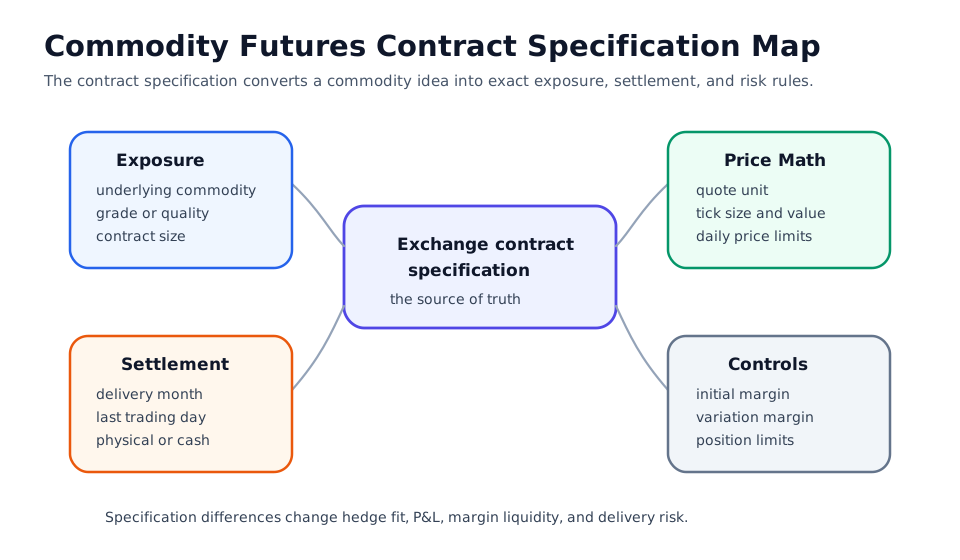
The term commodity futures contract refers to the individual standardized instrument within the broader commodity-futures market. The exchange specification, not a general definition, controls the trade.
| Specification | Question to answer | Why it matters |
|---|---|---|
| Underlying | Which commodity, grade, index, or assessment is referenced? | Similar labels can represent different economic exposures |
| Contract unit | How many barrels, bushels, pounds, ounces, or index units? | Converts the quote into notional value and P&L |
| Price quotation | Currency per unit, cents per unit, or index points? | Prevents scaling and sign errors |
| Tick size and value | What is the smallest move and its dollar value? | Determines execution increments and short-horizon risk |
| Contract month | Which delivery or settlement period applies? | Affects seasonality, basis, liquidity, and roll timing |
| Settlement | Physical delivery or cash settlement? | Determines expiration and operational obligations |
| Delivery terms | Which grade, location, notice period, and documents apply? | Controls what can satisfy the contract |
| Daily price limits | Can trading be restricted after a large move? | An intended exit may not be immediately executable |
| Margin | What initial, maintenance, and variation margin applies? | Determines liquidity needs, not maximum loss |
| Last trading and notice dates | When must an open position be closed or managed? | Avoids unintended delivery or settlement exposure |
Contract specifications and margin levels can change. Verify the current exchange rulebook, product page, clearing notices, and broker requirements before relying on a number.
How Contract Value and P&L Work
A first-pass dollar calculation is:
1Contract notional value = quoted price x contract unit
2Position P&L = price change x contract unit x number of contracts
The quote convention determines the correct unit conversion. A price shown in cents rather than dollars, a fractional quote, or a contract with a separate multiplier requires an additional adjustment.
Hypothetical Example
Assume a futures contract represents 1,000 commodity units and is quoted in dollars per unit. A trader buys one contract at $72.00 and closes it at $73.50.
1Price change = $73.50 - $72.00 = $1.50 per unit
2Gain = $1.50 x 1,000 = $1,500
If the price instead falls to $70.50, the long position loses $1,500. The amount posted as initial margin may be much smaller than the notional value, but the gain or loss is still calculated from the full contract exposure. Fees and any currency effects are excluded from this example.
Physical Delivery vs. Cash Settlement
| Feature | Physical-delivery contract | Cash-settled contract |
|---|---|---|
| Final obligation | Delivery process transfers an eligible commodity or delivery instrument | Net cash amount follows a specified settlement index or price |
| Operational focus | Grade, location, storage, notice, load-out, and delivery documents | Index methodology, observation window, publication, and fallback rules |
| Expiration risk | Unintended delivery or inability to make or take delivery | Unexpected settlement value or benchmark mismatch |
| Pricing anchor | Deliverable commodity and location economics | Defined reference price or index |
Closing a position before the delivery window usually avoids the final delivery process, but it does not make delivery rules irrelevant. Those rules help anchor the futures price and can affect liquidity and basis as expiration approaches.
What Drives Commodity Futures Prices?
Commodity futures prices can respond to:
- current cash or spot prices;
- expected production and consumption;
- inventories and spare capacity;
- storage, insurance, financing, and transportation costs;
- weather, crop cycles, maintenance, and seasonality;
- geopolitics, trade restrictions, and supply disruptions;
- currency movements;
- convenience yield and immediate availability;
- delivery-point congestion and contract rules; and
- liquidity, risk premiums, and market positioning.
The relationship between spot and futures prices is often analyzed through Futures Price, Contango and Backwardation, and Convenience Yield.
Futures Hedge vs. Cash Commodity
| Feature | Commodity futures hedge | Cash commodity transaction |
|---|---|---|
| Terms | Standardized by the exchange | Often customized by quality, location, timing, and logistics |
| Up-front funding | Margin and daily settlement | Purchase price, credit terms, or inventory financing |
| Exposure | Contract benchmark and month | Specific physical commodity |
| Main mismatch | Basis, timing, grade, location, and quantity | Quality, logistics, credit, and settlement |
| Exit | Offset or roll in the futures market | Sell, transfer, consume, or renegotiate the physical position |
| Expiration | Exchange delivery or cash-settlement process | Commercial contract terms |
A futures hedge reduces only the portion of risk that moves with the selected contract. A wheat farmer, airline, refiner, manufacturer, or metals dealer may still face local basis, processing, quality, volume, timing, currency, and operational risks.
Risks and Common Mistakes
- Leverage: A relatively small margin deposit controls a larger notional exposure.
- Basis risk: The cash commodity and futures contract may move differently.
- Margin liquidity: Adverse daily settlement can require cash before the commercial hedge produces an offsetting benefit.
- Delivery risk: Holding a deliverable contract too long can create notice or delivery obligations.
- Limit risk: Price limits or thin liquidity can delay an exit.
- Roll risk: Replacing an expiring contract can realize a gain or loss from the curve spread.
- Specification error: Using the wrong unit, month, grade, multiplier, or quote convention can materially misstate exposure.
- Overhedging: Contract units rarely match the commercial quantity perfectly.
- Forecast confusion: A futures price is a tradable contract price, not a guaranteed future spot price.
Evaluation Checklist
- Identify the exact commodity exposure, quantity, location, grade, currency, and timing.
- Confirm the contract unit, price quotation, tick value, month, and settlement method.
- Calculate notional value and P&L per relevant price move.
- Compare the futures benchmark with the actual cash-market exposure.
- Review last-trading, notice, delivery, position-limit, and price-limit rules.
- Stress margin needs and the possibility that an intended exit is unavailable.
- Define whether the position will be closed, rolled, cash settled, or delivered.
- Obtain transaction-specific accounting, tax, legal, and regulatory analysis.
Authoritative References
The CFTC futures basics describe commodity futures, delivery, cash settlement, hedgers, and speculators. The CFTC’s economic-purpose explainer explains futures margin and daily mark-to-market. For an example of a live product specification, CME Group publishes the current WTI crude oil futures contract information.
This page is for financial education only. It does not recommend a commodity, futures contract, hedge, or trading strategy. Futures can produce losses beyond initial margin and may not track the commercial or investment exposure being hedged.
FAQs
Do commodity futures require physical delivery?
Is margin the price of a commodity futures contract?
Why can a commodity futures hedge be imperfect?
Related Terms
- Futures Contract: The broader standardized exchange-traded contract structure.
- Futures Price: The quoted contract price for a specific month.
- Spot Price: Physical cash-market quote used when comparing spot and futures.
- Basis Risk: The risk that the hedge and actual exposure do not move together.
- Hedging: Using an offsetting position to reduce a specified risk.