Option Pricing Models
Models that estimate option value from payoff terms, volatility, time, rates, dividends, and underlying price behavior.
Option pricing models estimate the theoretical value of an option by connecting contract payoff terms with market inputs such as underlying price, strike, time, interest rates, dividends, and volatility.
Models do not set the market price by themselves. Actual option prices are negotiated in the market. A model helps explain whether the premium is consistent with a set of assumptions and what sensitivities matter.
Core Inputs
Most option pricing models start with the same practical inputs.
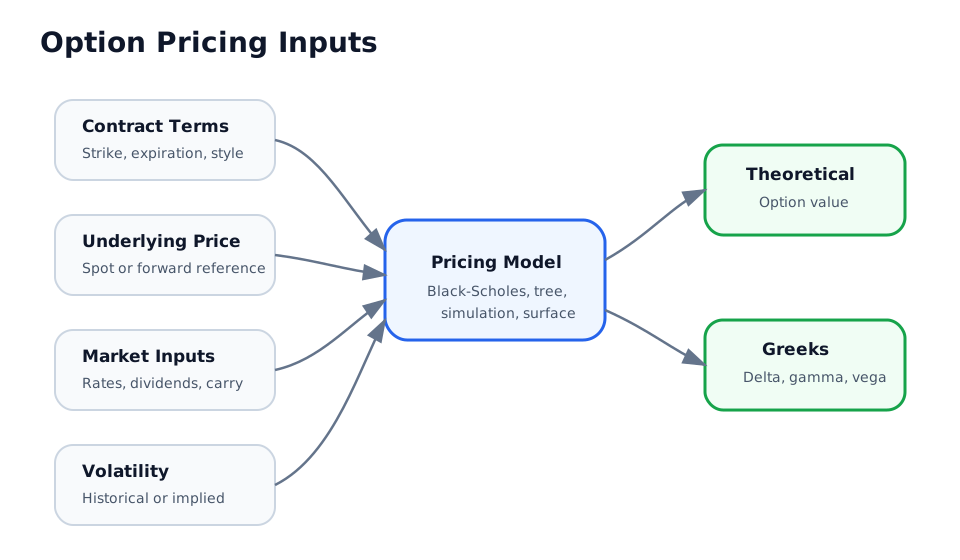
| Input | Why it matters |
|---|---|
| Underlying price | Determines current moneyness and payoff starting point |
| Strike price | Defines the exercise or settlement threshold |
| Time to expiration | Longer time usually gives more chance for favorable movement |
| Volatility | Higher expected volatility usually increases option value |
| Interest rate | Affects discounting and forward pricing |
| Dividends or carry | Changes forward value and early-exercise incentives |
| Exercise style | Determines whether early exercise can matter |
| Settlement and multiplier | Convert model value into cash exposure |
Main Model Families
| Model family | Best use | Key limitation |
|---|---|---|
| Black-Scholes-Merton | European-style options with clean inputs | Assumes continuous trading, lognormal returns, and often constant volatility |
| Binomial or lattice models | American options, dividends, discrete exercise choices | Tree design and step count affect precision |
| Monte Carlo simulation | Path-dependent or complex payoff structures | Computationally heavier and sensitive to assumptions |
| Volatility-surface models | Market-consistent pricing across strikes and expirations | Requires reliable market data and calibration |
The model should match the product. A simple European index option, an employee stock option, an American equity put, and an OTC barrier option usually should not be valued with the same mechanical shortcut.
Example
Suppose two calls have the same stock, strike, and expiration, but one trades with much higher implied volatility. A pricing model can show that the higher premium is not just “expensive” in dollar terms; it reflects a larger volatility assumption embedded in the market price.
That does not prove the option is mispriced. It only tells the analyst what assumption would have to be true for the premium to be fair.
Public Source Checks
- Cboe’s Options Calculator lets users explore theoretical option prices and Greeks using market data and model inputs.
- FINRA’s options overview explains option premiums, implied volatility, time decay, exercise, assignment, and risk basics.
- The OCC Options Disclosure Document explains standardized-option characteristics and risks that model outputs do not eliminate.
- The 1997 Nobel Prize press release gives historical context for option valuation and the Black-Scholes-Merton contribution.
Model Risk
Option pricing models can be wrong for practical reasons:
- volatility is not constant
- markets jump or gap
- liquidity disappears when the model assumes continuous trading
- dividends, borrow costs, or rates are stale
- exercise behavior is simplified
- bid-ask spreads exceed the apparent model edge
- the wrong settlement value or multiplier is used
Model output should be treated as an estimate, not a guarantee.
Related Terms
- Black-Scholes Option Pricing Model: A closed-form European option model.
- Binomial Option Pricing Model: A tree-based model for option valuation.
- Risk-Neutral Valuation: The no-arbitrage valuation framework behind many models.
- Implied Volatility: The volatility input implied by market option prices.
- Option Value: Intrinsic and extrinsic value in option premiums.
- Monte Carlo Simulation: A simulation method used for complex valuations.