Naked Put
Short put strategy written without a full hedge or cash-secured plan, creating premium income and downside purchase risk.
A naked put is a short put option position written without a full hedge or a clearly cash-secured plan to buy the underlying asset if assigned.
The seller receives premium but accepts the obligation to buy the underlying at the strike price if the option holder exercises.
Payoff at Expiration
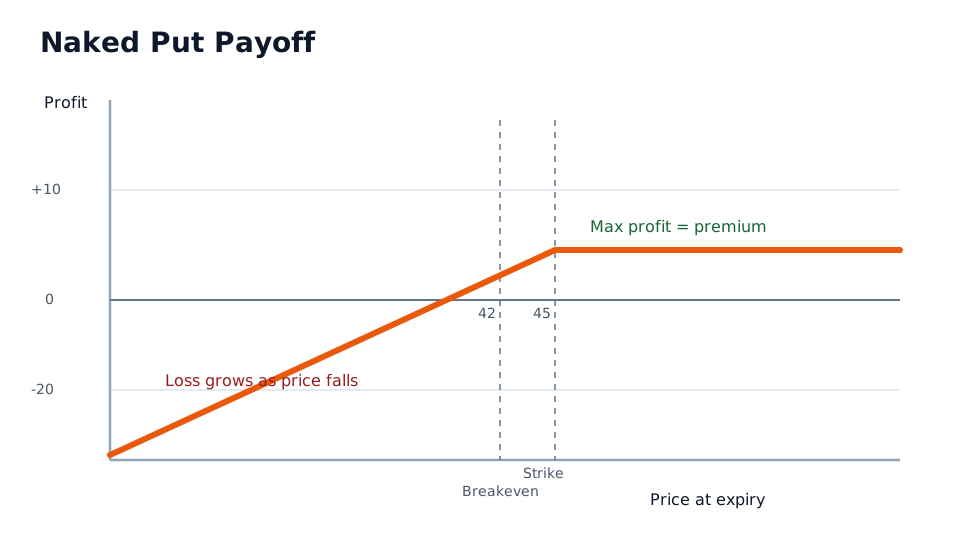
The naked-put payoff is capped at the premium received. Losses grow as the underlying falls below breakeven, with the worst case occurring if the underlying falls toward zero.
At expiration, approximate net profit for one short put before transaction costs is:
where:
- \(K\) is the strike price
- \(S_T\) is the underlying price at expiration
Example
Suppose a trader sells one put with a $45 strike for a $3 premium.
| Stock price at expiration | Option result | Approximate profit or loss |
|---|---|---|
$55 | Put expires worthless | +$3 premium |
$45 | Put is at the strike | +$3 premium |
$42 | At breakeven | $0 before costs |
$30 | Put is $15 in the money | -$12 before costs |
The seller may be required to buy shares at $45 even when the market price is far below $45.
Naked Put vs. Cash-Secured Put
| Feature | Naked put | Cash-secured put |
|---|---|---|
| Cash reserved to buy shares | Not fully reserved | Reserved or planned |
| Main objective | Premium income with leveraged downside exposure | Potentially buying shares at an effective lower price |
| Margin pressure | Can rise quickly in a selloff | Usually more controlled, though losses still occur |
| Worst-case loss | Large if the underlying falls sharply | Same economic stock downside, but funding is pre-planned |
A cash-secured put can still lose money. The difference is that assignment is planned and funded rather than an unexpected margin event.
When It Is Used
Experienced traders may sell naked puts when they believe:
- the underlying is likely to stay above the strike
- implied volatility is high relative to expected movement
- they can close or roll the position before assignment risk becomes unacceptable
- the account can withstand adverse margin changes
The trade is not equivalent to a limit order to buy shares. It includes option premium, assignment timing, volatility, liquidity, and margin risk.
Main Risks
Important risks include:
- large downside loss if the underlying falls sharply
- margin calls or forced liquidation during selloffs
- assignment before the trader planned to own the asset
- volatility expansion that raises the cost to close
- concentration if the put is written on a single stock or sector
- poor liquidity when the trader needs to exit
The risk is especially easy to underestimate when the premium looks attractive relative to recent price movement.
Public Source Checks
- The OCC Characteristics and Risks of Standardized Options explains option-writer obligations, exercise, assignment, and standardized-option risk.
- FINRA’s options overview explains that a put seller may be obligated to buy the underlying if assigned.
- FINRA’s assignment overview explains practical assignment risk for short options and multi-leg positions.
- The SEC’s Investor Bulletin on options summarizes call, put, premium, and option-participant basics.
Risk Controls
Before selling a naked put, document:
- whether the position is truly cash-secured or margin-dependent
- maximum position size if assigned
- acceptable ownership thesis for the underlying, if any
- breakeven price and stress loss
- event calendar before expiration
- liquidity, open interest, and bid-ask spread
- close, roll, or hedge trigger if the underlying falls
Related Terms
- Naked Option: The broader uncovered option-writing concept.
- Naked Call Options Strategy: The uncovered call counterpart.
- Put Option: The option contract being sold.
- Option Premium: The upfront credit received by the writer.
- Strike Price: The price at which the writer may have to buy the underlying.
- Margin Account: The account type where uncovered option margin is usually monitored.