One-Touch Option
Path-dependent option that pays a fixed amount if the underlying touches a specified level before expiration.
A one-touch option is an exotic option that pays a fixed amount if the underlying asset touches a specified trigger level before expiration.
The ending price alone is not enough. The key question is whether the underlying touched the trigger at any time defined by the contract.
Trigger Mechanics
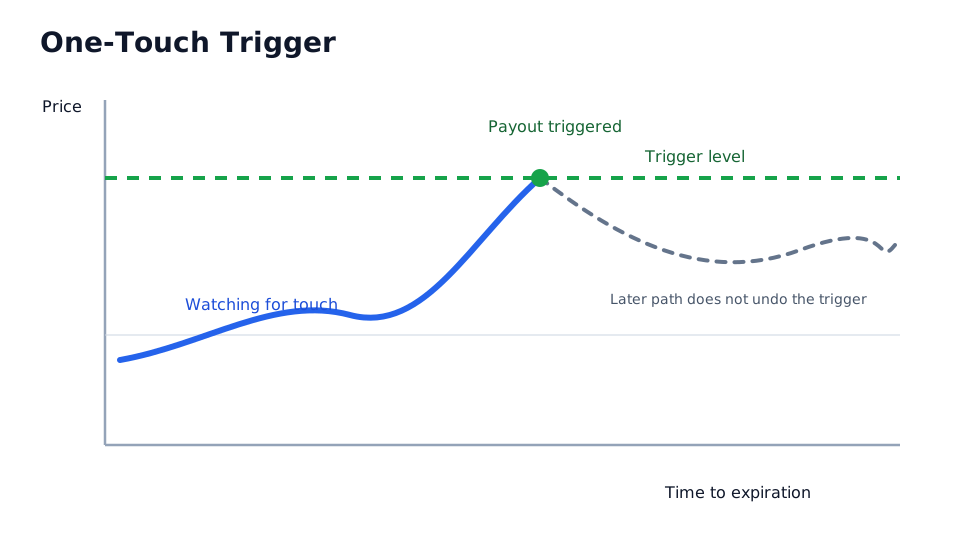
The diagram shows the central idea: the payout is triggered when the path touches the level, even if the underlying later moves away from it.
One-touch terms usually specify:
- underlying asset or reference rate
- trigger level
- observation period and price source
- fixed payout amount
- payment timing after the trigger
- whether the option expires after payment or remains subject to other terms
Example
Suppose a one-touch EUR/USD option pays $100,000 if EUR/USD touches 1.1200 at any time during the next month.
- If EUR/USD touches
1.1200once and then falls back, the trigger has still been hit. - If EUR/USD finishes the month at
1.1199and never touched1.1200, the option pays nothing.
The monitoring rule and official data source matter because small differences near the trigger can decide the payout.
One-Touch vs. Standard Option
| Feature | One-touch option | Standard call or put |
|---|---|---|
| Main condition | Trigger level touched before expiration | Moneyness at exercise or expiration |
| Payoff amount | Usually fixed | Varies with intrinsic value |
| Path dependency | Yes | Usually no |
| Main risk question | Will the level be touched? | Where will the underlying finish or be exercised? |
| Common market | FX and customized OTC structures | Listed and OTC markets |
One-Touch vs. Knock-Out
A one-touch option usually pays when the barrier is touched. A knock-out option usually terminates when the barrier is touched. Both are path-dependent, but the trigger has opposite economic meaning.
Pricing And Risk Drivers
Important drivers include:
- distance from the current price to the trigger
- volatility and jump risk
- time to expiration
- direction of expected movement
- observation frequency
- official price source
- counterparty and liquidity terms if OTC
Higher volatility often increases the probability of touching the trigger, but it can also make hedging and pricing more difficult.
Public Source Checks
- FINRA’s options overview explains basic option rights and obligations, but one-touch contracts require the actual product terms.
- The OCC Options Disclosure Document is relevant when the structure is a standardized listed option cleared through OCC.
- For OTC one-touch trades, the controlling evidence is the term sheet, confirmation, payoff schedule, observation-source language, collateral agreement, and valuation model.
Related Terms
- Binary Option: A fixed-payout option based on a yes-or-no outcome.
- Barrier Options: The broader class of knock-in and knock-out trigger-level contracts.
- Exotic Options: Options with nonstandard payoff or path-dependent features.
- OTC Options: Customized contracts where one-touch structures commonly appear.