Volatility
Volatility measures how much asset prices vary and is central to risk, option pricing, and trading strategy.
Volatility measures how much an asset’s price or return varies over time. In finance, it is a core way to describe uncertainty, risk, and the size of potential price moves.
Volatility is central to options because option buyers benefit from favorable movement and option sellers are exposed to adverse movement. More expected movement usually means higher option premiums.
Types Of Volatility
| Type | What it measures | Common use |
|---|---|---|
| Historical volatility | Past variation in returns | Risk review, backtesting, realized movement |
| Implied volatility | Volatility embedded in option prices | Option pricing, expected move, volatility trading |
| Realized volatility | Movement that actually occurred over a period | Comparing market outcomes with what options priced |
| Forecast volatility | Analyst or model estimate of future movement | Risk models, position sizing, scenario analysis |
These measures answer different questions. A stock can have low historical volatility and high implied volatility if a major event is approaching.
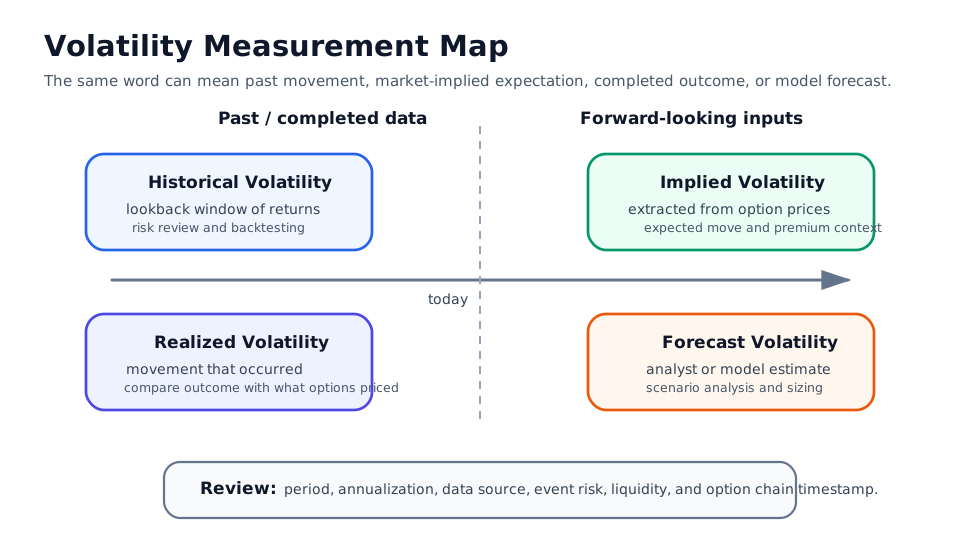
The diagram keeps the four common volatility labels separate. Historical and realized volatility look backward or at completed outcomes; implied and forecast volatility are forward-looking inputs or expectations.
Measuring Volatility
A common return-volatility measure is standard deviation:
where R_i is each return observation, R bar is the average return, and N is the number of observations.
Volatility is often annualized so different assets and time windows can be compared. For daily returns, analysts commonly multiply daily volatility by the square root of the number of trading days used in the convention.
Why Volatility Matters
Volatility affects:
- option premiums and implied volatility
- position sizing and stop-loss distance
- value-at-risk and stress testing
- margin requirements and liquidation risk
- expected move estimates around events
- portfolio diversification and drawdown behavior
High volatility is not automatically bad. It can create opportunity, but it also increases the range of possible gains and losses.
Volatility And Options
In options, volatility is not just a risk statistic. It is a pricing input.
If expected volatility rises, both calls and puts can become more expensive because larger price swings increase the chance of meaningful intrinsic value before expiration. This is why implied volatility can move option prices even when the underlying asset is flat.
Example: before an earnings announcement, option premiums may rise because the market expects a larger move. After the announcement, volatility can fall and option prices can drop even if the underlying moved in the expected direction.
VIX And Market Volatility
The VIX Index is a widely followed benchmark for expected near-term S&P 500 volatility. It uses S&P 500 option prices to estimate market expectations for volatility over roughly the next 30 days.
VIX is not the same as realized volatility in a single stock, and it is not a direct prediction of market direction. It is a market-implied volatility benchmark for a broad equity index.
Authority Sources
Use public sources to verify option-volatility mechanics:
- Cboe VIX products describe VIX as a measure of market expectations for near-term volatility conveyed by S&P 500 option prices.
- Cboe VIX FAQ explains that VIX uses SPX options to produce a constant-maturity 30-day expected-volatility measure.
- FINRA’s options overview explains how volatility affects option premiums and option risk.
For a specific option position, use the option chain, IV surface, historical-return data, event calendar, and executable bid-ask quotes.
Related Terms
- Implied Volatility: Volatility embedded in option prices.
- Option Value: Option value rises or falls partly because volatility changes.
- Vega Neutral: A position design that reduces exposure to implied volatility changes.
- Put-Call Ratio: A sentiment measure often reviewed alongside volatility.
- Theta Hedging: Time decay management can depend on the volatility environment.
- Straddle: A common way to trade expected movement.
Review Checklist
- Identify whether the volatility number is historical, realized, implied, or forecast.
- Confirm the lookback period, annualization convention, and data source.
- Compare volatility with liquidity and bid-ask spreads before trading.
- Check event risk before assuming volatility will stay near its recent average.
- Tie volatility assumptions to position size, margin, hedge design, and exit rules.