Options on Futures
Options on futures provide call or put rights tied to a specified futures contract, with product-specific exercise and settlement rules.
An option on futures, also called a futures option, gives the buyer the right, but not the obligation, to take a specified long or short futures position at the strike price under the contract’s exercise and settlement rules. The seller receives the premium and accepts the corresponding obligation if assigned.
The underlying instrument is a particular futures contract, not the commodity, interest rate, currency, or index referenced by that contract. Exercise often creates a futures position, but some products use cash settlement or other procedures. The exchange specification controls.
Key Takeaways
- A call generally benefits from a rise in the underlying futures price; a put generally benefits from a decline.
- The buyer pays a premium for a right, while the writer accepts assignment and margin risk.
- The option expiration and the underlying futures delivery month are related but may have different dates.
- Exercise or assignment can create a leveraged futures position that requires margin and active management.
- Premium depends on the futures price, strike, time, implied volatility, rates, and contract rules.
- Product specifications, broker cutoffs, liquidity, and settlement procedures matter as much as the option label.
Calls, Puts, Exercise, and Assignment
| Position | Contract right or obligation | Typical result of exercise or assignment |
|---|---|---|
| Long call | Right to buy the underlying futures contract at the strike | Long futures position |
| Short call | Obligation if assigned on an exercised call | Short futures position |
| Long put | Right to sell the underlying futures contract at the strike | Short futures position |
| Short put | Obligation if assigned on an exercised put | Long futures position |
The table describes the common futures-style outcome. Some products settle in cash or use different procedures, so the exact rulebook must be checked.
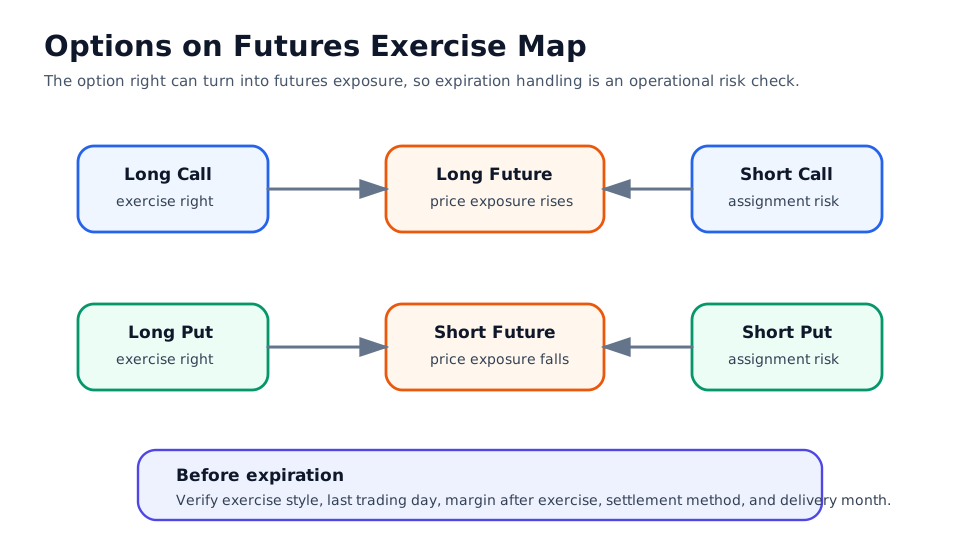
An option owner chooses whether to exercise when the contract permits that choice. A writer does not choose whether to be assigned. The clearing process allocates the obligation under exchange and clearing-house procedures.
American-style options can generally be exercised before expiration. European-style options are generally exercisable only at expiration. Automatic-exercise thresholds, contrary instructions, and broker deadlines are product-specific.
Identify the Underlying Contract
The option name should identify the futures product and the contract month used for valuation and exercise. An option may expire before the underlying futures contract reaches its own last trading day.
Before analyzing a position, verify:
| Contract detail | Why it matters |
|---|---|
| Futures product and month | Determines the actual underlying exposure |
| Option expiration and last trading time | Determines when the option right ends |
| Strike and quote unit | Determines moneyness and premium calculations |
| Contract multiplier | Converts quoted values into money amounts |
| Exercise style | Determines whether early exercise is possible |
| Automatic-exercise rule | Can create a futures position without a manual exercise request |
| Settlement method | Determines whether the outcome is futures delivery, cash, or another specified process |
| Futures margin after exercise | Determines the collateral and cash-flow needs of the resulting position |
| Delivery and notice calendar | Identifies obligations if a physically delivered future remains open |
A broad label such as “oil call” or “rate put” is not enough. Different expirations can have different prices, liquidity, sensitivities, and settlement timelines.
Premium and Payoff at Expiration
The buyer pays the option premium upfront. The writer receives it and may have to post margin. The quoted premium must be converted using the contract’s multiplier and quote convention.
For multiplier M, the simplified gross call payoff at expiration is:
The simplified gross put payoff is:
where F_T is the relevant futures settlement price and K is the strike. A simplified net result subtracts the premium and transaction costs. Actual settlement may occur through a resulting futures position rather than a direct cash payment equal to the formula.
Before exercise, a fully paid long option generally has loss limited to the premium and costs. That limit should not be carried over to a futures position created by exercise. The resulting future is marked to market and can produce additional gains, losses, and margin calls.
Worked Call Example
Assume an illustrative call option has:
- futures strike:
$70; - relevant futures price at expiration:
$76; - multiplier:
1,000units; and - premium paid:
$3per unit, or$3,000.
The call’s gross intrinsic value is:
The buyer’s simplified net result is $6,000 - $3,000 = $3,000, before fees and any product-specific settlement effects.
If the futures price were $68, the call would have no intrinsic value at expiration. The buyer could lose the $3,000 premium plus costs. If exercise establishes a long future at $70, that new position must be margined and can continue gaining or losing value after exercise.
The example is intentionally simplified. It does not model early exercise, changing implied volatility, bid-ask spreads, taxes, price limits, or the timing of premium and variation-margin cash flows.
Options on Futures vs. Futures Contracts
| Feature | Option on futures | Futures contract |
|---|---|---|
| Long buyer’s position | Right, not obligation | Binding long exposure |
| Initial cash flow | Buyer pays premium | Trader posts margin |
| Payoff before exercise | Asymmetric for the buyer | Linear with futures-price changes |
| Time and volatility | Important components of option value | Affect market price but there is no option time value |
| Expiration outcome | May expire, settle in cash, or create a future | Must be offset, settled, or handled under delivery rules |
| Buyer downside before exercise | Generally premium and costs for a fully paid option | Can exceed initial margin |
| Seller exposure | Assignment, margin, and potentially substantial loss | Linear market exposure and variation margin |
Buying an option is not the same as placing a stop order on a futures position. An option is a separate contract with a premium, expiration, strike, volatility exposure, and liquidity conditions.
Why Market Participants Use Them
Price protection with participation
A commodity producer can buy a put option on futures to establish downside protection while retaining some benefit if prices rise. A commercial buyer can buy a call to limit exposure to a large price increase while retaining some benefit if prices fall. The premium is the cost of this asymmetric protection.
The hedge may still be imperfect. The underlying futures product, contract month, quantity, grade, location, or benchmark may not match the business exposure, creating basis risk.
Defined-premium exposure
A buyer can take directional or volatility-sensitive exposure with the premium known at inception. The option can still expire worthless, lose value before expiration, or become difficult to sell at a reasonable price.
Portfolio and business hedging
Options on equity-index, interest-rate, currency, energy, metal, and agricultural futures can be used to reshape existing exposures. Suitability depends on the contract, the participant, and the hedge objective rather than the asset-class label.
Multi-leg structures
Calls, puts, and futures can be combined into spreads, collars, and synthetic positions. Each added leg creates execution, margin, assignment, and expiration interactions. A defined payoff diagram does not eliminate liquidity or operational risk.
Exercise, Expiration, and Settlement
An option position near expiration can have several outcomes:
- An out-of-the-money long option may expire with no value.
- An in-the-money option may be automatically exercised under product rules.
- An owner may exercise before expiration if the option is American-style and applicable deadlines are met.
- A short option may be assigned and create an unexpected futures position.
- A cash-settled contract may produce a cash amount rather than a futures position.
If exercise creates a future, determine when that position appears, when margin becomes due, and whether it is close to delivery or final settlement. A broker may impose an earlier cutoff than the exchange.
Closing an option before expiration can avoid exercise, but execution is not guaranteed. A wide bid-ask spread, a fast market, price limits, or low activity can make an exit costly or unavailable at the expected price.
Risks and Limitations
- Premium loss: A bought option can expire worthless even if the market view was broadly correct but the move was too small or too late.
- Leverage: A small premium can control a much larger notional exposure, causing large percentage changes in option value.
- Time decay: Other things equal, the remaining time component generally declines as expiration approaches.
- Volatility risk: A decline in implied volatility can reduce an option’s value even when the futures price moves in the expected direction.
- Writer risk: An uncovered short option can create substantial losses, margin calls, and forced liquidation.
- Exercise and assignment risk: The position can convert into an unwanted long or short future.
- Contract-month mismatch: The option’s underlying future may not align with the timing of the business or portfolio exposure.
- Liquidity risk: Some strikes and expirations trade infrequently or have wide spreads.
- Settlement and delivery risk: Automatic exercise, broker cutoffs, cash settlement, price limits, and physical-delivery rules can change the outcome.
- Basis risk: The futures contract may not track the exposure closely enough for the intended hedge.
No option structure guarantees profit, liquidity, hedge effectiveness, or protection from every loss.
How to Evaluate an Option on Futures
- Identify the exact option, strike, expiration, exchange, and underlying futures month.
- Convert the premium and tick value into money amounts using the correct multiplier.
- Confirm exercise style, automatic-exercise threshold, contrary-instruction process, and deadlines.
- Determine whether exercise creates a future, cash settlement, or another product-specific result.
- Model the position after exercise, including direction, entry price, margin, and delivery calendar.
- Stress the futures price, time remaining, implied volatility, bid-ask spread, and illiquid exit conditions.
- Compare the option hedge with the underlying exposure for quantity, timing, location, quality, and benchmark differences.
- Review the exchange rulebook, broker procedures, and applicable tax, accounting, legal, and regulatory treatment.
Common Mistakes
- Calling the physical commodity the option’s direct underlying when the contract is actually an option on a future.
- Assuming every product is American-style or every in-the-money option is handled identically.
- Treating the premium as the maximum loss after exercise has created a futures position.
- Ignoring the underlying futures month and its delivery or final-settlement calendar.
- Comparing premiums without converting quote units and multipliers.
- Describing an option buyer’s defined premium as guaranteed risk control despite liquidity and exercise constraints.
- Treating premium received by a writer as income without recognizing contingent loss and margin exposure.
Authoritative References
The CFTC futures glossary defines a futures option as an option on a futures contract. The CFTC’s Futures Market Basics explains the basic right to buy or sell a particular futures contract.
CME Group’s options-on-futures overview explains strike prices and the relationship to the underlying future. Its exercise and assignment lesson shows the common long- and short-futures outcomes.
For a live position, use the exact exchange product specification, clearing and expiration calendar, broker margin rules, and trade confirmation.
This page is for financial education only. It does not recommend an option, futures position, hedge, or trading strategy. Futures options are complex leveraged instruments that can expire worthless, create substantial writer losses, and establish futures positions with additional margin and settlement risk.
FAQs
Is an option on futures an option on the commodity itself?
Does exercising an option on futures always create a futures position?
Can an option on futures be exercised early?
Related Terms
- Futures Contract: The standardized instrument underlying the option.
- Call Option: The right associated with long exposure at the strike.
- Put Option: The right associated with short exposure at the strike.
- Strike Price: The price specified in the option contract.
- Expiration Date of Options: The deadline governing exercise or settlement.
- Initial Margin: Collateral that may be required for writers or resulting futures positions.
- Basis Risk: The risk that a futures-based hedge does not track the exposure closely enough.