Binary Option
Option contract with an all-or-nothing payoff based on whether a specified market condition is satisfied.
A binary option is an option contract whose payoff depends on a yes-or-no condition. If the condition is satisfied, the holder receives a fixed payout. If it is not satisfied, the holder receives nothing.
Unlike a standard call or put, a binary option does not give the holder the right to buy or sell the underlying asset. The payoff is a fixed cash amount or zero.
All-Or-Nothing Payoff
The payoff shape is a step, not a smooth line. Once the condition is met at the relevant measurement time, the payout jumps to the fixed amount.
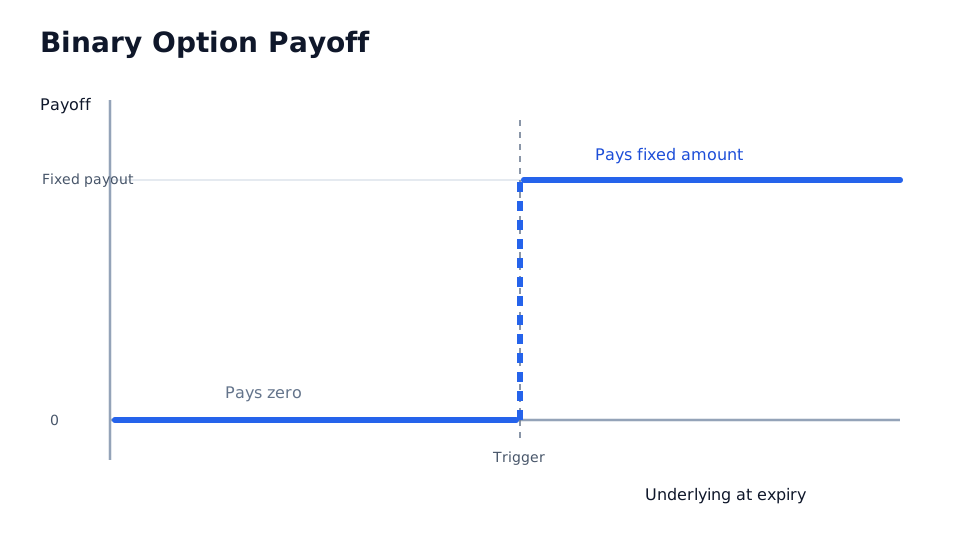
For a simple cash-or-nothing binary call measured at expiration:
where \(Q\) is the fixed payout, \(S_T\) is the underlying price at expiration, and \(K\) is the trigger level.
Common Structures
| Structure | Trigger | Practical point |
|---|---|---|
| Cash-or-nothing binary call | Underlying finishes above a level | Fixed cash payout, no asset delivery |
| Cash-or-nothing binary put | Underlying finishes below a level | Fixed cash payout if downside condition is met |
| One-touch option | Underlying touches a level before expiration | Path-dependent trigger |
| No-touch option | Underlying does not touch a level | Risk is whether the barrier is avoided |
The exact contract language controls whether the condition is measured at expiration, continuously, intraday, at official settlement, or through another reference source.
Example
Suppose a binary option costs $40 and pays $100 if an index closes above 5,000 on the expiration date.
- If the index closes at
5,010, the holder receives$100, for a$60gross gain before costs. - If the index closes at
4,999, the holder receives nothing and loses the$40paid.
The difference between a small win and a total loss can be one tick around the reference level.
Why It Matters
Binary options are useful for understanding digital payoff risk, event contracts, structured products, and some exotic OTC options. They can also be dangerous when marketed as simple short-term bets.
The main analytical issues are:
- exact trigger definition and observation time
- official price source used to determine the outcome
- fixed payout versus premium paid
- liquidity and ability to exit before expiration
- whether the venue, intermediary, and offer are properly registered or exempt
- fraud risk in off-exchange online platforms
Public Source Checks
- Investor.gov’s binary options glossary defines binary options as yes-or-no contracts with automatic exercise and fixed cash-or-nothing outcomes.
- The SEC and CFTC binary-options investor alert warns about binary-option fraud and explains that many internet platforms may not comply with U.S. requirements.
- The CFTC binary-options fraud advisory provides U.S. regulator guidance on fraudulent binary-option schemes.
- The OCC Options Disclosure Document is relevant when a binary option is a standardized listed option cleared through OCC.
Risk Controls
Before trading or analyzing a binary option, verify:
- legal venue and registration status
- underlying reference and official price source
- trigger level, observation time, and expiration
- fixed payout, premium, fees, and maximum loss
- whether early close-out is possible
- how disputes, outages, or bad ticks are handled
Related Terms
- One-Touch Option: A path-dependent binary-style payoff triggered when a level is touched.
- Knock-Out Option: A barrier option that terminates when a level is touched.
- Exotic Options: The broader family of nonstandard option structures.
- Option Premium: The upfront cost of buying the option.
- Strike Price: The reference level used in many option payoff conditions.