Arbitrage Pricing Theory
Multi-factor asset-pricing theory that explains expected returns through exposure to systematic risk factors.
Arbitrage Pricing Theory (APT) is a multi-factor asset-pricing framework that relates an asset’s expected return to its exposure to systematic risk factors.
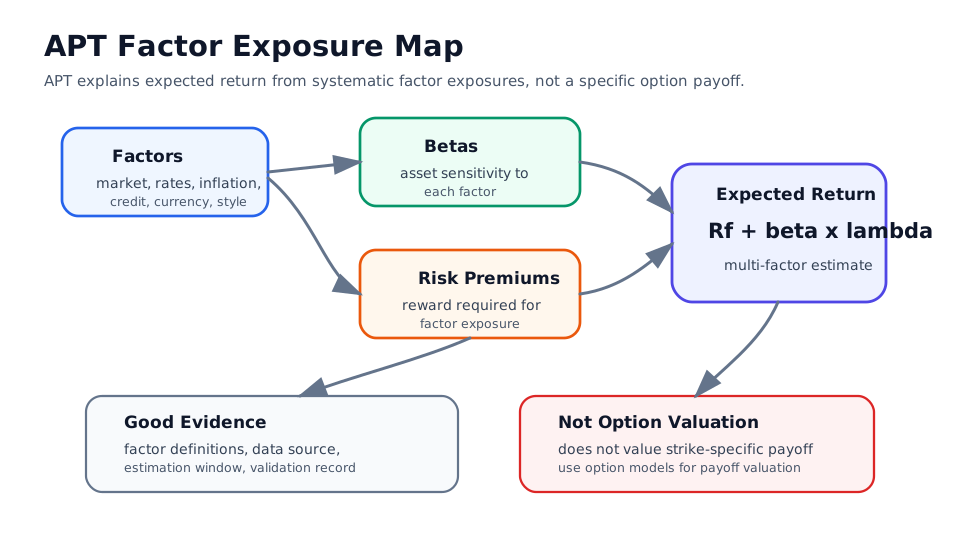
APT is not an option-pricing model in the same sense as Black-Scholes or a binomial tree. It belongs here because it uses no-arbitrage reasoning, but its main use is explaining expected returns across assets rather than valuing a specific option payoff.
Core Formula
A common APT expression is:
where:
- \(E(R_i)\) is the expected return on asset \(i\)
- \(R_f\) is the risk-free rate
- \(\beta_{ij}\) is asset \(i\)’s sensitivity to factor \(j\)
- \(\lambda_j\) is the risk premium for factor \(j\)
The diagram separates the moving parts. APT starts with systematic factors, estimates the asset’s exposure to each factor, multiplies those exposures by factor risk premiums, and combines them into an expected-return estimate.
How It Differs From CAPM
| Feature | APT | CAPM |
|---|---|---|
| Number of factors | Multiple systematic factors | One market factor |
| Factor list | Not fixed by the theory | Market portfolio is central |
| Practical use | Multi-factor expected-return and risk analysis | Market beta and required return |
| Main risk | Poor factor selection or unstable factor loadings | Market proxy and beta estimation limits |
APT is more flexible than CAPM, but that flexibility creates model risk. The analyst must choose and estimate the factors.
Possible Factors
APT does not prescribe a single official factor set. Common candidates include:
- equity market return
- interest-rate changes
- inflation surprises
- credit spreads
- commodity prices
- currency changes
- growth or business-cycle indicators
- style factors such as value, size, momentum, or quality
The factor set should match the portfolio, market, time horizon, and decision.
Where It Helps
APT is useful when an analyst wants to:
- separate systematic from idiosyncratic risk
- estimate expected return from multiple exposures
- explain portfolio performance attribution
- stress test factor shocks
- compare a security’s return with its risk exposures
- build or review multi-factor investment models
Public Source Checks
- The Federal Reserve FRED database is a public source for macroeconomic and market time series that may be used as candidate factors or context.
- The SEC investor introduction to diversification is useful background for distinguishing systematic risk from security-specific concentration risk.
- For a production investment model, the controlling evidence is the model documentation, factor definitions, data source, estimation period, and validation record.
Related Terms
- CAPM: A one-factor expected-return model centered on market beta.
- Systematic Risk: Risk that cannot be diversified away within a broad market.
- Factor Models: Models using risk factors to explain returns.
- Arbitrage: The broader price-consistency concept.
- Risk-Neutral Valuation: A no-arbitrage pricing framework for derivatives.