Option Pricing Theory
Theory explaining how no-arbitrage, payoff structure, volatility, time, rates, and hedging determine option value.
Option pricing theory explains why an option has value and how that value changes with payoff structure, uncertainty, time, rates, dividends, and hedging assumptions.
The central insight is no-arbitrage. If a derivative payoff can be replicated with traded instruments, then the derivative and the replicating strategy should have consistent prices. Otherwise, arbitrage pressure should push prices back into line.
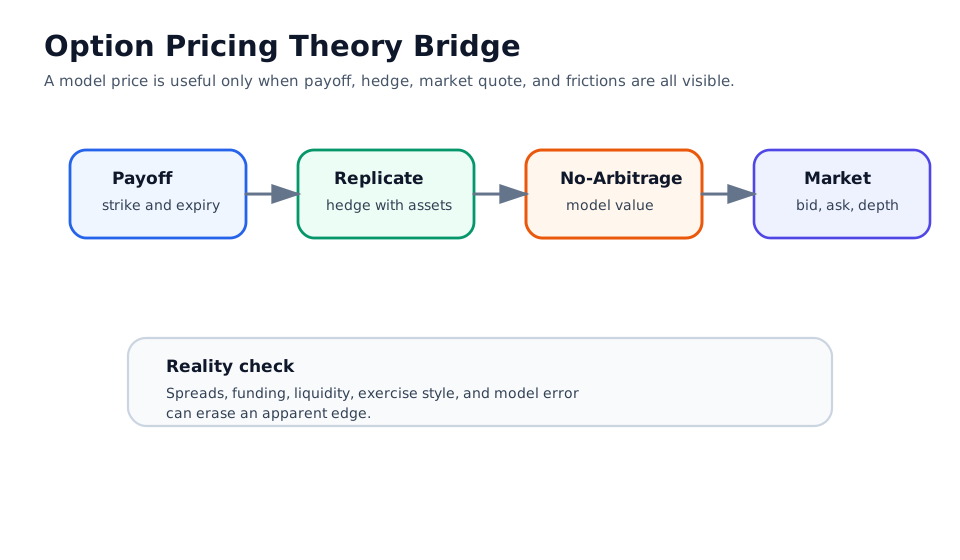
The diagram shows the practical pricing bridge: the option payoff is matched to a replicating or hedging strategy, checked against market frictions, and then compared with executable quotes.
Core Valuation Logic
A simplified option valuation starts with four questions:
- What payoff does the option create?
- How uncertain is the underlying price path?
- Can the payoff be replicated or hedged?
- What discounting, carry, and settlement terms apply?
That logic leads to models such as Black-Scholes, binomial trees, finite-difference methods, Monte Carlo simulation, and market-implied volatility surfaces.
Intrinsic Value And Time Value
An option premium can be separated conceptually into:
Intrinsic value is the payoff if exercise or settlement happened immediately. Extrinsic value reflects time, volatility, rates, dividends, and the chance of future favorable movement.
Why Volatility Matters
An option gives asymmetric exposure. The holder can benefit from favorable moves while downside is limited to the premium paid. Higher expected volatility usually increases that optionality.
This is why implied volatility is often the most important unknown in practical option pricing. The market premium can be read as a volatility assumption when the other inputs are known.
Model Prices vs. Market Prices
A theoretical price is not the same as an executable trade price. Model output must be compared with:
- bid-ask spread
- liquidity and market depth
- transaction costs
- exercise style and settlement
- dividends, borrow costs, and funding
- model assumptions and calibration
- risk limits and margin treatment
An apparent model edge can disappear after spread, slippage, and hedging costs.
Public Source Checks
- The 1997 Nobel Prize press release explains the no-arbitrage option-valuation breakthrough associated with Black, Scholes, and Merton.
- Cboe’s Options Calculator is a practical public tool for exploring theoretical option prices and Greeks.
- FINRA’s options overview explains option premiums, implied volatility, time decay, exercise, assignment, and risks.
- The OCC Options Disclosure Document explains standardized-option risks and contract mechanics.
Related Terms
- Option Pricing Models: Practical model families used to implement pricing theory.
- Risk-Neutral Valuation: A no-arbitrage framework for discounting expected payoffs.
- Option Value: Intrinsic and extrinsic value in an option premium.
- Implied Volatility: Volatility inferred from market prices.
- Arbitrage: The price-consistency force behind no-arbitrage valuation.
- Hedging: The practical process behind replication and risk control.