Risk-Neutral Valuation
No-arbitrage method that prices derivatives by discounting expected payoffs under risk-neutral probabilities.
Risk-neutral valuation prices a derivative by taking expected payoffs under a risk-neutral probability measure and discounting them at the risk-free rate.
The phrase does not mean investors are actually neutral to risk. It means the pricing calculation can be performed under an adjusted probability measure when no-arbitrage assumptions and market-completeness conditions are satisfied.
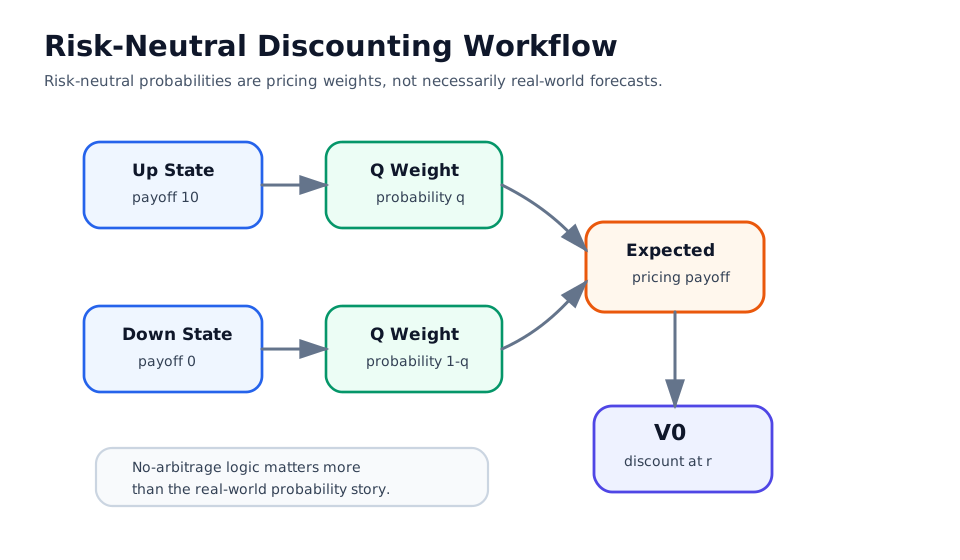
The diagram shows the core workflow: build terminal payoffs, weight them with risk-neutral probabilities, take the expected payoff, and discount it back at the risk-free rate.
Core Formula
In a simple setting:
where:
- \(V_0\) is today’s value
- \(r\) is the risk-free rate
- \(T\) is time to payoff
- \(\mathbb{Q}\) is the risk-neutral probability measure
- \(\text{Payoff}_T\) is the derivative payoff at time \(T\)
Why It Works
The intuition comes from replication. If a derivative payoff can be replicated with traded assets, the derivative should have the same price as the replicating portfolio. Otherwise, arbitrage would be possible.
Risk-neutral probabilities are the probabilities that make discounted traded asset prices consistent with that no-arbitrage condition. They are pricing probabilities, not necessarily real-world beliefs.
One-Period Example
Suppose a derivative pays 10 in an up state and 0 in a down state. If the risk-neutral probability of the up state is 0.60 and the one-period risk-free growth factor is 1.02, then:
The 0.60 is not necessarily a forecast. It is the pricing probability implied by the no-arbitrage setup.
Practical Limits
Risk-neutral valuation is powerful, but the result depends on assumptions:
- whether the payoff can be hedged or replicated
- whether markets are liquid enough for no-arbitrage logic
- whether rates, dividends, funding, and collateral are modeled correctly
- whether jumps or path-dependent features matter
- whether counterparty credit and margin terms change the payoff economics
Public Source Checks
- The 1997 Nobel Prize press release describes the no-arbitrage option-valuation insight behind the Black-Scholes-Merton framework.
- Cboe’s Options Calculator shows practical theoretical pricing and Greeks based on model inputs.
- The OCC Options Disclosure Document explains that listed options still involve standardized contract risks even when valuation models are used.
Related Terms
- Option Pricing Theory: The broader no-arbitrage framework.
- Black-Scholes Option Pricing Model: A model using risk-neutral valuation logic.
- Binomial Option Pricing Model: A tree model that uses risk-neutral probabilities.
- Option Pricing Models: Practical model families for valuing options.
- Arbitrage: The price-consistency mechanism behind the framework.