Options Price Reporting Authority (OPRA)
OPRA consolidates and disseminates listed U.S. options quotation and trade data from participating exchanges.
The Options Price Reporting Authority (OPRA) is the U.S. listed-options market-data infrastructure that disseminates consolidated last-sale and quotation information from participating securities options exchanges. If a platform shows real-time listed-options bid, ask, trade, volume, open-interest, or end-of-day information, OPRA is often part of the data chain behind that display.
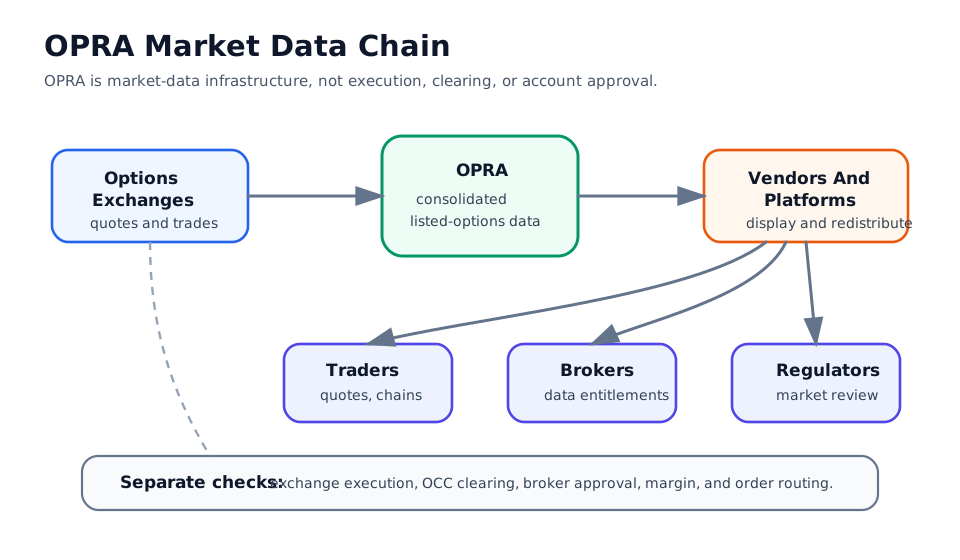
OPRA is not an exchange, broker, clearinghouse, or trading strategy. It is market-data infrastructure. Its job is to collect and distribute options-market information so traders, brokers, vendors, regulators, and analysts can see a consolidated view of exchange-listed options activity.
What OPRA Does
OPRA receives options quote and transaction data from approved participant exchanges and distributes the consolidated information to subscribers, vendors, and platforms under the OPRA plan. The official OPRA site describes the service as disseminating consolidated last-sale and quotation information from national securities exchanges approved by the SEC to list and trade exchange-traded securities options.
The diagram separates the market-data chain from nearby trading functions. OPRA centralizes listed-options data, but execution, clearing, account approval, and margin still sit in separate systems.
| Data area | Why it matters |
|---|---|
| Last-sale reports | Show executed trades and help users review recent transaction prices. |
| Quotation information | Shows bid and ask interest across listed option series. |
| Volume and open-interest data | Supports activity, liquidity, and positioning analysis. |
| Administrative messages | Communicate operational details that can affect market-data interpretation. |
| Vendor access | Allows data vendors and platforms to redistribute OPRA information under applicable terms. |
The official source for current OPRA information is opraplan.com. The SEC also publishes materials related to the OPRA national market system plan, including OPRA plan rule and filing materials.
Why It Matters To Traders
Options are fragmented across multiple listed exchanges. A trader looking at one option series needs to understand whether the displayed quote is real time or delayed, whether it represents consolidated data, and whether the broker or platform has the relevant subscription rights. Poor data assumptions can lead to bad limit prices, weak spread estimates, stale Greeks, or incorrect liquidity conclusions.
OPRA data is especially relevant when reviewing:
- best bid and offer information for a listed option series
- trade prints and time-and-sales records
- option-chain liquidity and spread width
- real-time versus delayed data displays
- market-data fees and vendor entitlements
- post-trade review of execution quality
OPRA Versus Nearby Market Functions
| Function | Role |
|---|---|
| OPRA | Consolidated U.S. listed-options market-data dissemination. |
| Options exchange | Venue where listed option orders can execute. |
| OCC | Clearinghouse for standardized listed options. |
| Broker | Customer interface for account approval, routing, margin, and exercise instructions. |
| Data vendor | Platform that packages and displays OPRA and other market data to users. |
This separation matters. OPRA can tell a platform what the market data shows, but it does not decide whether your order fills, whether your account has margin capacity, or whether a strategy is suitable.
Related Terms
- Options Market: Broader marketplace where listed and OTC options are traded.
- Options Clearing Corporation (OCC): Clearinghouse for standardized listed options.
- Option Series: Specific option contract set with the same underlying, type, strike, and expiration.
- LIFFE: Historical London derivatives exchange often encountered in older futures and options references.
- Price Discovery: Process by which trading and quotations reveal market-clearing prices.