OTC Options
Customized options negotiated off exchange, where documentation, valuation, collateral, liquidity, and counterparty risk are central.
OTC options are option contracts negotiated directly between counterparties rather than traded as standardized listed options on an exchange.
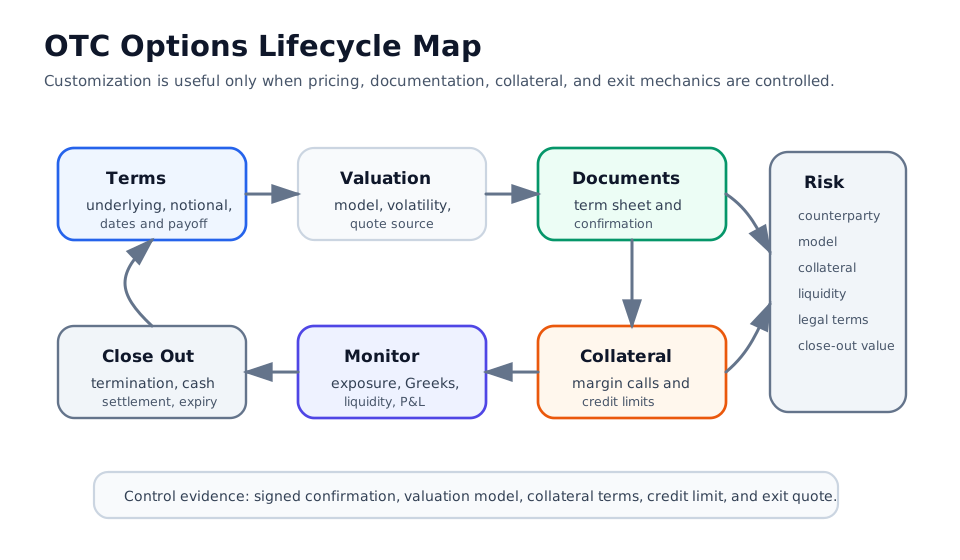
The appeal is customization. The cost is that pricing, liquidity, documentation, collateral, and counterparty credit risk become more important than in a standardized exchange-traded option.
How OTC Options Differ From Listed Options
| Feature | OTC option | Listed option |
|---|---|---|
| Contract terms | Negotiated | Standardized by exchange and clearing rules |
| Counterparty | Bilateral counterparty or dealer | Clearinghouse structure for listed contracts |
| Liquidity | May be limited or dealer-dependent | Often visible through option chains and exchange markets |
| Valuation | Model and quote dependent | Market quotes often easier to observe |
| Documentation | Term sheet, confirmation, master agreement, collateral terms | Exchange rules, OCC disclosure, brokerage terms |
| Customization | High | Limited to listed strikes, expirations, and products |
Why It Matters
OTC options can be tailored for hedging, structured products, corporate risk management, and institutional trading. They can reference currencies, commodities, interest rates, equity baskets, funds, credit events, or bespoke payoff conditions.
That flexibility creates practical risk:
- a model may be needed to value the option
- the counterparty may be the only exit source
- collateral and margin terms may drive liquidity needs
- close-out value can depend on documentation
- path-dependent terms can be hard to hedge
- legal enforceability matters
Example
A company with foreign-currency exposure may negotiate an OTC option that matches a specific invoice date, notional amount, and currency pair. That can hedge the actual cash flow more precisely than a listed option.
The same customization means the company must understand the dealer quote, payoff formula, settlement currency, collateral terms, early termination rights, and credit exposure to the dealer.
Public Source Checks
- The BIS OTC derivatives statistics overview describes global OTC derivatives data covering notional value, market value, and credit exposure across major derivative categories.
- The SEC OTC derivatives dealer page explains that OTC derivatives dealers may compute market and credit risk capital charges using approved risk models.
- The CFTC glossary is useful for derivatives terminology and highlights the distinction between bilateral OTC contracts and centrally cleared futures structures.
- ISDA documentation and collateral materials are important industry references, but the controlling legal terms are the signed agreement and confirmation for the trade.
Related Terms
- Derivative: The broader category of contracts whose value depends on an underlying reference.
- Exotic Options: Many exotic structures are negotiated OTC.
- Forward Contract: Another common OTC derivative.
- Knock-Out Option: A barrier structure often seen in customized derivatives.
- One-Touch Option: A path-dependent fixed-payout structure often documented OTC.
- Option Pricing Models: Models used to value option payoffs when market prices are not directly observable.