Expiration Date of Options
An option expiration date is the final date on which an option can be exercised, assigned, or settled under its contract terms.
The expiration date of an option is the final date on which the contract’s exercise, assignment, or settlement rights are determined. After expiration, the option no longer gives the holder the right to buy or sell the underlying asset.
Expiration is one of the core terms in every option contract. It defines how much time remains for the underlying price to move, when time value disappears, and when exercise or assignment decisions become operationally important.
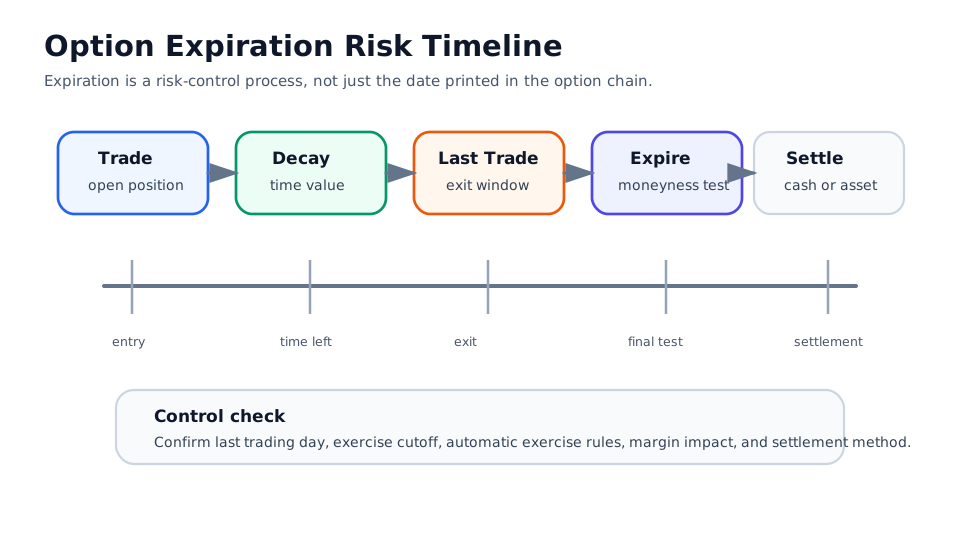
The expiration timeline matters because the market exit window, exercise instructions, final moneyness test, and settlement can be separate operational events.
Why Expiration Matters
Options are wasting assets. Unlike a stock, an option has a built-in clock. As expiration approaches, the contract has less time for the underlying to move favorably, so the extrinsic value embedded in the premium usually declines.
Expiration affects:
- the amount of time value in the option premium
- the pace of theta decay
- whether the trade thesis has enough time to work
- the likelihood of exercise or assignment
- whether the position should be rolled, closed, exercised, or allowed to expire
- the settlement process and final trading deadline
For short-dated options, expiration can dominate the analysis. A correct directional view can still lose money if the move happens after the option expires.
Expiration Date Versus Expiration Time
The expiration date is the calendar date tied to the option contract. The expiration time is the exact cutoff under the applicable contract, exchange, clearing, and broker rules.
| Term | What it controls | Why it matters |
|---|---|---|
| Expiration date | The contract date when rights end or settlement is determined | Defines the option’s life and final moneyness test |
| Last trading day | The final day the contract can normally be traded | May occur before final settlement for some products |
| Expiration time | The precise operational cutoff for exercise or settlement | Affects exercise instructions, assignment risk, and broker deadlines |
For many listed equity options, market participants focus on the standard monthly or weekly expiration date. Index options, cash-settled contracts, AM-settled products, and broker-specific exercise deadlines can require more detailed review.
What Changes Near Expiration
As expiration approaches, the same underlying price move can have a larger effect on option value because there is less time left to recover. This is especially true near the strike price, where a small move can determine whether the option finishes in the money or out of the money.
Near expiration, traders should watch:
- rapid time decay in out-of-the-money and at-the-money contracts
- widening bid-ask spreads in thinly traded strikes
- pin risk when the underlying closes near the strike
- assignment risk for short options
- automatic exercise rules for in-the-money listed options
- settlement timing for cash-settled or index options
Expiration is therefore a risk-control date, not just an administrative label.
Worked Example
Assume a stock trades at $100, and a trader owns a one-month $105 call purchased for $2.
| Stock price at expiration | Intrinsic value | Net result before fees |
|---|---|---|
$100 | $0 | -$2 premium loss |
$105 | $0 | -$2 premium loss |
$106 | $1 | -$1 net loss |
$107 | $2 | breakeven |
$112 | $7 | $5 net profit |
The trader can be right that the stock rises and still lose money if the stock does not rise far enough before expiration.
Authority Sources
Use public sources to verify the basic option framework before relying on expiration mechanics:
- OCC Characteristics and Risks of Standardized Options is the primary disclosure source for standardized listed option risks, exercise, settlement, and product mechanics.
- FINRA’s options overview provides investor-facing context on listed options, rights, obligations, premiums, and risk.
- Investor.gov’s options bulletin is a useful plain-language source for basic option terminology and investor risks.
For a live trade, confirm the exact option chain, exchange product specifications, OCC calendar, broker exercise cutoff, account margin status, and whether the contract is physically settled or cash settled.
Risk Controls
Before holding an option into expiration, document:
- whether the option is long or short
- whether it is in the money, at the money, or out of the money
- the last trading day and exercise instruction deadline
- the expected settlement method
- whether automatic exercise could create an unwanted underlying position
- whether short-option assignment could create margin stress
- the exit rule if liquidity disappears near the close
Expiration exposure is most important when it changes cash settlement, physical delivery, margin, assignment, or underlying-asset exposure.
Related Terms
- Strike Price: The price level used to test whether the option has intrinsic value.
- Last Trading Day: The final day the option can normally be traded.
- Option Premium: The market price paid or received for the option before expiration.
- At The Money: A moneyness state that can be especially sensitive near expiration.
- In-the-Money Options: Options with intrinsic value before premium is considered.
- Theta: Measures the effect of time decay on option value.
Review Checklist
- Identify the option symbol, expiration date, settlement style, and last trading day.
- Compare the underlying price with the strike as expiration approaches.
- Confirm whether the contract is physically settled or cash settled.
- Check broker-specific exercise and do-not-exercise deadlines.
- Model what happens if the option expires slightly in the money or slightly out of the money.
- Close, roll, exercise, or let expire only after confirming margin and assignment exposure.