Black-Scholes Option Pricing Model
Closed-form model for estimating European option value from price, strike, time, volatility, rates, and dividends.
The Black-Scholes option pricing model estimates the theoretical value of a European-style option using the current underlying price, strike price, time to expiration, volatility, interest rate, and dividend or carry assumptions.
It is one of the standard models in modern derivatives valuation. It is also a benchmark, not a guarantee that the market price is correct or that the model assumptions hold.
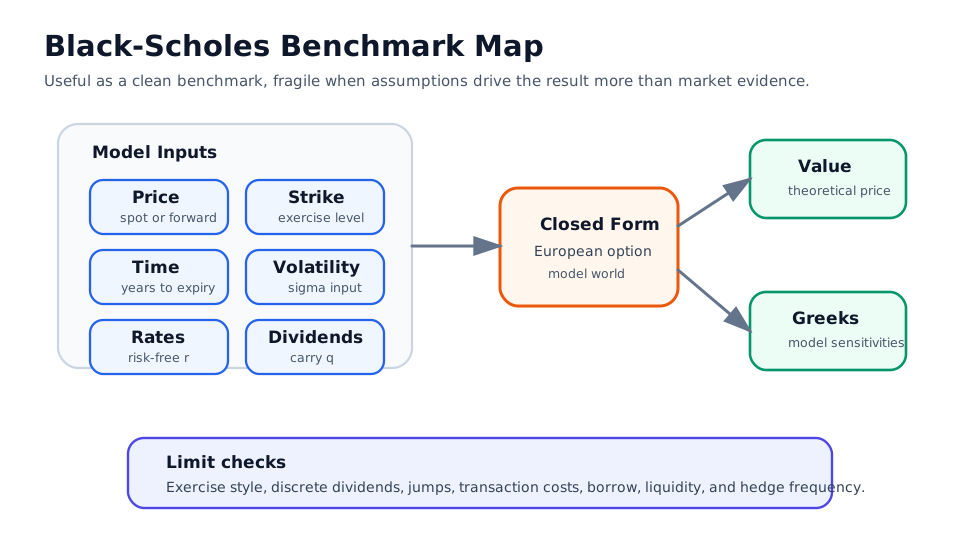
The diagram summarizes the model as a benchmark: contract terms and market assumptions feed a closed-form value and Greeks, then the result must be checked against exercise style, liquidity, dividends, and hedging realism.
Core Formula
For a European call option with continuous dividend yield \(q\), the Black-Scholes-Merton formula is:
where:
Key terms:
- \(S_0\): current underlying price
- \(K\): strike price
- \(T\): time to expiration in years
- \(r\): continuously compounded risk-free rate
- \(q\): continuous dividend yield or carry adjustment
- \(\sigma\): volatility assumption
- \(N(\cdot)\): cumulative standard normal distribution
What The Model Is Doing
The model prices the option through a no-arbitrage replication argument. In simplified terms, a continuously adjusted hedge can replicate the option payoff, so the option should trade near the cost of that replicating strategy under the model assumptions.
This is why volatility is so important. The formula turns a volatility assumption into a theoretical premium, and the market can be inverted to infer implied volatility.
Main Assumptions
The basic Black-Scholes framework assumes:
- European-style exercise
- continuous trading and frictionless markets
- no transaction costs or taxes
- constant volatility and interest rates
- lognormal underlying price behavior
- known dividends or carry
- ability to hedge continuously
Real markets violate many of these assumptions. That does not make the model useless; it means the user must understand the gap between model world and trading reality.
When It Is Useful
Black-Scholes is most useful for:
- understanding how option premiums react to model inputs
- estimating theoretical European option value
- calculating Greeks under a standard framework
- converting market premiums into implied volatility
- comparing model prices across strikes and maturities
It is less suitable as a stand-alone answer for American options with early-exercise value, illiquid options, large discrete dividends, jumps, hard-to-borrow stocks, and path-dependent exotic options.
Public Source Checks
- The 1997 Nobel Prize press release describes the Black-Scholes-Merton contribution to option valuation and the no-arbitrage insight behind it.
- Cboe’s Options Calculator lets users explore theoretical option prices and Greeks using model inputs.
- FINRA’s options overview explains option premiums, implied volatility, time decay, and risk considerations.
- The OCC Options Disclosure Document explains listed-option risks that still apply when a model price looks precise.
Related Terms
- Option Pricing Models: The broader set of valuation frameworks.
- Binomial Option Pricing Model: A discrete-time alternative that can handle early-exercise logic.
- Risk-Neutral Valuation: The valuation framework behind the model.
- Option Value: The premium being modeled.
- Volatility: The input that often dominates option value.
- Strike Price: The exercise level used in the formula.