Protective Put Strategy
A protective put combines an owned asset with a purchased put to limit downside through expiration while retaining upside, less the premium paid.
A protective put is an options strategy that combines an owned asset with a purchased put option on the same underlying. The put gives its holder the right to sell at the strike price, creating a defined downside floor through the option’s expiration when the hedge amount and contract terms match the asset position.
The strategy retains the asset’s upside exposure but subtracts the put premium from the net result. A protective put is also called a married put when the asset and put are purchased at the same time.
Key Takeaways
- The position consists of a long asset and a long put on that asset.
- The put strike sets the gross sale-price floor at expiration; the premium and asset cost basis determine the maximum net loss.
- The hedge lasts only for the option’s stated term and covers only the quantity represented by the contracts.
- Higher strikes generally provide more protection but can cost more, all else equal.
- A purchased put can gain when the asset falls or implied volatility rises, but time decay and premium cost work against the holder.
- The buyer still faces basis, liquidity, execution, expiration, tax, and operational risks.
Position Construction
For a straightforward listed-equity example, the investor owns shares and buys enough puts to cover the same number of shares. A standard equity option commonly represents 100 shares, but corporate actions can create adjusted contracts with different deliverables. The current contract specification controls.
Before describing the position as protected, verify:
- identical underlying or a documented proxy relationship;
- share quantity and option contract multiplier;
- put strike and expiration;
- option exercise style and settlement;
- premium, bid-ask spread, and commissions; and
- whether the investor intends to sell, exercise, roll, or let the put expire.
A put on an index or related ETF may reduce portfolio risk without creating a guaranteed floor for each holding. That is a cross-hedge and retains basis risk.
Payoff at Expiration
Let (S_T) be the asset price at expiration, (K) the put strike, (B) the asset price or cost basis used for the analysis, and (P) the put premium per unit. For a one-to-one hedge, the combined profit at expiration is:
Equivalently:
If the strike is below the analysis basis, the simplified maximum loss per unit is:
If the put expires without value and there are no other cash flows, the upside breakeven is (B+P). These formulas omit dividends, interest, taxes, fees, early exercise, and contract adjustments.
Payoff Shape
The diagram shows the expiration payoff: losses flatten below the strike, while gains above breakeven continue with the underlying after accounting for the premium.
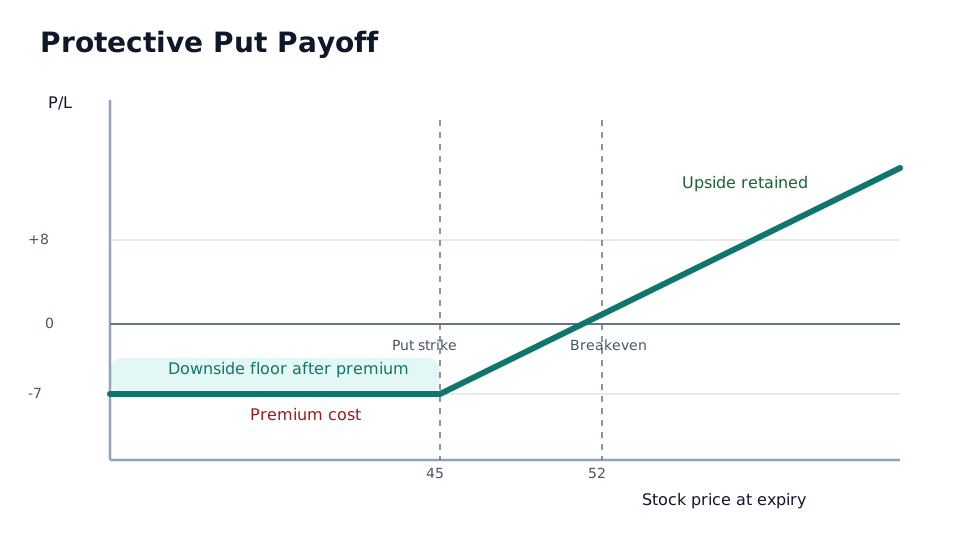
The flat section is not a promise that the account value cannot move before expiration. The put’s market price changes with time, implied volatility, rates, dividends, liquidity, and the underlying price.
Practical Example: Protecting a $100 Stock
Assume an investor buys stock at $100 and pays $4 for a three-month put with a $95 strike. The example is stated per share and assumes a one-to-one hedge held through expiration.
| Stock at expiration | Stock profit or loss | Put payoff | Premium | Combined profit or loss |
|---|---|---|---|---|
| $70 | -$30 | +$25 | -$4 | -$9 |
| $95 | -$5 | $0 | -$4 | -$9 |
| $100 | $0 | $0 | -$4 | -$4 |
| $104 | +$4 | $0 | -$4 | $0 |
| $120 | +$20 | $0 | -$4 | +$16 |
The maximum expiration loss is $9 per share: the $5 decline from the $100 purchase price to the $95 strike plus the $4 premium. The upside breakeven is $104. Below $95, additional stock losses are offset by additional intrinsic value in the put.
For 100 shares and one standard 100-share put contract, the simplified maximum loss is $900 before commissions and other costs. Without the put, a decline to $70 would produce a $3,000 stock loss.
Choosing the Strike
Strike selection determines how much loss the investor retains before the put becomes in the money.
| Put strike relative to asset price | Protection tradeoff | Premium tendency, all else equal |
|---|---|---|
| Lower out-of-the-money strike | Larger deductible and protection mainly against deeper declines | Lower |
| Near-the-money strike | Earlier downside participation by the put | Higher |
| Higher in-the-money strike | Higher gross sale-price floor | Higher |
Premium is also affected by time, implied volatility, rates, dividends, liquidity, and supply and demand. A lower strike is not automatically better value; it purchases a different loss threshold.
Choosing the Expiration
The expiration should cover the intended risk window. A put that expires before the event or liability being hedged does not protect the later period.
Longer-dated protection usually includes more time value, but repeatedly buying short-dated puts can also be costly and creates roll risk. If the investor rolls the hedge, the replacement put has a new strike, premium, volatility level, and expiration. Protection is not continuous unless the transition is managed.
Protective Put vs. Alternatives
| Choice | Downside treatment | Upside treatment | Main cost or constraint |
|---|---|---|---|
| Protective put | Defines an expiration floor below the strike | Retained, less premium | Upfront premium and expiration |
| Sell the asset | Removes future asset downside | Removes future asset upside | Exit, tax, and reinvestment consequences |
| Stop order | Attempts to sell after a trigger | Retained until sale | Execution price is not guaranteed in a gap or illiquid market |
| Covered call | Premium provides only a limited cushion | Capped above the call strike | Assignment and forgone upside |
| Collar | Long put defines a floor | Short call caps upside | Call premium helps fund the put |
A so-called zero-cost collar can have little or no net premium at inception, but it still has transaction costs, opportunity cost, assignment risk, and a materially different payoff.
Sensitivities Before Expiration
The combined position generally has:
- positive but changing delta because the long stock is partly offset by the long put;
- positive gamma from the purchased put;
- negative theta from the put’s time decay, all else equal; and
- positive vega because higher implied volatility generally increases the put’s model value.
These are broad patterns for a plain long put plus long stock. The magnitude depends on moneyness, time, volatility surface, dividends, rates, and contract features. Option Greeks are local model sensitivities, not guaranteed price changes.
Risks and Limitations
- Premium risk: protection can expire unused, and repeated purchases can materially reduce long-run return.
- Expiration risk: the asset can fall after the put expires or after protection is rolled to a different strike.
- Quantity risk: too few contracts leave part of the position unprotected; too many create net short exposure below the strike.
- Basis risk: an index, ETF, or related-asset put may not track the owned portfolio.
- Liquidity risk: a wide spread can make entry, exit, or rolling expensive.
- Exercise and settlement risk: exercise style, settlement method, deadlines, and account capacity affect the outcome.
- Corporate-action risk: splits, mergers, distributions, or adjusted deliverables can change contract interpretation.
- Tax and accounting risk: treatment depends on jurisdiction, holding period, entity, and transaction sequence.
- Counterparty and intermediary risk: clearing, broker controls, and account-liquidation terms still matter.
Common Mistakes
- Calling the position fully protected without matching the underlying and quantity.
- Treating the strike as the net breakeven or maximum-loss level without including premium and cost basis.
- Assuming a stop order provides the same contractual floor as a put.
- Comparing put premiums without matching strike, expiration, volatility, and contract multiplier.
- Buying protection after implied volatility has risen without evaluating the premium and intended risk window.
- Forgetting dividends, corporate actions, expiration deadlines, or adjusted contracts.
- Evaluating only whether the put made money rather than whether the combined position met the hedge objective.
Authoritative Sources
The Options Industry Council’s Protective Put overview provides the standard position, maximum-loss, breakeven, and married-put distinctions. OCC’s Characteristics and Risks of Standardized Options explains standardized-option rights, exercise, assignment, contract adjustments, and risks. FINRA’s options overview discusses listed options, strategy mechanics, and option-risk considerations.
Use the current option chain, contract specification, OCC adjustment memo where applicable, broker records, and tax or legal advice for an actual position. This article is for financial education only and is not personalized investment, options, tax, legal, or accounting advice.