Pullback in Trading
A pullback is a temporary move against a prevailing trend. Learn how swing structure, drawdown, timeframe, and later confirmation affect the label.
A pullback is a temporary price move against an established trend that has not yet replaced the trend’s defining structure. The term most often means a decline within an uptrend; an upward move within a downtrend is often called a countertrend rally. At the start of the move, whether it will remain temporary is unknown.
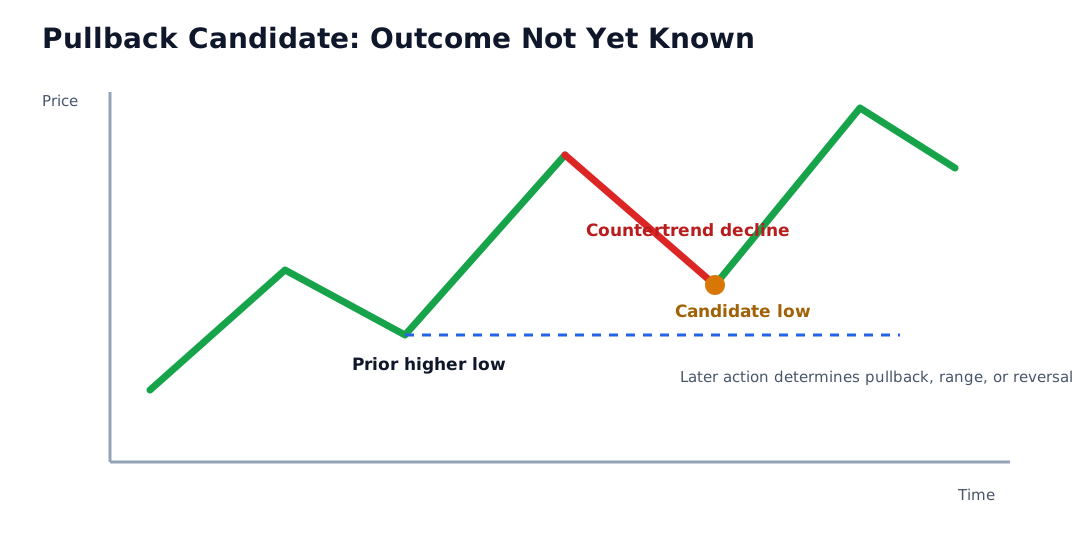
Pullback is therefore partly a provisional and retrospective label. A decline can begin as a pullback candidate, then become a range or reversal as new swing points appear.
Key Takeaways
- A pullback requires a prior trend; otherwise the move may be ordinary range fluctuation.
- The move is countertrend on the selected timeframe but can be a complete trend on a shorter chart.
- In an uptrend, remaining above a prior meaningful higher low can preserve the existing structure.
- No universal percentage separates a pullback from a correction or reversal.
- Support, moving averages, and trend lines are references, not guaranteed turning prices.
- Buying a decline is a separate decision that requires entry, order, size, invalidation, and loss rules.
A Pullback Needs a Prior Trend
In an Uptrend, meaningful highs and lows generally progress upward. A countertrend decline can remain consistent with that structure while it holds above the prior higher low.
In a Downtrend, an upward rally can remain countertrend while it stays below the prior lower high.
A move inside a horizontal range is not necessarily a pullback because there may be no prevailing directional trend to pull back from.
Worked Example
Assume a daily uptrend has these confirmed points:
- prior higher low: $110
- latest higher high: $130
- current decline low: $117
The drawdown from the latest high is:
($130 - $117) / $130 x 100 = 10.0%
The $117 low remains above the $110 structural reference, so the move can still be classified as a pullback candidate under this particular swing rule.
Two possible later paths show why the early label is uncertain:
| Later event | Structural reading |
|---|---|
| Price forms a low at $117 and then closes above $130 | Prior uptrend resumes under the selected rule |
| Price closes below $110, rebounds only to $115, then falls to $105 | Prior uptrend weakens and lower-high/lower-low evidence develops |
The 10% drawdown does not by itself settle the classification. A volatile asset may routinely move that much inside a trend, while a lower-volatility asset may experience a major structural change after a smaller decline.
Candidate, Confirmed Pullback, and Reversal
| State | What is known | What is not known |
|---|---|---|
| Countertrend move begins | Price moves against the prior trend | Duration and final depth |
| Pullback candidate | Prior structure remains intact so far | Whether the trend will resume |
| Retrospectively confirmed pullback | Price resumes the prior trend under a stated rule | Whether the renewed trend will persist |
| Reversal evidence | Opposite swing structure begins to form | Future direction remains uncertain |
Calling the low in real time is difficult because a swing low is normally identifiable only after later prices rise. A backtest must use the confirmation timestamp, not assume an entry at the exact low.
Pullback vs. Similar Terms
| Term | Main idea | Key distinction |
|---|---|---|
| Pullback | Temporary countertrend move within a prevailing trend | Prior structure survives and later resumes |
| Retracement | Partial reversal of a prior price move | Often used similarly, without necessarily classifying the larger trend |
| Reversal | Sustained change in trend direction | Opposite structure replaces the prior trend |
| Market Correction | Meaningful decline from a recent high | Drawdown concept, often broader than one trading setup |
| Consolidation | Sideways pause with limited directional progress | Direction may be absent rather than countertrend |
Fixed percentage labels can be convenient shorthand, but they do not replace instrument-specific structure and volatility analysis.
Common Reference Areas
Analysts may compare a pullback with:
- prior higher low or lower high
- former breakout zone
- horizontal support or resistance
- rising or falling Trend Line
- moving average
- volatility-based distance from a recent high
These references can disagree. A price may remain above a swing low while closing below a moving average. The method should state which reference controls and why.
Timeframe Conflict
A weekly uptrend can contain a daily pullback and an hourly downtrend at the same time. A complete note might say:
The weekly swing structure remains upward. Daily price is in a countertrend decline above the prior weekly higher low, while the hourly chart has formed lower highs and lower lows.
This is more precise than saying the asset is simply bullish or bearish. The expected holding period and risk horizon determine which timeframe is relevant to a decision.
Volume and Momentum
Some methods expect volume or downside momentum to diminish during a pullback. Those observations should use a defined baseline and formula.
Lower volume does not prove that sellers are weak, and higher volume does not prove a reversal. Auctions, news, expiry, index changes, short covering, and liquidity conditions can alter activity independently of the chart narrative.
From Pullback Observation to Trade
“Buy the pullback” omits the essential decisions:
- What prior trend qualifies?
- Which reference area is eligible?
- Is entry intraday, on a close, or after a renewed high?
- What condition invalidates the setup?
- How is position size tied to the loss limit?
- Which order type is used?
- What happens if price gaps through the planned stop?
A market order may execute away from the displayed price. A limit order may not fill. A stop order can trigger and become a market order during fast conditions. The chart does not remove these tradeoffs.
How to Evaluate a Pullback Claim
- Define the prior trend and timeframe.
- Identify the last meaningful swing supporting that trend.
- Measure the countertrend move from a stated reference.
- Specify what preserves, resumes, or invalidates the prior structure.
- Record when a candidate low or high became observable.
- Document conflicting shorter and longer timeframes.
- Separate signal, order, fill, and transaction cost.
- Include candidates that became reversals or never resumed.
Risks and Common Mistakes
- Calling every decline a pullback without a prior uptrend.
- Assuming a lower price means better fundamental value.
- Buying before the candidate low can be identified.
- Moving the prior swing level after it breaks.
- Switching timeframe to preserve the preferred story.
- Treating a moving average or trend line as guaranteed support.
- Ignoring event risk, gaps, spread, liquidity, and leverage.
- Testing only pullbacks that later resumed successfully.
Public Source Checks
- CFTC Futures Glossary defines charting and technical-analysis terminology using historical market data.
- CFTC: Commodity Trading Systems Sold on the Internet warns that hypothetical results may omit spreads, execution effects, fees, and the ability to absorb losses.
- Investor.gov: Types of Orders explains market, limit, and stop-order mechanics.
- Investor.gov: Executing an Order explains why actual execution can differ from a displayed market price.
Related Terms
- Market Trend: The directional structure that gives the pullback context.
- Uptrend: Rising structure in which a downward pullback may occur.
- Reversal: Sustained change that a pullback candidate may become.
- Support and Resistance: Reaction zones often monitored during a pullback.
- Breakout: Boundary crossing that may later be retested.
FAQs
How can a pullback be distinguished from a reversal?
Is there a maximum pullback percentage?
Does a pullback end at support?
Is every pullback a buying opportunity?
This article provides general chart-reading education, not a recommendation to buy a decline or personalized investment advice.