Rho in Options Trading
Rho estimates how much an option's theoretical value changes when interest rates change.
Rho is an option Greek that estimates how much an option’s theoretical value changes when interest rates change. It is usually quoted as the approximate dollar change in option value for a one-percentage-point change in the relevant risk-free interest rate.
Rho is usually less visible than Delta, Gamma, Theta, or Vega for short-dated equity options. It becomes more relevant for longer-dated options, rate-sensitive underlyings, currency options, and periods when interest rates are changing materially.
Formula
Rho is the sensitivity of option value to the interest-rate input:
where:
- \(V\) is the option’s theoretical value
- \(r\) is the relevant interest-rate input
If a call option has rho of 0.06, a one-percentage-point rate increase would, all else equal, raise the model value by about $0.06. If a put option has rho of -0.04, the same rate move would lower the model value by about $0.04.
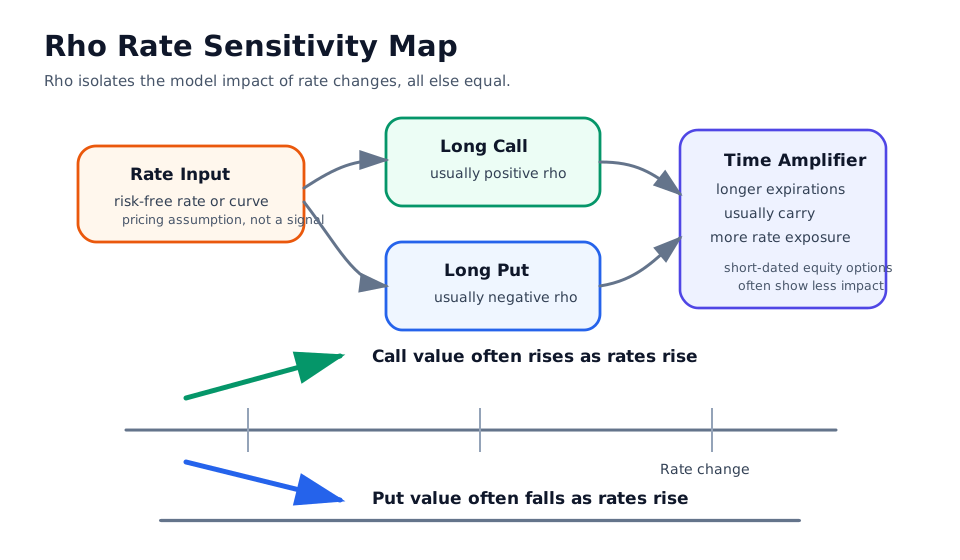
The diagram shows the usual equity-option intuition: higher rates tend to help long calls and hurt long puts, while longer time to expiration gives the rate input more room to matter.
Why Rho Is Often Small
For many short-dated equity options, price movement, implied volatility, and time decay dominate interest-rate sensitivity. Rho can still matter when:
- the option has a long time to expiration
- the rate environment is moving quickly
- the underlying is a currency, bond, rate, or rate-sensitive asset
- the option is part of a portfolio with large notional exposure
- the pricing model uses stale yield, dividend, or funding assumptions
Rho is a model sensitivity, not a standalone trade signal. The sign and size depend on the model, option type, maturity, dividends, currency, and settlement convention.
Calls Versus Puts
| Position type | Typical rho direction | Intuition |
|---|---|---|
| Long call | Usually positive | Higher rates can increase the value of deferring payment for the underlying. |
| Long put | Usually negative | Higher rates can reduce the present value of the strike-related payoff. |
| Long-dated option | More rate-sensitive | More time leaves more room for discounting and carry assumptions to matter. |
| Short-dated option | Often lower rho impact | Price, gamma, vega, and theta usually dominate. |
These are common equity-option intuitions, not universal rules. Currency options and rate options can have different conventions and drivers.
Public Source Checks
The Options Industry Council’s Greeks overview describes rho as interest-rate sensitivity and places it alongside delta, gamma, theta, and vega. The OCC Options Disclosure Document is the source to check for standardized-options risk disclosure before trading listed options.
Related Terms
- Call Option: Contract type whose long position often has positive rho.
- Put Option: Contract type whose long position often has negative rho.
- Currency Option: Option type where interest-rate differentials can be especially relevant.
- Option Value: Option premium and theoretical value context.
- Implied Volatility: Usually a more important short-term option-pricing input than rho for many equity options.