Option Premium and Value
Option premium is the traded price of an option, while valuation separates that price into intrinsic and extrinsic components.
An option premium is the market price paid by the buyer and received by the writer. Option value can refer to that quoted price or to an estimated theoretical value under a pricing model.
For listed options, option value is usually observed as the option premium quoted in the market. For analysis, it is useful to separate that value into intrinsic value and extrinsic value.
The diagram separates quoted option premium into the part that already exists as exercise value and the part that depends on time, volatility, rates, dividends, and market liquidity.
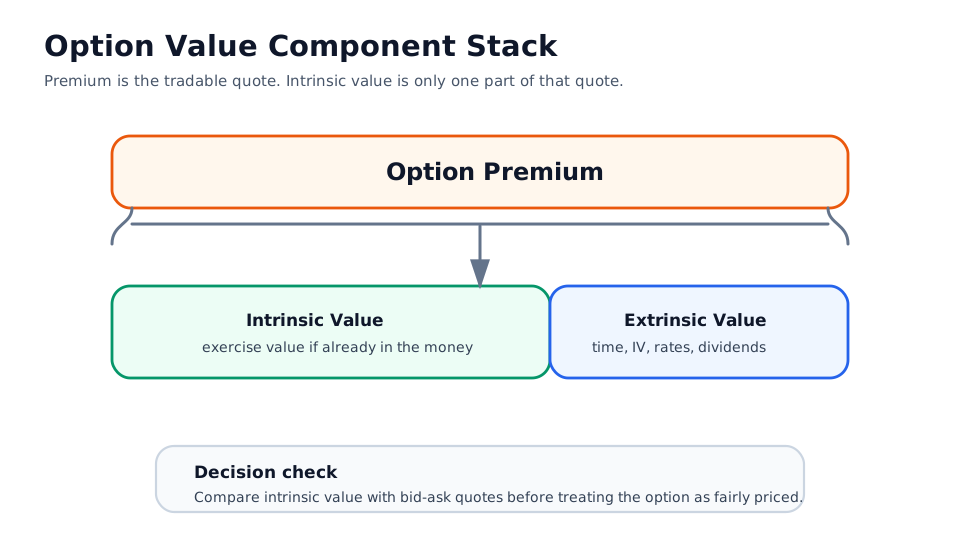
Intrinsic And Extrinsic Value
| Component | Meaning | Example |
|---|---|---|
| Intrinsic value | Immediate exercise value if the option is in the money | A $100 call has $5 intrinsic value if the stock trades at $105 |
| Extrinsic value | Value above intrinsic value, driven by time, volatility, rates, dividends, and supply/demand | The same call may trade for $7, implying $2 of extrinsic value |
An out-of-the-money option has no intrinsic value, but it can still have extrinsic value because the underlying may move favorably before expiration.
Main Drivers Of Option Value
Option value changes when key inputs change:
- Underlying price: Calls generally gain when the underlying rises; puts generally gain when it falls.
- Strike price: The strike determines moneyness and exercise value.
- Time to expiration: More time usually increases the chance of a favorable move.
- Implied volatility: Higher implied volatility usually increases option premiums.
- Interest rates and dividends: Carry assumptions can affect calls and puts differently.
- Liquidity and order flow: Bid-ask spreads and market depth affect executable value.
The quoted value is therefore not just “where the stock is.” It is a package of price, time, volatility, and contract mechanics.
Worked Example
Assume a stock trades at $105 and a $100 call expiring in one month trades for $7.
| Item | Amount |
|---|---|
| Stock price | $105 |
| Strike price | $100 |
| Intrinsic value | $5 |
| Option premium | $7 |
| Extrinsic value | $2 |
If the stock stays at $105 until expiration, the extrinsic value disappears and the call is worth about $5 before fees. The holder can still lose money relative to the $7 premium paid even though the option remains in the money.
Why Option Value Matters
Option value matters because it converts contract rights into a tradable price. It is central to:
- deciding whether an option looks rich or cheap
- measuring profit and loss on an option position
- separating intrinsic value from time and volatility value
- comparing long options, short options, spreads, and hedges
- evaluating exercise, assignment, and close-out decisions
- checking whether quoted markets are liquid enough to support the trade
For risk work, use executable bid/ask quotes and confirmations rather than theoretical value alone.
Authority Sources
Use public sources to verify option mechanics:
- OCC Characteristics and Risks of Standardized Options explains standardized option characteristics, risks, exercise, assignment, and settlement.
- FINRA’s options overview explains premiums, strike prices, expiration, intrinsic value, and option-pricing factors.
- Investor.gov’s options bulletin provides a plain-language overview of option rights and risks.
For a live position, verify the option chain, trade confirmation, contract multiplier, settlement terms, bid-ask spread, open interest, and account-specific exercise rules.
Related Terms
- Implied Volatility: A major input into option value.
- Strike Price: The exercise price that determines intrinsic value.
- In-the-Money Options: Options with intrinsic value before premium is considered.
- Call Option: A right to buy the underlying.
- Put Option: A right to sell the underlying.
Review Checklist
- Separate intrinsic value from total premium.
- Check whether the option value is based on bid, ask, midpoint, last trade, or model value.
- Verify the contract multiplier before converting option price into dollar exposure.
- Compare theoretical value with executable market quotes.
- Model what happens to value if price, time, and implied volatility move against the position.