Contango and Backwardation
Contango and backwardation describe upward- and downward-sloping futures curves and their implications for carry, hedging, and rolling exposure.
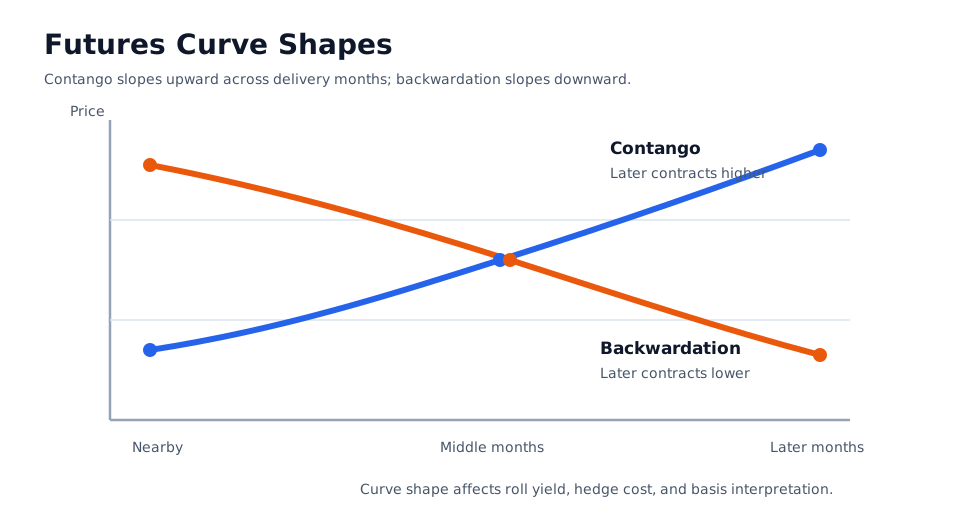
Contango and backwardation describe the ordering of prices across futures contract months. A market is in contango when later-dated contracts trade above nearer contracts; it is in backwardation when later contracts trade below nearer contracts. The labels describe the curve observed now, not a guaranteed forecast of where spot prices will trade later.
Curve shape matters to producers, consumers, portfolio managers, and traders because it affects hedge selection, inventory economics, contract rolls, and the return of futures-based products.
Key Takeaways
- Contango is an upward-sloping futures curve; backwardation is a downward-sloping curve.
- Compare contracts on the same underlying, grade, location, quotation basis, and observation time.
- Storage, financing, insurance, income, and convenience yield can influence the curve, but expectations and market constraints also matter.
- Contango does not automatically predict falling returns, and backwardation does not guarantee gains.
- A long futures strategy’s roll outcome depends on how contract prices change, how exposure is sized, and when the roll occurs, not only on the visible spread.
- “Normal backwardation” is a separate theoretical concept involving expected future spot prices and risk premiums.
How to Identify the Curve
For two contract months on the same futures curve:
where near and later identify delivery or settlement months. A curve can be flat, humped, seasonal, or backwardated near the front and in contango farther out. In those cases, describe the specific segment rather than assigning one label to the entire curve.
| Observed relationship | Common label | What it establishes |
|---|---|---|
| Later futures above nearby futures | Contango | Upward slope between those months |
| Later futures below nearby futures | Backwardation | Downward slope between those months |
| Futures above current spot | Contango relative to spot | Positive futures-minus-spot spread at that time |
| Futures below current spot | Backwardation relative to spot | Negative futures-minus-spot spread at that time |
Spot and futures quotes must be economically comparable. A crude-oil futures price at one delivery point cannot be compared mechanically with a cash quote for a different grade or location.
Worked Curve Example
Assume the following hypothetical prices for the same commodity and delivery location:
| Delivery | Curve A | Curve B |
|---|---|---|
| Spot | $70.00 | $70.00 |
| Month 1 | $70.50 | $69.50 |
| Month 2 | $71.20 | $68.80 |
| Month 4 | $72.00 | $67.80 |
Curve A is in contango because prices rise with maturity. Curve B is in backwardation because prices fall with maturity.
The table does not prove that the spot price will rise to $72.00 or fall to $67.80. Each futures price is a current tradable contract price shaped by carry, convenience, expectations, liquidity, risk premiums, and contract rules.
Cost of Carry and Convenience Yield
For a storable commodity, a simplified continuous-compounding relationship is:
where:
- \(F_{0,T}\) is the futures price for maturity \(T\);
- \(S_0\) is the current spot price;
- \(r\) is the financing rate;
- \(u\) represents storage, insurance, and other carrying costs; and
- \(y\) is convenience yield or another benefit of holding the physical commodity.
If financing and storage costs exceed the benefit of immediate ownership, contango is economically plausible. If convenience yield is high because nearby inventory is scarce or operationally valuable, backwardation can emerge.
This model is a framework, not a complete pricing rule for every market. Non-storable underlyings, delivery bottlenecks, credit constraints, seasonal supply, embedded options, and benchmark methodology can require different analysis.
Why Curves Change Shape
| Driver | Possible curve effect | Evidence to examine |
|---|---|---|
| Storage and insurance costs | Can support contango | Warehouse, tank, transport, and insurance economics |
| Financing rates | Higher carry can lift deferred prices | Funding curves and collateral terms |
| Low nearby inventories | Can support backwardation | Inventory and availability data |
| High convenience yield | Can lift spot or nearby contracts | Operational demand for immediate physical supply |
| Seasonality | Can create humps or alternating slopes | Production, harvest, maintenance, and demand cycles |
| Delivery constraints | Can distort one contract month | Delivery-point capacity and exchange notices |
| Expected supply or demand changes | Can move selected maturities | Fundamental forecasts and market prices |
| Positioning and liquidity | Can steepen or flatten spreads | Volume, open interest, and bid-ask depth |
Neither curve shape has one universal cause. Confirm the actual market evidence before attributing contango to oversupply or backwardation to scarcity.
Roll Mechanics
A futures position does not automatically continue after expiration. To maintain exposure, a participant generally closes or settles the expiring contract and opens a later one.
For a long position:
- in contango, the replacement contract is usually more expensive than the expiring contract;
- in backwardation, the replacement contract is usually cheaper; and
- the realized result depends on price changes before and after the roll, contract sizing, execution, and collateral income.
Buying a later contract at a higher quoted price is not by itself an immediate accounting loss. The negative roll effect often associated with contango arises if the higher-priced contract declines toward spot or the nearby price as time passes, all else equal. Likewise, backwardation does not guarantee positive roll return because the whole curve can move adversely.
Effect on Different Users
| User | Why the curve matters |
|---|---|
| Producer hedging a future sale | Contract month and spread affect the price locked and timing basis |
| Consumer hedging a purchase | Deferred premium or discount affects hedge cost and procurement economics |
| Inventory holder | Cash-and-carry opportunities depend on storage, funding, delivery, and spread |
| Futures-based fund | Contract selection and roll schedule affect return relative to spot |
| Spread trader | Profit or loss depends on relative movement between contract months |
| Analyst | Curve shape can reveal nearby tightness, seasonality, or carry economics but is not conclusive alone |
Contango vs. Backwardation
| Feature | Contango | Backwardation |
|---|---|---|
| Curve slope | Upward | Downward |
| Later vs. nearby price | Higher | Lower |
| Common physical-market association | Positive net carry or abundant nearby supply | High convenience yield or tight nearby supply |
| Long-roll tendency, all else equal | Potential drag | Potential benefit |
| Short-roll tendency, all else equal | Potential benefit | Potential drag |
| Main analytical mistake | Treating it as a certain bearish forecast | Treating it as a certain bullish forecast |
Normal Backwardation Is Different
Observed backwardation compares contract prices available at the same time across maturities or with spot. Normal backwardation is a theory comparing a futures price with the expected spot price at maturity, often in the context of risk premiums paid by hedgers.
Because the expected future spot price is unobservable, normal backwardation cannot be established merely by looking at a downward-sloping curve. Keep the observed market structure separate from the theoretical expected-price relationship.
Risks and Common Mistakes
- Comparing contracts with different grades, locations, currencies, or settlement methods.
- Assuming a curve slope predicts the direction of the entire market.
- Treating the front-month spread as representative of every maturity.
- Ignoring delivery congestion, expiry, and spot-month liquidity.
- Calling a high futures price “contango” without identifying the comparison contract or spot quote.
- Assuming a futures-based fund will match the return of the physical commodity or spot index.
- Calculating roll return from the quoted spread alone without tracking price evolution and position size.
- Ignoring fees, bid-ask spreads, collateral yield, margin, tax, and currency effects.
Evaluation Checklist
- Identify the underlying, grade, location, currency, contract months, and observation time.
- State whether the comparison is later versus nearby futures or futures versus spot.
- Plot several maturities instead of relying on one spread.
- Check storage, funding, inventory, seasonality, delivery, and convenience-yield evidence.
- Separate observed backwardation from normal-backwardation theory.
- Model the actual roll date, contract size, execution cost, and collateral return.
- Stress changes in the entire curve, not only parallel spot-price moves.
Authoritative References
The CFTC Futures Glossary defines contango as progressively higher prices in succeeding delivery months and backwardation as progressively lower distant-month prices. CME Group’s contango and backwardation lesson explains spot-versus-futures curves, carrying costs, convenience yield, and convergence.
This page is for financial education only. It does not forecast commodity prices or recommend a futures, spread, hedge, fund, or roll strategy. Futures positions can produce losses beyond initial margin.
FAQs
Is contango always bad for a long futures investor?
Does backwardation prove there is a commodity shortage?
Can a curve be in contango and backwardation at the same time?
Related Terms
- Futures Price: The quoted price for a specified contract month.
- Convenience Yield: The noncash benefit of holding an available physical commodity.
- Cost of Carry: Financing, storage, insurance, income, and related carrying economics.
- Roll Yield: Return effect associated with maintaining futures exposure across expirations.
- Basis Risk: The risk that a futures hedge and the actual exposure move differently.