Index Options: S&P 500 and Other Index Contracts
Index options provide call or put exposure to an index level, commonly using cash settlement rather than delivery of every component security.
An index option is a call or put whose underlying reference is an index level rather than shares of one company. Many index options settle in cash because an index itself cannot be delivered.
SPX options reference the S&P 500 Index, while OEX options reference the S&P 100 Index. These are different option classes with different specifications. This page uses SPX as the main worked example because it is a widely followed broad-market contract.
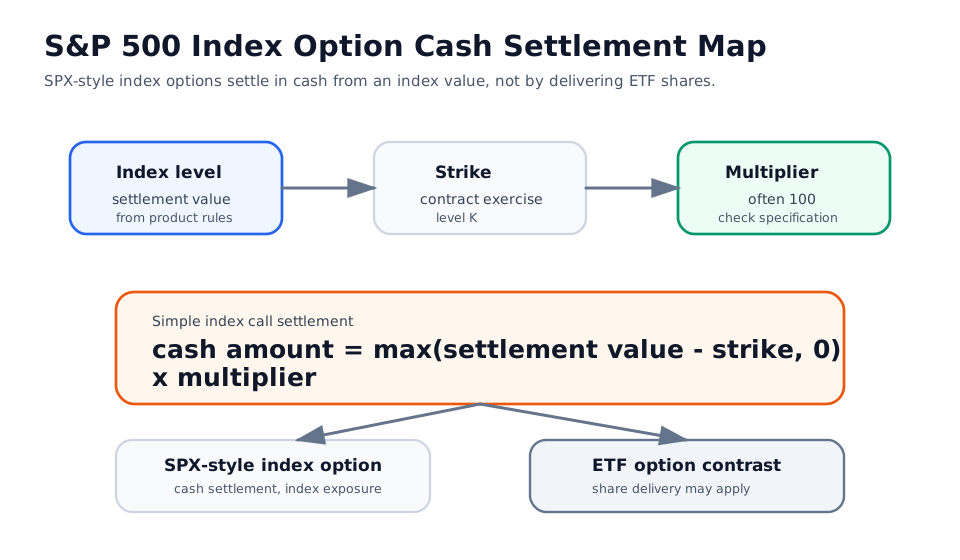
Core Mechanics of Index Options
S&P 500 index options differ from ordinary equity options in several practical ways:
| Feature | Index option | Single-stock option |
|---|---|---|
| Underlying | Index level | Shares of one company |
| Settlement | Usually cash settled for SPX-style products | Usually physical share delivery |
| Exercise style | Often European-style for SPX | Often American-style for U.S. equity options |
| Exposure | Broad U.S. large-cap market | Company-specific risk |
| Assignment result | Cash settlement at expiration | Potential stock delivery or purchase |
These are common patterns, not universal rules. Contract specifications control the exact exercise style, settlement value, expiration cycle, trading hours, and multiplier for every index option.
Cash Settlement
For a simple index call, the expiration settlement amount is based on the difference between the settlement value and strike, multiplied by the contract multiplier:
For SPX options, the commonly used multiplier is 100, but the product specification should always be checked.
SPX vs. SPY Options
S&P 500 index options are not the same as options on an S&P 500 ETF.
| Feature | SPX index options | SPY ETF options |
|---|---|---|
| Underlying | S&P 500 Index level | SPDR S&P 500 ETF shares |
| Settlement | Cash | ETF shares |
| Exercise style | European-style for SPX | American-style |
| Early exercise | Not for European-style SPX | Possible |
| Use case | Institutional broad-market exposure and cash-settled hedges | ETF-linked trading and share-settled strategies |
Both can be liquid. The better instrument depends on account size, tax treatment, margin, settlement preference, and execution needs.
Why It Matters
S&P 500 index options are central to U.S. equity-market risk management. They show up in:
- portfolio hedges using protective puts
- covered or collateralized index option-writing programs
- volatility and variance-related strategies
- intraday and zero-days-to-expiration trading
- institutional overlay programs
- VIX-related market interpretation
The volatility market is closely connected because VIX methodology uses S&P 500 index option prices as inputs.
Public Source Checks
- Cboe’s SPX options product page provides product specifications and describes SPX options as cash-settled, European-style S&P 500 index options.
- The Cboe SPX fact sheet summarizes settlement type, exercise style, notional size, and related S&P 500 option products.
- FINRA’s options overview explains general option approval, exercise, assignment, and option-risk concepts.
- The OCC Options Disclosure Document explains standardized listed-option risks and should be reviewed before trading listed options.
Risk Controls
Before using S&P 500 index options, verify:
- product ticker and contract specification
- AM or PM settlement convention
- expiration date and last trading time
- exercise style and cash-settlement mechanics
- multiplier, notional exposure, and account-level margin
- bid-ask spread, open interest, and execution plan
- whether a position could settle into a large cash debit or credit
Related Terms
- Call Option: The right to benefit from upside above the strike.
- Put Option: The right to benefit from downside below the strike.
- Strike Price: The index level used to determine intrinsic value.
- Expiration Date of Options: The date when rights and settlement are determined.
- Implied Volatility: A major driver of index-option premiums.
- Option Value: The premium behavior that combines intrinsic and extrinsic value.