Registered Holder
A registered holder or stockholder of record is the person or nominee listed on the issuer's official ownership records.
A registered holder, also called a record holder or stockholder of record, is the person or entity whose name appears on an issuer’s official security-holder records for a particular position. The registered holder may be the investor directly, or it may be a broker, bank, securities depository, trustee, or nominee holding the position for one or more beneficial owners.
Record ownership identifies the party recognized in the issuer-level ownership chain. It does not always identify the person who receives the ultimate economic benefits or makes the investment decision.
Key Takeaways
- A registered holder appears on the issuer’s or transfer agent’s records.
- A beneficial owner may own the economic interest while an intermediary appears as registered holder.
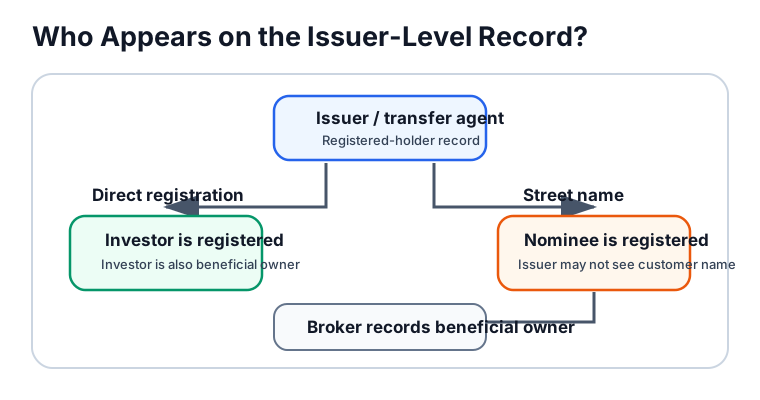
- Direct registration records the investor’s own name; street-name registration normally records an intermediary or nominee.
- Voting instructions, distributions, notices, and corporate actions can pass through several intermediaries.
- Registration method does not determine investment value, safety, liquidity, tax treatment, or suitability.
- Record-date and proof-of-ownership rules depend on the issuer, security, jurisdiction, governing documents, and event.
Registered Holder vs. Beneficial Owner
The distinction is easiest to see by asking two questions:
- Whose name appears on the issuer-level record?
- Who receives the economic benefits and bears the investment risk?
| Holding structure | Name on issuer or transfer-agent record | Investor’s role |
|---|---|---|
| Direct registration | Investor | Registered and beneficial owner |
| Personal certificate, where available | Investor | Registered and beneficial owner, subject to any separate arrangement |
| Street name | Broker, bank, depository nominee, or another intermediary | Beneficial owner shown on intermediary records |
| Trust or custodial arrangement | Trustee, custodian, or nominee may be registered | Beneficial interests depend on governing arrangement |
The exact legal rights can be more complex than this simplified table. Trusts, employee plans, funds, pledged positions, derivatives, and multi-tier custody arrangements can separate title, voting authority, economic exposure, and control in different ways.
Direct Registration and Street Name
Direct registration
Under direct registration, eligible securities are recorded in the investor’s own name on the issuer’s books and held in book-entry form through the issuer’s transfer agent. The investor normally receives a statement rather than a physical certificate.
Direct registration can give the issuer or transfer agent a direct record of the investor. Selling may require moving shares to a broker or using an issuer-sponsored sale facility, depending on the security and available services.
Street-name registration
In a street-name account, the issuer’s records show an intermediary or nominee. The broker maintains a customer account showing the investor as beneficial owner. A central depository may create another layer between the issuer record and the broker.
Street name supports efficient trading and settlement, but communications and instructions may need to move through the intermediary chain. The beneficial owner’s response deadline can therefore be earlier than the issuer’s formal deadline.
Worked Example: One Investor, Two Record Systems
Maya buys 500 shares through a brokerage account.
At the issuer level, the share register may show a securities-depository nominee as registered holder of a large aggregate position. The broker’s books show that 500 of the economically corresponding shares belong to Maya as beneficial owner.
If the company declares a dividend:
- The issuer or paying agent processes the distribution using registered-holder records.
- The depository and broker allocate the amount through their records.
- Maya’s brokerage account receives the distribution attributable to her
500shares.
If the company requests a shareholder vote, voting materials and instructions can travel through the same chain. Maya normally sends instructions through her broker rather than appearing personally on the issuer’s register.
If Maya transfers the shares to direct registration, the broker and transfer system remove the street-name position from her brokerage account, and the transfer agent establishes a registered position in her name. The shares do not exist in both accounts at once.
Why Registered-Holder Status Matters
Voting and corporate communications
The issuer begins with its registered-holder records. Street-name beneficial owners normally receive proxy materials and submit voting instructions through brokers or other intermediaries. The governing law and proxy process determine how those instructions are transmitted and counted.
Dividends and other distributions
Cash, shares, rights, or other property may first be allocated to registered holders and then distributed through the custody chain. Account restrictions, tax documentation, sanctions screening, and local market procedures can affect processing.
Tender offers, exchanges, and reorganizations
Registered holders and intermediaries receive event terms and deadlines. Beneficial owners may need to instruct their broker before the stated expiration so the intermediary can complete processing.
Proof of ownership
An issuer or transfer agent can generally verify a directly registered position from its own records. A beneficial owner may instead need a broker statement, confirmation, or specific proof from an eligible record holder, depending on the purpose.
Transfers, estates, and gifts
Directly registered positions are changed through the transfer agent’s procedures. Street-name positions are normally handled through the broker. Estate, trust, divorce, court-order, lien, and gift transfers can require additional legal and tax documentation.
Record Date Is Not Settlement Date
A record date identifies the holders relevant to a specified corporate event under the applicable rules and issuer action. It should not be confused automatically with:
- trade date
- settlement date
- ex-dividend date
- meeting date
- payment date
Market infrastructure may use those dates together to determine which beneficial owner receives a distribution or voting entitlement. Investors should verify the event notice and intermediary deadline rather than relying on a single date in isolation.
How to Verify a Holding
The correct source depends on registration method:
| Question | Typical starting point |
|---|---|
| Is the position directly registered? | Issuer’s current transfer agent |
| Is it held in street name? | Brokerage or custody statement |
| Who is the current transfer agent? | Issuer investor-relations site or current regulatory filing |
| Does a restriction or stop-transfer order apply? | Transfer agent, broker, issuer, and governing documents |
| Which deadline applies to a corporate action? | Official event materials plus intermediary instructions |
| How is voting authority exercised? | Proxy materials, broker instructions, and applicable rules |
An account screenshot alone may be insufficient for a legal, tax, estate, or shareholder-proposal requirement. The receiving party’s evidence standard should be checked before documents are submitted.
Common Mistakes and Risks
Assuming the issuer knows every street-name investor. The issuer-level register may show only a depository or nominee for an aggregated position.
Treating registered holder and beneficial owner as universal synonyms. They coincide in direct registration but can differ in nominee arrangements.
Missing intermediary deadlines. A broker may need instructions before the issuer’s published deadline.
Believing direct registration eliminates issuer risk. Registration method changes recordkeeping and custody structure, not the issuer’s business or credit risk.
Assuming direct registration guarantees immediate trading. Moving a position or submitting a sale request can involve eligibility rules, processing time, fees, and limited order choices.
Sending sensitive originals without verified instructions. Stock powers, certificates, estate documents, and identity records should be sent only through confirmed procedures.
Official Source Checks
- Investor.gov: Holding Your Securities compares physical certificates, street-name registration, and direct registration.
- SEC: Street Name explains that an intermediary appears as holder while the broker records the customer as beneficial owner.
- SEC: Transfer Agents explains the ownership-record, certificate, transfer, and distribution functions of transfer agents.
These sources describe U.S. market structures. Other jurisdictions use different terminology, depositories, corporate-law rules, and ownership systems.
Related Terms
- Beneficial Ownership: Economic ownership or control that can exist without direct registration.
- Street Name: Registration in an intermediary’s or nominee’s name for a beneficial owner.
- Share Register: The issuer-level ownership record that lists registered holders.
- Direct Registration System (DRS): Book-entry registration directly in an investor’s name for eligible securities.
- Stock Transfer Agent: The issuer-appointed party that maintains registered-holder records and processes eligible transfers.
- Record Date: A date used to identify holders relevant to a specified corporate action.
- Proxy Voting: The process by which voting authority or instructions are exercised without attending in person.
FAQs
Is a registered holder always the beneficial owner?
This article is educational and does not provide legal, tax, estate, compliance, or investment advice. Confirm the governing documents and current procedures for a specific security.