Bond Equivalent Yield
Bond equivalent yield places a short-term discount return or periodic bond yield on a stated annual bond-style quotation basis for comparison.
Bond equivalent yield (BEY) is an annual yield quotation convention used to put a short-term discount return or periodic bond yield on a bond-style basis. In U.S. Treasury bill usage, it is commonly the price-based coupon-equivalent or investment yield used to compare a bill with coupon securities. In coupon-bond usage, it can mean a nominal annual yield based on two semiannual periods.
The phrase is convention-sensitive. A BEY is not automatically an effective annual yield, bank discount rate, current yield, or realized one-year return.
Key Takeaways
- BEY is a quotation conversion, not an additional source of return.
- For a short U.S. Treasury bill, the coupon-equivalent or investment yield uses purchase price rather than face value and a 365- or 366-day year.
- The common simple bill formula applies to bills with no more than one half-year to maturity; longer bills use a semiannual-equivalent calculation.
- A coupon-bond BEY commonly equals twice the six-month periodic yield.
- BEY does not include intra-year compounding, so it differs from effective annual yield.
- A short-term annualized number does not guarantee the investor can reinvest at that rate for a full year.
- Instrument, market, day count, settlement date, and source methodology must be identified before comparing quotes.
Why the Convention Exists
Treasury bills and many money-market instruments do not pay periodic coupons. The investor pays less than face value and receives face value at maturity. Bills are often quoted on a bank discount basis that uses face value and a 360-day year.
Coupon bonds, by contrast, are commonly quoted using price-based yields with semiannual bond conventions. BEY adjusts the short-term discount return toward a bond-style basis so the two quotations can be compared more meaningfully.
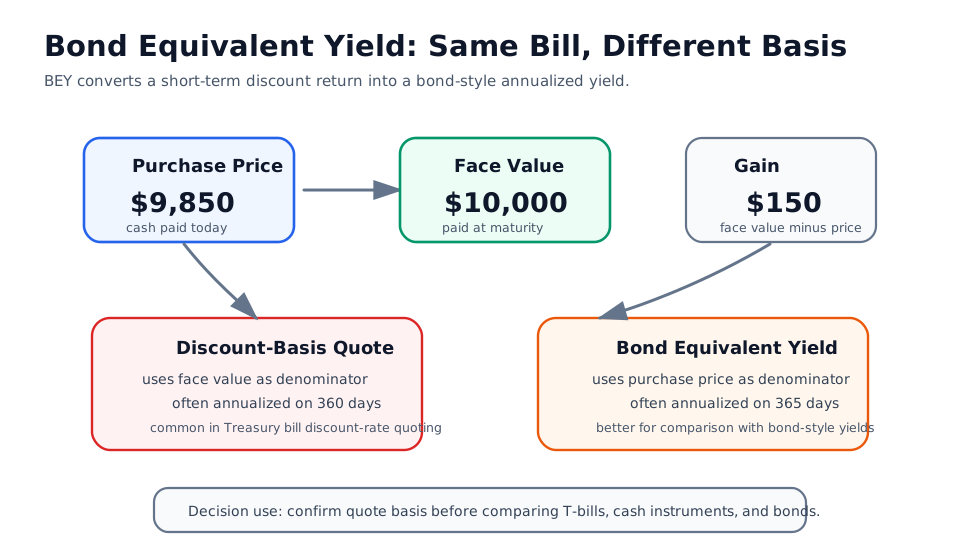
The conversion does not make the instruments economically identical. Credit, liquidity, taxes, maturity, reinvestment, settlement, and transaction costs still differ.
Short Treasury Bill Formula
For a U.S. Treasury bill with no more than one half-year to maturity, a common coupon-equivalent or investment-yield formula is:
where:
Fis face value paid at maturity;Pis purchase price;Dis the actual number of days to maturity; andYis 365, or 366 when the applicable annual basis includes a leap day.
The first fraction is the holding-period return on price. The second annualizes it without compounding.
Worked Bill Example
Assume a bill has:
$10,000face value;- a
$9,850purchase price; - 120 days to maturity; and
- a 365-day annual basis.
Holding-period yield
Bond equivalent or investment yield
Bank discount rate
The bank discount rate uses face value and a 360-day year:
Effective annual yield
If the 120-day return could be compounded repeatedly at the same rate, the mathematical effective annual yield would be:
The same bill therefore displays different percentages under four valid questions:
| Measure | Result | Main basis |
|---|---|---|
| 120-day holding-period yield | 1.5228% | Price-based return for the actual term |
| Bank discount rate | 4.50% | Face-value discount, 360-day annualization |
| BEY or investment yield | 4.632% | Price-based simple annualization, 365-day basis |
| Effective annual yield | 4.704% | Hypothetical compounding at the same short-term rate |
The larger annualized number does not mean the investor earns that percentage during 120 days. The actual term return in the example is 1.5228% before costs and taxes.
Bills Longer Than One Half-Year
The simple price-return formula is not the full U.S. Treasury coupon-equivalent calculation for a bill with more than one half-year to maturity. Treasury uses a formula that places the return on a semiannual-equivalent basis:
where P is price per 100, D is days to maturity, Y is days in the year, and i is the coupon-equivalent yield to solve for.
The distinction matters for 52-week bills and other maturities beyond one half-year. Use the auction result, official formula, or a validated market system rather than extending the short-bill approximation mechanically.
Semiannual Bond Quotation
For a coupon bond with a six-month periodic yield r_6m, the nominal annual bond-equivalent yield is commonly:
The corresponding effective annual yield is:
For example, a 5.00% BEY implies a 2.50% six-month periodic rate and:
BEY is 5.00%, while EAY is 5.0625%. The difference is the assumed compounding of the first half-year’s return during the second half of the year.
Constant Maturity Treasury Rates
The U.S. Treasury describes its Constant Maturity Treasury rates as bond-equivalent yields for securities that pay semiannual interest. The rates are simple annualized quotations, not effective annual percentage yields.
A CMT is also a modeled par-curve point rather than the yield on a particular bill, note, or bond. “Bond equivalent” describes the quotation basis; “constant maturity” describes the modeled curve maturity.
BEY Compared With Nearby Measures
| Measure | Denominator or calculation | Annual basis | Compounding | Typical use |
|---|---|---|---|---|
| Bank discount rate | Discount / face value | 360 days | None | Treasury bill and money-market quotation |
| Bill BEY or investment yield | Discount / purchase price | 365 or 366 days | Simple for short-bill formula | Bill-to-coupon comparison |
| Coupon-bond BEY | Twice six-month periodic yield | Two semiannual periods | Not included in quoted nominal rate | U.S. bond-market quotation |
| Effective annual yield | Growth over a full year | One year | Included | Comparing annual compounding outcomes |
| Current Yield | Annual coupon / current price | Annual coupon | None | Coupon-income snapshot |
| Yield to Maturity | Price and all maturity cash flows | Instrument convention | Convention-specific | Full cash-flow yield comparison |
Rates should be converted to the same basis before ranking alternatives. Matching percentage labels without matching conventions creates false differences.
When BEY Is Useful
- Comparing a Treasury bill with a short coupon-bearing Treasury security.
- Translating a discount quote into a price-based annualized return.
- Normalizing short-term instruments displayed on mixed broker screens.
- Interpreting official Treasury bill coupon-equivalent or investment-yield data.
- Converting between nominal semiannual yield and effective annual yield.
- Checking whether two data vendors are reporting different conventions rather than different market prices.
Limits and Risks
Reinvestment is not assured
Annualizing a 30-, 90-, or 120-day return assumes a scale-up of a short observation. The investor may not be able to reinvest maturity proceeds at the same rate.
Credit and liquidity remain
Putting two yields on the same basis does not equalize default probability, bid-ask spreads, collateral value, market depth, or settlement risk.
Taxes and costs are omitted
Quoted BEY generally excludes transaction fees, financing, custody, and investor-specific taxes. Those can change the economic ranking.
Market conventions differ
Commercial paper, certificates of deposit, municipal notes, and non-U.S. instruments can use different day counts and yield definitions. Do not apply the U.S. Treasury bill formula solely because the security is short term.
Negative or unusual prices need validated formulas
System formulas, rounding, leap-year treatment, and negative-rate handling can differ. Reconcile the result to governing instrument and market documentation.
How To Verify a BEY Quote
- Identify the security, market, settlement date, maturity date, price, and face value.
- Confirm whether the label means bill investment yield, coupon-equivalent yield, or nominal semiannual bond yield.
- Count actual days and determine whether 365 or 366 applies.
- Determine whether the maturity is no more than one half-year.
- Recalculate the holding-period return and the quoted annualization.
- Compare with bank discount rate and EAY only after converting them to defined bases.
- Check price rounding, fees, tax treatment, credit, liquidity, and reinvestment assumptions.
- Use the official auction or market-system convention for an actual trade or report.
Common Mistakes
- Calling the bank discount rate BEY.
- Using face value rather than purchase price in the simple BEY numerator ratio.
- Applying a 360-day basis to a U.S. Treasury bill investment yield.
- Applying the short-bill formula to a bill longer than one half-year.
- Treating BEY as an effective annual yield.
- Assuming the annualized quote is the return earned during the instrument’s actual short term.
- Ignoring 366-day leap-year treatment where applicable.
- Comparing BEY with another yield without matching compounding and cash-flow assumptions.
- Assuming a convention conversion removes credit, liquidity, tax, or reinvestment differences.
Authoritative Sources
- TreasuryDirect publication on investing directly with the Treasury distinguishes bill discount rate from the price-based investment rate or equivalent coupon yield.
- U.S. Treasury bill calculation examples provide official coupon-equivalent formulas for bills up to and beyond one half-year.
- U.S. Treasury daily rate notes explain bank discount and coupon-equivalent Treasury bill quotations.
- U.S. Treasury interest-rate FAQ explains the semiannual bond-equivalent basis of CMT rates and conversion to effective annual yield.
- TreasuryDirect marketable-securities glossary defines investment yield as an annualized simple rate based on a 365- or 366-day year without compounding.
This article provides general financial education, not individualized investment, tax, legal, or accounting advice. Use the official convention and transaction record for an actual security.
Related Terms
- Bond Yield: Broader family of current, redemption, spread, and quotation-based yield measures.
- Treasury Bill: Discount security for which coupon-equivalent or investment yield is commonly reported.
- Current Yield: Coupon-income ratio that answers a different question from BEY.
- Yield to Maturity: Cash-flow yield for a bond held through final maturity under stated assumptions.
- Effective Yield: Annual return measure that incorporates compounding under its stated convention.