Bond
A bond is a debt security in which an issuer borrows from investors and promises interest, principal repayment, or both under stated terms.
A bond is a debt security. When an investor buys a bond, the investor lends money to a bond issuer such as a government, municipality, corporation, or public authority. The issuer promises to make interest payments, repay principal, or both under the bond terms.
A bond is not the same as a stock. A stock represents ownership. A bond represents a creditor claim that depends on the issuer’s ability and legal obligation to pay.
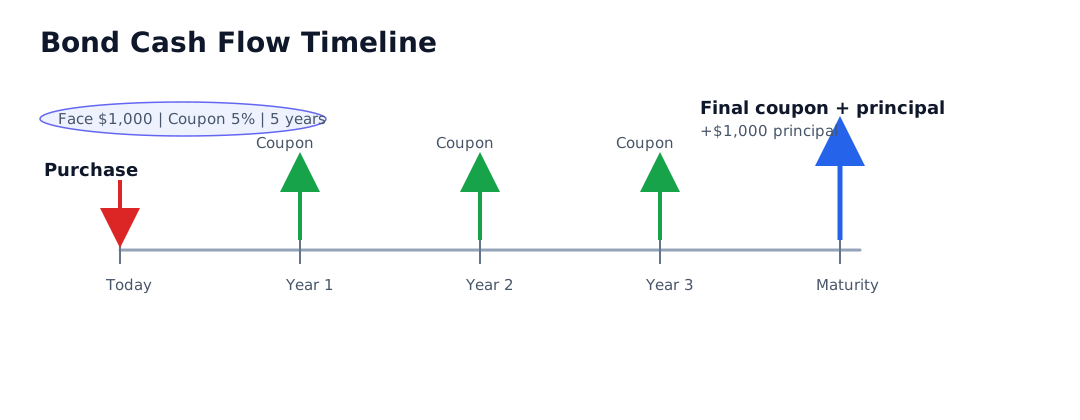
A plain-vanilla bond is a timeline of cash flows: purchase now, coupons during the life of the bond, and principal back at maturity.
Key Takeaways
- Bonds are debt instruments, not ownership interests.
- The main terms are issuer, face value, coupon rate, maturity date, price, and yield.
- Bond prices and yields usually move in opposite directions.
- Scheduled payments are not guarantees; credit risk, interest-rate risk, liquidity risk, call risk, and inflation risk still matter.
- This page is educational and does not recommend any bond, strategy, or holding period.
Core Parts Of A Bond
| Part | Plain-English meaning | Why it matters |
|---|---|---|
| Issuer | Borrower that sells the bond | Determines credit exposure and disclosure record. |
| Face value | Contractual principal reference amount | Used for coupon calculations and maturity repayment. |
| Coupon rate | Stated annual interest rate on face value | Determines scheduled interest payments. |
| Maturity date | Date principal is due, unless repaid earlier | Drives duration, reinvestment risk, and repayment timing. |
| Market price | What investors pay today | Can be above, below, or near face value. |
| Yield | Return measure based on price, coupon, and timing | Lets investors compare bonds with different prices and coupons. |
Basic Bond Pricing
A simple fixed-rate bond is valued as the present value of remaining coupon payments plus the face value due at maturity:
Where:
- \(P\) = bond price
- \(C\) = coupon payment
- \(r\) = market yield or discount rate
- \(F\) = face value
- \(n\) = number of remaining periods
The formula is a teaching simplification. Real bonds may include call features, sinking funds, taxes, accrued interest, odd coupon dates, liquidity discounts, and default risk.
Worked Example: Price, Coupon, And Yield
Assume a simplified bond has:
- $1,000 face value
- five years remaining
- a 4% annual coupon, paid once a year
- a 5% market yield for comparable risk
The annual coupon is $1,000 x 4% = $40. Discount the five $40 coupons and the $1,000 maturity payment at 5%:
The bond trades below par because its 4% coupon is lower than the 5% yield investors require. Its simple current yield is:
$40 / $956.71 = 4.18%
That 4.18% is not the 5% yield to maturity. The yield to maturity also reflects the assumed $43.29 gain from the $956.71 purchase price to $1,000 at maturity and the timing of every cash flow. The calculation assumes scheduled payments are made. Actually realizing the same compound return also depends on reinvesting coupons at the calculated yield.
Real market calculations commonly use semiannual coupons, accrued interest, day-count conventions, settlement dates, and clean versus dirty prices. Callable bonds also require yield-to-call and yield-to-worst review.
Price, Yield, Premium, And Discount
If market yields rise, an older bond with a lower coupon becomes less attractive, so its price generally falls. If market yields fall, an older bond with a higher coupon becomes more attractive, so its price generally rises.
| Price position | What it means | Common reason |
|---|---|---|
| At par | Price is near face value | Coupon is close to current market yield. |
| Premium | Price is above face value | Coupon is higher than comparable market yields, or terms are attractive. |
| Discount | Price is below face value | Coupon is lower than market yields, credit risk has risen, or liquidity is weak. |
Common Bond Types
- Corporate Bond: Company debt.
- Municipal Bond: State, local, or public-authority debt.
- Treasury Bond: Long-term U.S. Treasury marketable security.
- Zero-Coupon Bond: Bond sold at a discount and paid at maturity without regular coupons.
- Callable Bond: Bond the issuer may redeem before maturity under stated terms.
How To Evaluate A Bond
- Identify the obligor. Confirm the legal issuer, guarantor, and source of repayment.
- Map the cash flows. Check face value, coupon type, payment frequency, maturity, amortization, and embedded options.
- Read the documents. Use the final prospectus, official statement, pricing supplement, and bond indenture for the exact security.
- Use the right yield. Compare yield to maturity, yield to call, and yield to worst where relevant rather than coupon alone.
- Test the downside. Review default, downgrade, rate, inflation, liquidity, call, currency, and tax risks.
- Check market evidence. Match the CUSIP or other identifier to recent trade data, quote size, accrued interest, and transaction costs.
Common Mistakes
- Confusing coupon rate with total return.
- Assuming a bond is safe because it has a maturity date.
- Ignoring duration and interest-rate sensitivity.
- Comparing yields without checking credit quality, call features, tax treatment, and liquidity.
- Treating an individual bond and a bond fund as if they have the same maturity behavior.
Public Source Checks
Investor.gov’s bond overview is useful for beginner bond mechanics and risks. FINRA’s bond due-diligence guidance highlights price, yield, liquidity, and trade checks. TreasuryDirect marketable securities explains U.S. Treasury bills, notes, bonds, TIPS, and FRNs.
Related Terms
- Bond Yield: Return measure affected by price, coupon, maturity, and risk.
- Yield to Maturity: Estimated return if a bond is held to maturity under stated assumptions.
- Credit Spread: Extra yield investors demand for credit risk.
- Bond Indenture: Contract defining payment terms, covenants, defaults, and remedies.
- Duration: Approximation of price sensitivity to yield changes.
- Yield to Worst: Lowest modeled yield across applicable redemption outcomes.