BCG Growth-Share Matrix
The BCG growth-share matrix classifies businesses by market growth and relative share to frame capital-allocation choices and portfolio trade-offs.
The BCG growth-share matrix, also called the Boston Matrix or BCG Matrix, is a corporate portfolio framework that classifies business units or products using two dimensions: market growth and relative market share. Its four labels - question marks, stars, cash cows, and pets or dogs - help frame where a company might invest, maintain, harvest, reposition, or divest. The matrix is a screening tool, not a valuation model or an automatic capital-allocation rule.
Key Takeaways
- Market growth is used as a proxy for market attractiveness and investment need.
- Relative market share is used as a proxy for competitive position, scale, and potential cash generation.
- A question mark has high growth and low share; a cash cow has low growth and high share.
- A star can consume cash despite a strong position because rapid growth requires reinvestment.
- A pet or dog can still create value through cash flow, intellectual property, customer relationships, or strategic fit.
- Analysts should validate every quadrant with margins, returns on capital, free cash flow, competitive evidence, valuation, and execution risk.
The Four Quadrants
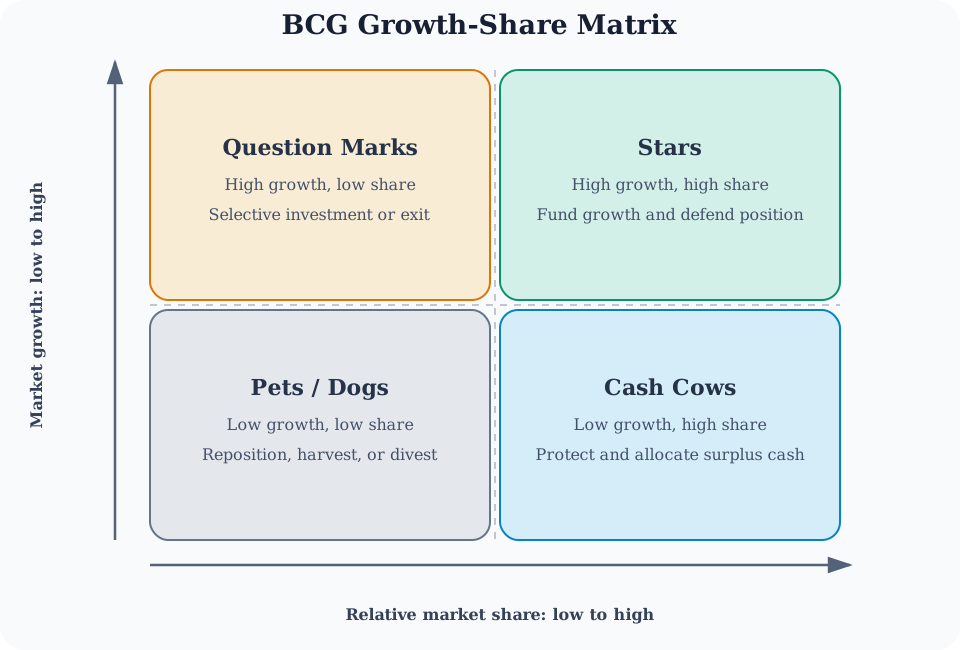
The diagram uses a conventional low-to-high scale from left to right for relative market share. Some presentations reverse the horizontal axis, so readers should check the labels rather than infer a quadrant from position alone.
| Quadrant | Growth | Relative share | Typical financial hypothesis | Decision questions |
|---|---|---|---|---|
| Question mark | High | Low | Needs investment but has an uncertain path to leadership and positive cash flow | Can share be gained economically? What milestones limit further funding? |
| Star | High | High | Strong position with substantial reinvestment needs; may or may not generate surplus cash | Does growth earn more than the cost of capital? Can the position be defended? |
| Cash cow | Low | High | Mature position that may produce cash beyond its reinvestment needs | Is cash generation durable? How much maintenance investment is required? |
| Pet or dog | Low | Low | Weak position with limited growth, but economics and strategic fit vary | Can it earn acceptable returns, support another unit, be repositioned, or be exited? |
These are hypotheses, not conclusions. High share does not prove high margins, and high growth does not prove value creation.
Measuring the Axes
Relative Market Share
A common calculation compares the business unit’s market share with that of the largest competitor:
A result above 1.0 indicates that the unit is larger than the selected competitor under this convention. Other implementations use a different competitor rank or benchmark. The denominator, geographic market, customer segment, product boundary, and measurement period must therefore be documented.
Market Growth
A simple market-growth calculation is:
Market size can be measured in revenue, units, users, capacity, or another economically relevant measure. Inflation, acquisitions, currency translation, and category redefinition can create apparent growth without a comparable increase in real demand.
There is no universal cutoff between high and low. A defensible matrix states the threshold, source, period, and reason it fits the decision.
Cash Cows and Question Marks
Cash Cow
A cash cow is a high-relative-share business in a slower-growth market. In the original portfolio logic, its established position and lower growth investment need allow it to supply cash for other units. That outcome is not guaranteed. A mature business may still require large maintenance capital expenditures, working capital, regulatory investment, customer acquisition, or restructuring.
Before treating a unit as a funding source, compare operating cash flow with maintenance capital expenditure, lease and debt obligations, taxes, pension funding, and the investment needed to protect revenue. Revenue alone does not make a cash cow.
Question Mark
A question mark is a low-relative-share business in a high-growth market. It may need substantial investment to build distribution, capacity, product quality, customer adoption, or scale. The central question is whether additional capital can create a defensible position before the market matures.
Management should not choose between “invest” and “divest” from the label alone. A staged plan can tie funding to evidence such as retention, unit economics, share gains, margin progression, regulatory approval, or capacity utilization. If milestones fail, management can reduce, partner, sell, or stop the initiative before committing the full budget.
Worked Example: Classifying Four Business Units
Assume a diversified company uses 10% annual market growth as its high-growth threshold and relative market share of 1.0 as its high-share threshold.
| Unit | Market growth | Unit share | Largest competitor | Relative share | Initial classification |
|---|---|---|---|---|---|
| Core Payments | 4% | 30% | 20% | 1.50 | Cash cow |
| Cloud Security | 18% | 24% | 20% | 1.20 | Star |
| AI Workflow | 25% | 8% | 32% | 0.25 | Question mark |
| Legacy Hardware | -2% | 5% | 35% | 0.14 | Pet or dog |
For AI Workflow:
Its 25% market growth places it above the growth threshold, while 0.25 relative share places it below the share threshold. The matrix therefore labels it a question mark.
That label does not answer whether the company should invest. Suppose the unit requires $40 million over two years. Management would still need forecasts for customer acquisition, contribution margin, retention, capacity, competitive response, downside loss, and terminal value. It should compare the program’s risk-adjusted value with debt reduction, dividends, repurchases, acquisitions, and investment in the other units.
Legacy Hardware should not be sold merely because it appears in the lower-left quadrant. It may share customers, service contracts, intellectual property, or manufacturing capacity with stronger units. The matrix surfaces the review; transaction economics determine the action.
Using the Matrix for Capital Allocation
- Define the portfolio unit. Use a business, product, geography, or customer segment with decision-relevant financial information.
- Define the market consistently. Set product boundaries, geography, customer class, currency, and period before calculating share or growth.
- Source the data. Reconcile internal sales with industry data and disclose estimates where competitor information is incomplete.
- Plot the units. State the high-low thresholds and consider sizing each point by revenue, invested capital, or another transparent measure.
- Add finance evidence. Review free cash flow, return on invested capital, margin, reinvestment, leverage, and valuation.
- Identify strategic options. Compare investment, maintenance, partnership, harvest, repositioning, and divestiture.
- Set milestones and review dates. Markets and competitive positions change, so a quadrant should not become a permanent identity.
BCG’s official growth-share matrix history describes the framework as a way to prioritize businesses using competitive position and market attractiveness, with relative share and growth as the underlying drivers. BCG’s original Product Portfolio essay explains the cash-generation and reinvestment logic behind the quadrants.
Common Mistakes and Limitations
- Confusing a corporate portfolio of operating businesses with an investor’s securities portfolio.
- Calling a product a cash cow because it has high revenue without measuring market share, growth, cash flow, and reinvestment.
- Assuming every question mark can become a star if management spends enough.
- Assuming every star creates value despite poor margins or returns below the cost of capital.
- Divesting every pet or dog without measuring standalone cash flow, shared costs, tax effects, buyer value, and strategic dependencies.
- Defining the market so narrowly that the unit appears to be a leader by construction.
- Using nominal market growth without adjusting for inflation, currency, acquisitions, or category changes.
- Treating relative market share as a complete measure of competitive advantage.
- Ignoring valuation: a strategically strong unit can still be a poor acquisition at an excessive price.
The framework compresses complex competitive and financial conditions into two variables. It is most useful as a portfolio discussion tool combined with capital allocation, scenario analysis, and valuation.
Related Terms
- Capital Allocation compares reinvestment, acquisitions, debt reduction, distributions, and liquidity needs.
- Return on Invested Capital tests whether a unit’s operating returns justify the capital committed.
- Fundamental Analysis adds company, industry, financial-statement, and valuation evidence.
- GE McKinsey Matrix uses broader measures of industry attractiveness and competitive strength.
- Divestiture is one possible transaction outcome, not an automatic response to a quadrant label.
FAQs
What is a cash cow in the BCG Matrix?
What is a question mark in the BCG Matrix?
Does the BCG Matrix tell a company what to buy or sell?
This article is for financial education only. It does not provide investment, valuation, transaction, management, or strategic advice for a particular company or security.