Stock Float
Stock float is the number of company shares considered available for public trading. Learn the formula, exclusions, uses, and public-float distinctions.
Stock float, also called floating stock or free float, is the number of a company’s outstanding shares considered available for public trading. It excludes shares that are restricted or treated as strategic, controlling, or otherwise unavailable under the methodology being used.
Key Takeaways
- Stock float is a share count; market capitalization and regulatory public float are dollar values.
- Float is smaller than or equal to outstanding shares.
- There is no single universal exclusion list. Index providers, exchanges, regulators, and data vendors can calculate float differently.
- A small float may contribute to limited trading capacity, but float alone does not determine liquidity or volatility.
- Lockup expirations, insider sales, issuances, repurchases, and ownership changes can alter float.
Stock Float Formula
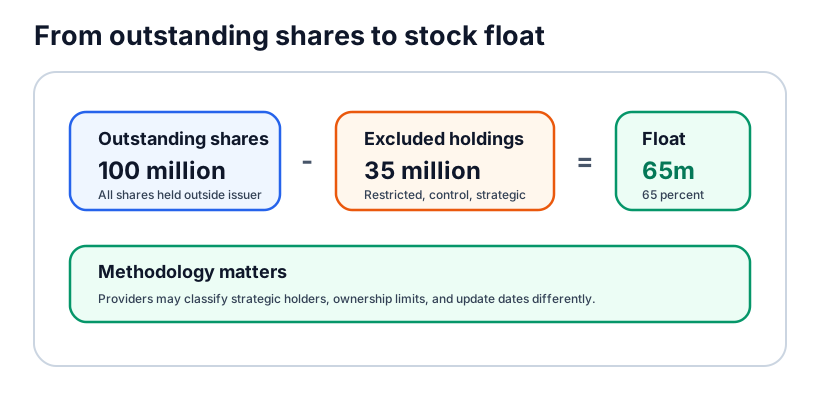
A simplified calculation is:
The excluded amount can include restricted shares and specified holdings of founders, officers, directors, governments, parent companies, or strategic owners. The exact treatment depends on the source’s rules.
Worked Example
Assume a company has 100 million shares outstanding. A data provider excludes:
20 millionshares held by founders as a controlling position10 millionrestricted shares subject to a lockup5 millionshares held by a strategic corporate owner
Under that methodology:
The float percentage is:
Another provider could report a different number if it classifies one of those holdings differently or updates ownership data on another schedule.
What Is Commonly Excluded?
Float methodologies often review:
- shares subject to legal, contractual, or lockup restrictions
- controlling or strategic holdings
- cross-ownership by another company
- holdings of founders, officers, or directors
- government holdings not expected to trade
- employee or trust holdings subject to disposal limits
- foreign ownership restrictions
Not every insider-held share is automatically untradeable, and not every large holding is permanently strategic. This is why an analyst should use the published methodology rather than subtracting every disclosed insider position mechanically.
S&P Dow Jones Indices’ Float Adjustment Methodology calculates an investable weight factor from available float shares divided by total shares outstanding and specifies how strategic holders and market-specific restrictions are treated. Other providers can apply different ownership thresholds, bands, or review schedules.
Stock Float vs. Related Share Measures
| Measure | Unit | What it represents |
|---|---|---|
| Authorized shares | Shares | Maximum shares the company is permitted to issue under its governing documents |
| Issued shares | Shares | Shares the company has issued, including any later held as treasury shares |
| Outstanding shares | Shares | Issued shares currently held outside the company |
| Stock float | Shares | Outstanding shares treated as available to public investors under a stated method |
| Float percentage | Percentage | Float shares divided by outstanding shares |
| Float-adjusted market cap | Currency | Share price multiplied by float shares |
| SEC public float | Currency | Market value of common equity held by non-affiliates under the applicable SEC rule |
The last distinction is important. The SEC’s small-business glossary defines public float as the value of voting and non-voting common equity held by non-affiliates. In market-data discussions, “stock float” often means a number of shares. Similar language therefore can refer to different measurements.
Why Stock Float Matters
Stock float can affect several practical questions:
- Trading capacity: A portfolio manager needs to estimate how much stock can trade without excessive market impact.
- Index eligibility and weight: Many equity indexes exclude strategic holdings before calculating constituent weights.
- Ownership concentration: A low float can reveal that much of the company remains controlled by a small group.
- Capital raising: New public issuance can expand float, while private placements to strategic holders may not.
- Short selling and borrowing: Available lendable supply depends on more than float, but float is part of the security’s ownership context.
The Nasdaq float glossary uses the common equity-market meaning: outstanding shares available for public trading after specified insider or restricted holdings are excluded.
Float Is Not the Same as Liquidity
Float is one input to liquidity analysis, not a direct measurement of liquidity.
A stock with a large float can still trade poorly if investor interest is low, ownership is passive and concentrated, or market makers quote little depth. A stock with a smaller float may trade actively if turnover is high and order-book depth is strong.
Evaluate float alongside:
- average daily share and dollar volume
- bid-ask spread
- quoted and executable depth
- turnover as a percentage of float
- concentration among major holders
- securities-lending availability
- trading halts and venue coverage
Likewise, a small float does not guarantee high volatility. News, leverage, valuation, market structure, investor positioning, and available liquidity also affect price behavior.
How Stock Float Changes
Float can rise when:
- restricted shares become freely tradeable after a lockup
- founders or strategic holders distribute shares to public investors
- the company completes a broadly marketed public offering
- a controlling owner reduces its stake
Float can fall when:
- the company repurchases publicly held shares
- a strategic investor accumulates a controlling block
- shares become subject to new restrictions
- an acquisition removes shares from public ownership
A stock split increases the number of float shares proportionately but does not change the float percentage or economic value solely because of the split.
How to Verify Stock Float
Before using a float figure:
- Identify the source and methodology. Do not assume every provider applies the same exclusions.
- Confirm the share class. Multiple classes can have different prices, rights, restrictions, and public availability.
- Reconcile outstanding shares. Use the issuer’s latest filing and material subsequent corporate actions.
- Review ownership disclosures. Check insider, affiliate, government, parent-company, and strategic holdings.
- Check the effective date. Float data may lag lockup expirations, offerings, repurchases, or ownership changes.
- Separate shares from value. Confirm whether the source reports float shares, float percentage, or public-float market value.
Common Mistakes and Limitations
- Using one universal formula: Restricted shares are not the only possible exclusion, and provider rules differ.
- Equating insiders with non-float automatically: Classification depends on control, restrictions, methodology, and current ownership.
- Treating float as daily trading volume: Float is an available share base; volume is actual turnover during a period.
- Assuming high float guarantees liquidity: Spread, depth, turnover, and ownership concentration still matter.
- Using stale ownership data: Float can change without the total outstanding share count changing.
- Confusing stock float with banking float or currency regimes: The same word has unrelated meanings elsewhere in finance.
Related Terms
- Outstanding Shares: The broader share count from which float exclusions are made.
- Restricted Stock: Shares subject to conditions that can limit transfer or sale.
- Treasury Stock: Reacquired shares held by the company and excluded from shares outstanding.
- Float-Adjusted Market Capitalization: The market value calculated from float shares.
- Liquidity: The ability to transact without excessive cost or price impact.
FAQs
Are stock float, floating stock, and free float the same?
Does low float mean a stock will rise?
This article is educational and does not provide investment, securities, legal, accounting, or trading advice. Float classifications and market conditions can change; verify current issuer disclosures and the relevant methodology.