Coupon Yield
Coupon yield measures a bond's annual coupon interest as a percentage of face value, distinct from current yield or yield to maturity.
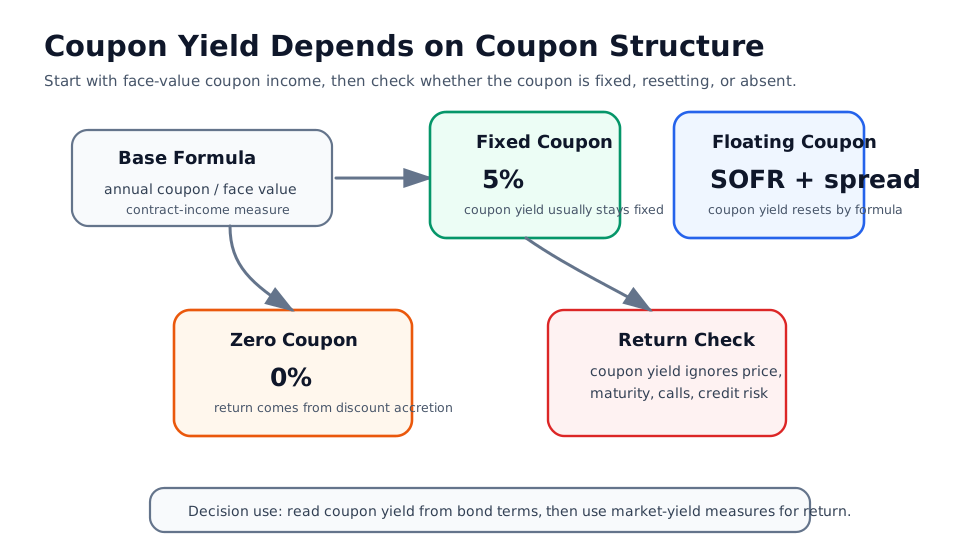
Coupon yield measures annual coupon interest as a percentage of a bond’s face value. For a plain fixed-rate bond, coupon yield is usually the same as the bond’s coupon rate or nominal yield.
Coupon yield tells you the contractual income rate stated on the bond. It does not tell you the investor’s total return, because it ignores the market price paid, maturity value, call risk, reinvestment, credit risk, taxes, and inflation.
Formula
For a bond with $1,000 face value and $50 of annual coupon payments:
Why It Matters
Coupon yield matters because it identifies the stated cash income produced by the bond’s coupon terms. It helps analysts separate coupon income from market return.
That distinction matters because two bonds can have the same coupon yield but very different investment outcomes:
- one may trade at a premium while another trades at a discount
- one may be callable while another is noncallable
- one may have weak credit quality or poor liquidity
- one may have floating-rate coupons that reset over time
- one may pay no coupon at all and rely on discount accretion
Coupon yield is useful, but it is only one part of fixed-income return analysis.
Coupon Structure Cases
| Structure | How coupon yield behaves | What to check |
|---|---|---|
| Fixed-rate bond | Coupon yield is set in the bond terms and usually stays constant | Face value, coupon rate, payment frequency, maturity, call terms |
| Floating-rate bond | Coupon yield resets with a benchmark or formula | Reference rate, spread, reset dates, caps, floors, fallback language |
| Step-up or deferred coupon | Coupon yield changes by schedule or payment terms | Step dates, deferral rights, payment-in-kind terms, issuer option |
| Zero Coupon Bond | Coupon yield is zero because there are no periodic coupons | Issue discount, accretion, tax treatment, maturity value |
Do not force every bond into a fixed-coupon formula. The coupon structure determines whether a simple coupon-yield reading is useful.
Coupon Yield vs. Other Yield Measures
| Measure | Denominator or basis | Main question | Main limitation |
|---|---|---|---|
| Coupon yield | Face value | What coupon income rate is stated in the bond terms? | Ignores market price |
| Current Yield | Current market price | How much coupon income is bought at today’s price? | Ignores maturity value and calls |
| Yield to Maturity | Modeled price and cash flows | What return is implied if held to maturity? | Assumes cash flows arrive as modeled |
| Yield to Worst | Lowest relevant redemption-yield scenario | What is the conservative redemption yield? | Still convention- and scenario-dependent |
If the bond trades at par and has no special features, coupon yield, current yield, and YTM may be close. Once price, call risk, or maturity assumptions matter, coupon yield is not enough.
Practical Example
Suppose a bond has:
- face value:
$1,000 - coupon rate:
5% - annual coupon payment:
$50
Its coupon yield is 5%. If the bond trades at $950, coupon yield remains 5%, but current yield rises because the investor buys the $50 coupon at a lower price. If the bond trades at $1,050, coupon yield still remains 5%, but current yield falls.
The coupon yield describes the bond’s coupon terms. The investor’s return depends on purchase price, holding period, redemption value, credit risk, and reinvestment.
What To Verify
Before relying on coupon yield, verify:
- face value or par value
- annual coupon amount and coupon rate
- coupon frequency and day-count convention
- whether the coupon is fixed, floating, step-up, deferred, or payment-in-kind
- call terms, put rights, sinking fund, amortization, and maturity date
- market price if comparing income yield or total return
- tax treatment and whether coupon income is taxable, tax-exempt, or subject to special rules
Coupon yield should be traceable to the bond terms, prospectus, indenture, security master record, or broker quote. If the decision involves return rather than coupon terms, add current yield, YTM, yield to call, yield to worst, duration, spread, and credit analysis.
Public Source Checks
Useful public references include:
- FINRA Understanding Bond Yield and Return: Explains coupon yield, current yield, YTM, YTC, and YTW in investor terms.
- MSRB Bond Prices and Yields: Municipal-bond education on price, yield, coupon rate, and yield to maturity.
- Investor.gov Bonds FAQs: SEC investor education on bond principal, interest, maturity, and risk.
These sources help define the yield labels. A bond-specific decision still needs the actual security terms, market price, settlement basis, issuer risk, and portfolio objective.
When Coupon Yield Misleads
Coupon yield can mislead when:
- a bond trades far above or below par
- the investor uses coupon yield as if it were total return
- a callable bond is likely to be redeemed before maturity
- a high coupon reflects weak credit quality or poor liquidity
- floating-rate coupons reset and future coupon income is uncertain
- taxes change the after-tax value of coupon income
- inflation reduces the real purchasing power of fixed coupons
Coupon yield is a contract-income measure. Use market-yield measures for investment-return decisions.
Related Terms
- Coupon Rate: Stated annual coupon percentage on face value.
- Coupon Payment: Periodic cash payment used to calculate coupon yield.
- Nominal Yield: Closely related face-value coupon-yield concept.
- Current Yield: Annual coupon divided by market price.
- Yield to Maturity: Broader held-to-maturity return measure.
- Floating Rate Note: Bond structure where coupon yield can reset over time.