Nominal Yield
Nominal yield is annual coupon interest divided by a bond's face value.
Nominal yield is a bond’s annual coupon interest divided by its face value. In plain bond language, it is usually the same idea as the coupon rate: the stated annual interest rate set on the bond when the coupon terms are established.
Nominal yield is useful for understanding the bond’s contractual income rate. It is not enough to compare total return because it ignores the price an investor actually pays, maturity value, call risk, reinvestment, credit risk, taxes, and inflation.
Formula
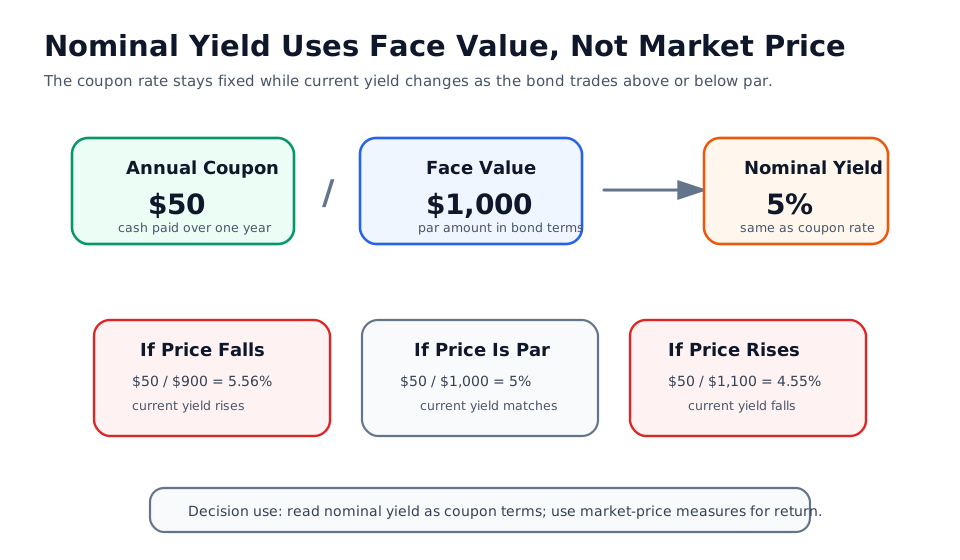
If a bond has a $1,000 face value and pays $50 of annual coupon interest, nominal yield is:
Why It Matters
Nominal yield matters because it identifies the stated coupon income attached to a bond’s face value. A 5% nominal yield on $1,000 face value means $50 of annual coupon payments, regardless of whether the bond later trades at $950, $1,000, or $1,050.
That makes nominal yield useful for:
- reading the bond’s stated coupon terms
- estimating contractual coupon cash flow
- distinguishing coupon income from market-price return
- comparing a bond’s coupon with current market yields
- spotting whether a bond is likely to trade at a premium or discount
It is a contract-income measure, not a full investment-return measure.
Nominal Yield vs. Current Yield and YTM
| Measure | Denominator | What it answers | Main blind spot |
|---|---|---|---|
| Nominal yield | Face value | What coupon rate is stated on par value? | Ignores today’s market price |
| Current Yield | Current market price | How much coupon income is bought at today’s price? | Ignores maturity value and calls |
| Yield to Maturity | Price and modeled cash flows | What return is implied if held to maturity? | Assumption-driven and not guaranteed |
| Real Yield | Inflation-adjusted return basis | What return remains after inflation? | Depends on inflation measure and horizon |
Nominal yield stays tied to face value. Current yield changes when market price changes. YTM changes with price, maturity, coupon timing, and redemption assumptions.
Practical Example
Suppose a fixed-rate bond has:
- face value:
$1,000 - annual coupon payment:
$50 - nominal yield:
5%
If that bond trades at $900, the nominal yield is still 5%, but the current yield rises to about 5.56% because the same $50 coupon is divided by a lower market price.
If the bond trades at $1,100, the nominal yield remains 5%, but the current yield falls to about 4.55% because the investor is paying more for the same coupon cash flow.
What To Verify
Before relying on nominal yield, verify:
- face value or par value
- coupon rate and annual coupon amount
- coupon frequency and day-count convention
- whether the coupon is fixed, floating, step-up, deferred, or payment-in-kind
- maturity date, call terms, sinking fund, and amortization
- current market price if the decision compares yield or return
- tax treatment and whether the coupon is taxable, exempt, or subject to special rules
Nominal yield is clean only for the coupon term. Once the decision involves market return, liquidity, price sensitivity, or hold/sell timing, use broader measures such as current yield, YTM, yield to call, yield to worst, duration, and credit spread.
Public Source Checks
Useful public references include:
- FINRA Understanding Bond Yield and Return: Explains coupon yield, current yield, YTM, YTC, and YTW.
- Investor.gov Bonds FAQs: SEC investor education on bond principal, interest, maturity, and risk.
- U.S. Treasury Daily Treasury Rates: Benchmark Treasury yield context for comparing a bond’s stated coupon with current market rates.
These sources help frame coupon and yield terms. A bond-specific decision still needs the actual security terms, price source, settlement basis, and issuer risk.
When Nominal Yield Misleads
Nominal yield can mislead when:
- the bond trades far above or below par
- the investor compares coupon rate with market yield as if they were the same
- the bond is callable and may be redeemed before maturity
- credit risk explains a high stated coupon
- inflation erodes the real purchasing power of coupons
- taxes change the after-tax income result
- floating-rate or step-up terms make the coupon path uncertain
Treat nominal yield as the starting coupon label. Do not use it as the final return estimate.
Common Confusion
Do not confuse nominal yield with current yield. Nominal yield uses face value; current yield uses current market price.
Do not confuse nominal yield with yield to maturity. YTM includes price, maturity value, and timing assumptions; nominal yield does not.
Do not assume a higher nominal yield makes a bond better. A high coupon can reflect higher credit risk, longer maturity, weaker liquidity, call risk, or market stress.
Related Terms
- Coupon Rate: The stated annual coupon percentage on face value.
- Coupon Yield: Closely related term for coupon income relative to face value.
- Current Yield: Annual coupon divided by market price.
- Bond Yield: Broader yield family that includes nominal yield and other measures.
- Yield to Maturity: Broader held-to-maturity return measure.
- Face Value: The principal amount used as the denominator for nominal yield.