Current Yield
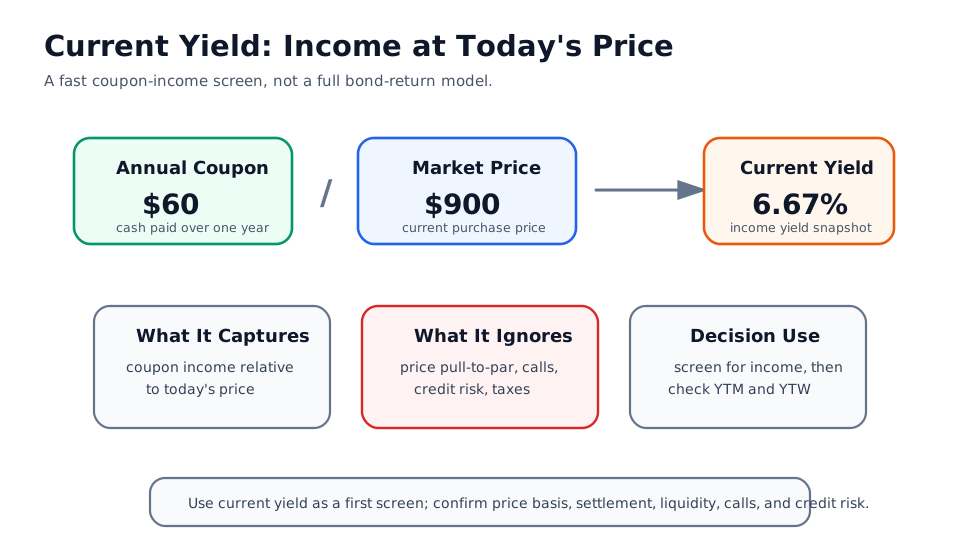
Current yield is annual coupon income divided by a bond's current market price, providing a quick income measure that excludes redemption and price-return effects.
Current yield, also called running yield, is a bond’s annual coupon payment divided by its current market price. It shows the coupon income available at today’s price, but it does not measure total return, account for the gain or loss at redemption, or identify the most relevant call scenario.
Current yield is useful as a fast income screen. It is not sufficient for choosing among bonds with different maturities, call terms, credit risk, liquidity, or tax treatment.
Key Takeaways
- Current yield equals annual coupon cash divided by current bond price.
- Coupon rate uses face value; current yield uses market price.
- A discount bond normally has current yield above its coupon rate, while a premium bond normally has current yield below its coupon rate.
- Current yield ignores pull to par, calls, principal loss, reinvestment, default, fees, and taxes.
- A zero-coupon bond has zero current yield even when it has a positive yield to maturity.
- The quoted result can differ depending on whether the denominator is clean price or full settlement price.
- Current yield is not a forecast or a guaranteed realized return.
Formula and Worked Example
For a plain fixed-rate bond:
Suppose a $1,000 face-value bond has a 6% annual coupon and trades at $920:
The 6.52% result means the annual coupon equals about 6.52% of the quoted price. It does not mean the investor will earn 6.52% over every one-year holding period.
Current Yield at Discount, Par, and Premium
Assume three otherwise identical five-year bonds each pay a $60 annual coupon on $1,000 face value. The YTM values below use annual payments for a simplified illustration.
| Market price | Price condition | Coupon rate | Current yield | Approximate YTM |
|---|---|---|---|---|
$920 | Discount | 6.00% | 6.52% | 8.00% |
$1,000 | Par | 6.00% | 6.00% | 6.00% |
$1,080 | Premium | 6.00% | 5.56% | 4.19% |
Current yield and YTM differ because YTM incorporates the movement between purchase price and the $1,000 maturity payment, as well as the timing of all cash flows.
- The discount bond can gain
$80toward par if held to maturity and paid as promised, so its YTM exceeds current yield. - The premium bond loses
$80relative to purchase price when only$1,000is repaid at maturity, so its YTM is below current yield. - The par bond has equal coupon rate, current yield, and YTM in this simplified just-after-coupon example.
Current Yield vs. Other Yield Measures
| Measure | Formula or basis | What it captures | What it omits or assumes |
|---|---|---|---|
| Coupon Rate | Annual coupon / face value | Contractual coupon rate | Current market price |
| Current yield | Annual coupon / current price | Coupon income at today’s price | Redemption, calls, price change, and timing |
| Yield to Maturity | Price and all scheduled maturity cash flows | Modeled full-horizon yield | Assumes payment and stated maturity path |
| Yield to Call | Price and cash flows through one call date | Call-scenario yield | Applies only to the selected call |
| Yield to Worst | Lowest specified redemption yield | Conservative contractual redemption comparison | Does not model default or every market outcome |
| Holding-period return | Cash received plus sale-price change | Actual result over the chosen horizon | Unknown until price and cash flows occur |
The most useful measure depends on the question. Current yield answers an income question, not a total-return or risk question.
Callable-Bond Example
Assume a bond has:
$1,000face value;- a 7% annual coupon, or
$70; - a current price of
$1,080; and - a possible call in two years at
$1,020.
Its current yield is:
Using annual cash flows for simplicity, the yield to that call is about 3.75%. The call scenario is much lower because the investor pays $1,080 but receives only $1,020 at redemption after two coupon payments.
Current yield hides that premium loss. For a callable premium bond, Yield to Worst is usually more informative than current yield alone.
Clean Price or Dirty Price?
Bond prices are often quoted on a clean basis excluding accrued interest, while the settlement or dirty price includes accrued interest. Current-yield data providers may use quoted clean price, but a cash-on-cash calculation based on actual settlement funds can use the full price.
Suppose a bond pays $60 annually, has a clean price of $980, and has $20 of accrued interest:
| Denominator | Calculation | Result |
|---|---|---|
| Clean quoted price | $60 / $980 | 6.12% |
| Full settlement price | $60 / $1,000 | 6.00% |
Neither number explains the complete holding-period economics. The buyer pays accrued interest because part of the next coupon economically belongs to the seller. State the price basis when precision matters, and do not compare yields built from different denominators.
Special Cases
Zero-coupon bonds
A zero-coupon bond pays no periodic coupon, so its current yield is 0%. It can still have a positive or negative yield to maturity because return comes from the difference between purchase price and maturity payment.
Floating-rate notes
Current yield can be estimated from the current annualized coupon divided by price, but future coupon payments reset. The resulting measure can become stale quickly and does not capture discount margin, index changes, floors, caps, or credit-spread risk.
Inflation-linked bonds
Coupon cash can change as adjusted principal changes. A static annual coupon numerator may not represent future cash income. Real yield and inflation assumptions are more useful for full analysis.
Amortizing and prepayable securities
Principal payments reduce the amount on which future coupons are earned. A current annual coupon snapshot can overstate future cash income if principal amortizes or prepays.
Defaulted or nonperforming bonds
Contractual coupon divided by a distressed price can produce an extremely high current yield even when coupon payment is suspended or doubtful. Expected cash flows and recovery analysis replace the mechanical ratio.
Why Current Yield Changes
For a fixed coupon, current yield changes mainly because price changes:
- rising required yields usually lower price and raise current yield;
- falling required yields usually raise price and lower current yield;
- credit deterioration can lower price and mechanically raise current yield;
- a call expectation can cap price and change the relevance of the maturity yield;
- liquidity and stale quotes can distort the denominator.
A rising current yield is therefore not automatically favorable. It can be caused by a worsening credit or liquidity outlook rather than improved income quality.
How To Evaluate Current Yield
- Confirm face value, coupon rate, coupon frequency, and annual coupon cash.
- Verify whether the price is clean or dirty, current or stale, and executable or indicative.
- Check maturity, calls, puts, sinking funds, principal amortization, and prepayment terms.
- Compare current yield with YTM, yield to call, and yield to worst as applicable.
- Review credit quality, payment status, seniority, collateral, and recovery assumptions.
- Measure duration, spread, liquidity, bid-ask cost, and expected holding period.
- Consider taxes, currency, inflation, and reinvestment separately.
- Use expected cash flow rather than contractual coupon when payment is uncertain.
Common Mistakes
- Using coupon rate instead of annual coupon cash in the numerator.
- Dividing by face value and calling the result current yield.
- Treating current yield as YTM or expected total return.
- Ignoring the redemption loss on a premium bond.
- Ignoring call risk when a premium bond can be redeemed early.
- Treating a high distressed current yield as dependable income.
- Comparing a clean-price calculation with a full-price calculation without adjustment.
- Applying current yield to a zero-coupon or amortizing bond as though it captures return.
- Ignoring taxes, transaction costs, and reinvestment.
Authoritative Sources
- Investor.gov current-yield glossary defines current yield as bond interest relative to actual market price and provides a simple example.
- FINRA’s bond yield and return guide distinguishes coupon yield, current yield, yield to maturity, yield to call, and realized return.
- MSRB’s bond prices and yields guide explains municipal bond price-yield mechanics and current-yield limitations.
- TreasuryDirect’s pricing guide explains why Treasury note and bond price depends on yield to maturity and coupon rate.
This article provides general financial education, not individualized investment, tax, legal, or accounting advice. Actual decisions require the security terms, current market evidence, and the reader’s constraints.
Related Terms
- Bond Yield: Umbrella term for current, maturity, call, worst, and other yield conventions.
- Coupon Rate: Contractual annual coupon percentage based on face value.
- Yield to Maturity: Price-implied yield using all scheduled cash flows through maturity.
- Yield to Worst: Lowest calculated yield among specified contractual redemption scenarios.
- Bond Prices at Par, Premium, or Discount: Explains why market price changes current yield relative to coupon rate.