Callable Bond
A callable bond gives the issuer a contractual right to redeem the bond before maturity at specified dates and prices.
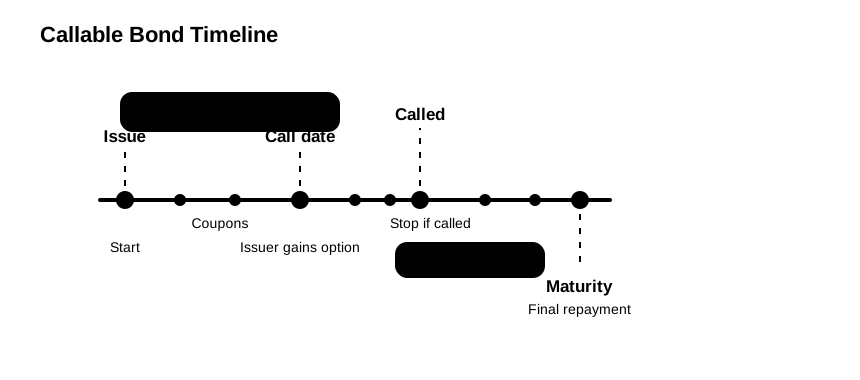
A callable bond, also called a redeemable bond, gives the issuer a contractual right to redeem the debt before its stated maturity date. The issuer controls the option, so the investor may receive principal back and stop receiving coupons earlier than expected.
Key Takeaways
- The call provision defines eligible call dates, call prices, notice, and other redemption conditions.
- The first call date is the earliest date an optional call can usually be exercised; it is not necessarily the date the bond will be called.
- A noncallable bond generally lacks an ordinary issuer option to redeem early, but extraordinary, sinking-fund, make-whole, or mandatory redemption terms still require review.
- A nonrefunding provision can restrict calls financed by lower-cost replacement debt without blocking every possible redemption.
- Yield to maturity can overstate the relevant return when an early call is plausible; compare yield to call and yield to worst.
Call Terms To Read
| Term | Meaning | Why it matters |
|---|---|---|
| Call date | Date on which redemption is permitted | Determines when coupons can stop |
| Call price | Amount paid on redemption | May be par, a premium, or formula-based |
| Call protection | Initial period or restriction limiting calls | Preserves cash flows only within its exact scope |
| Make-whole call | Redemption price based on discounted remaining payments | Formula and benchmark can materially change value |
| Sinking-fund redemption | Scheduled redemption of part of an issue | Some holders can receive principal before maturity |
| Nonrefunding provision | Restriction on specified refinancing-driven calls | Does not necessarily make the bond fully noncallable |
Callable vs. Putable vs. Noncallable
| Structure | Option holder | Main investor effect |
|---|---|---|
| Callable | Issuer | Early redemption and reinvestment risk |
| Putable | Investor | Right to require repurchase on stated terms |
| Noncallable | Neither party has an ordinary issuer call under the stated terms | More predictable maturity, subject to other redemption clauses and default |
Worked Example: A Premium Bond Called Early
Assume an investor pays $1,080 for a $1,000 bond with a 6% annual coupon, ten-year maturity, and an issuer call at 102% of par after year five. If the issuer exercises that first call, the investor receives five $60 coupon payments and $1,020 of redemption principal rather than holding the bond for ten years.
| Cash-flow question | If called after year 5 | If not called and held to maturity |
|---|---|---|
| Annual coupon | $60 | $60 |
| Number of annual coupons | 5 | 10 |
| Principal or redemption payment | $1,020 | $1,000 |
| Purchase premium not recovered by redemption | $60 | $80 |
The 6% coupon rate is not the investor’s yield. The investor paid an $80 premium but recovers only a $20 call premium, so $60 of the purchase premium is lost when the bond is called. The five coupons partly offset that loss, but their timing matters; yield to call discounts each payment rather than simply dividing total cash by five.
The issuer is more likely to consider an optional call when refinancing is economically attractive, but rates are not the only factor. Credit spreads, transaction costs, covenant changes, available financing, and the exact call price can alter the decision. The example is educational and does not predict whether an issuer will call a bond.
Risks and Limitations
- Reinvestment risk: Returned principal may earn less after a call.
- Yield risk: Quoted yield may assume a cash-flow path that does not occur.
- Price-cap risk: Expected calls can limit upside when yields fall.
- Credit risk: A call feature does not improve the issuer’s ability to pay.
- Document risk: Optional, extraordinary, sinking-fund, tax, and make-whole redemptions operate differently.
- Liquidity risk: Realized sale value can differ from model price or quoted yield.
How To Evaluate a Callable Bond
- Read the complete redemption schedule and notice terms.
- Calculate yield to each plausible call date, maturity, and yield to worst.
- Compare call price with purchase price and accrued interest.
- Test rate, spread, and issuer-refinancing scenarios.
- Check whether a nonrefunding clause, make-whole formula, or sinking fund changes the analysis.
- Review credit, liquidity, tax, and settlement risks separately.
Public Source Checks
FINRA’s callable bonds guide explains optional, extraordinary, sinking-fund, and make-whole redemptions and emphasizes yield-to-call and reinvestment risk. Security-specific conclusions must come from the prospectus or official statement.
This page is educational only and does not recommend any bond or yield strategy.