Credit Spread
Credit spread is the yield or model-implied spread over a reference benchmark that reflects credit, liquidity, uncertainty, and bond-specific risks.
Credit spread is the additional yield or model-implied spread that a bond offers over a selected benchmark with lower credit risk. It is usually quoted in basis points and reflects more than expected default loss: liquidity, uncertainty, market positioning, structure, and embedded options can also affect the number.
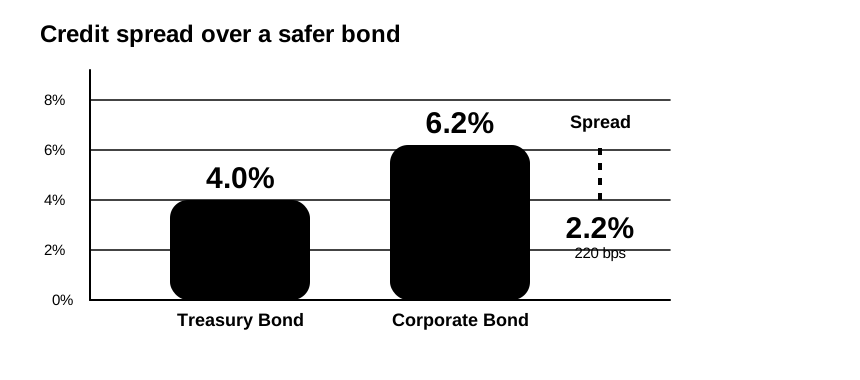
This simple example measures the yield gap to a similar-maturity government benchmark. More advanced spread measures use a curve or option model.
Key Takeaways
- A credit spread is a relative market price, not a direct probability of default or guaranteed excess return.
- The benchmark, currency, maturity or duration, quote time, price source, and calculation convention must be stated.
- Wider spreads generally indicate that the market requires more compensation; they do not prove a bond is cheap.
- Spread can change because the bond moves, the benchmark moves, or both move differently.
- G-spread, Z-spread, and option-adjusted spread are related but not interchangeable calculations.
Simple Credit Spread Formula
For a basic same-maturity yield comparison:
If a corporate bond yields 6.20% and the selected government benchmark yields 4.00%, the spread is:
16.20% - 4.00% = 2.20% = 220 basis points
One basis point equals 0.01%, so 100 basis points equal one percentage point. This arithmetic produces a nominal or simple spread. It does not by itself adjust for the full yield curve, cash-flow timing, or embedded options.
What a Credit Spread Can Contain
It is tempting to call the entire 220 basis points “default compensation,” but the observed spread can include several components:
- Expected credit loss: Probability of default combined with loss severity if default occurs.
- Credit-risk premium: Compensation for uncertainty around losses and adverse outcomes.
- Liquidity premium: Compensation for infrequent trading, dealer balance-sheet costs, or a wide bid-ask spread.
- Option value: Callable, putable, convertible, or prepayable features can affect the quoted spread.
- Structural risk: Seniority, collateral, guarantees, and covenants change the holder’s claim.
- Technical factors: New supply, fund flows, index rebalancing, hedging demand, and inventory can move spreads.
- Tax or regulatory effects: Different treatment can affect demand even when expected credit loss is unchanged.
The components are not separately observable from one simple spread quote.
Worked Example: Rates and Spread Move Separately
Assume a five-year corporate bond initially yields 5.50% while its benchmark yields 4.00%. Its spread is 150 basis points.
One month later, the benchmark yield falls to 3.70%, but concern about the issuer pushes the corporate bond’s yield to 5.70%.
1Initial spread: 5.50% - 4.00% = 1.50% = 150 bps
2New spread:     5.70% - 3.70% = 2.00% = 200 bps
The corporate yield rose 20 basis points even though the benchmark fell 30 basis points because the spread widened by 50 basis points. The bond’s price would generally decline, with the approximate sensitivity depending on its duration, convexity, and cash-flow features.
If its spread duration were approximately 4.2 years, a rough first-order spread effect would be:
1Approximate price change = -4.2 x 0.50% = -2.1%
This is an estimate, not a forecast. Convexity, carry, accrued interest, option behavior, and simultaneous curve changes can alter the realized move.
Choosing the Benchmark
A useful comparison normally aligns:
- currency;
- maturity or duration;
- nominal versus inflation-linked cash flows;
- fixed versus floating rate structure;
- tax status where relevant; and
- quote and settlement date.
U.S. corporate spreads are often quoted over a Treasury curve, but other markets may use sovereign, swap, or another reference curve. The U.S. Treasury notes that constant-maturity yields are read from an interpolated par curve and may not equal the yield of one actual security. That distinction matters when reproducing a spread.
Credit Spread vs. Related Measures
| Measure | Core calculation | Best use | Main limitation |
|---|---|---|---|
| Nominal credit spread | Bond yield minus one benchmark yield | Fast, intuitive comparison | Ignores the full curve and option value |
| G-Spread | Bond yield minus interpolated government-curve yield | Plain-bond government benchmark comparison | Still relies on one maturity-equivalent curve point |
| Z-Spread | Constant spread added to every spot-curve point | Option-free bonds with known cash flows | Does not model changing cash flows from embedded options |
| Option-Adjusted Spread | Model-solved spread across rate paths after option behavior | Callable and prepayable securities | Depends heavily on model and behavioral assumptions |
Do not compare two spread values until their benchmarks and conventions are aligned.
Why Spreads Widen or Tighten
Spreads may widen when expected credit quality weakens, liquidity deteriorates, volatility rises, supply exceeds demand, or investors prefer safer assets. They may tighten when fundamentals improve, liquidity strengthens, demand rises, or uncertainty falls.
A rating action can contribute, but spreads often move before the formal credit downgrade or upgrade. Spread is therefore a current market signal, while a rating is an agency opinion under a methodology.
How to Evaluate a Spread Quote
- Identify the exact bond, clean price, settlement date, accrued interest, and yield convention.
- Record the benchmark curve, interpolation method, and quote time.
- Match currency, maturity, duration, seniority, rating, sector, and option features.
- Determine whether the number is nominal spread, G-spread, Z-spread, OAS, or another measure.
- Compare the bond with its own history, issuer curve, peer group, and relevant index.
- Investigate whether widening comes from credit, liquidity, technical flows, or option assumptions.
- Stress-test default, recovery, downgrade, rate, and liquidity scenarios rather than treating spread as realized return.
Common Mistakes
- Calling spread a risk-free profit premium.
- Using a current bond yield with a benchmark from a different time or settlement basis.
- Comparing a long-duration bond with a similar-maturity benchmark when cash-flow timing differs materially.
- Treating a wide spread as proof of undervaluation.
- Ignoring transaction costs and stale prices in illiquid bonds.
- Comparing index OAS with an individual bond’s nominal spread.
- Assuming spread fully captures expected loss or recovery.
Public Source Checks
FINRA’s guide to bond spreads explains basis-point quotation, benchmark comparison, and common reasons spreads change. The U.S. Treasury publishes its yield-curve methodology and constant-maturity yield FAQ. The Federal Reserve Bank of St. Louis provides corporate bond and OAS series through FRED, with source and series-specific notes that should be read before comparison.
This page is educational only. A spread quote does not determine whether a bond is fairly valued or suitable for a particular reader.
Related Terms
- Yield Spread: The broader difference between two quoted yields.
- Credit Risk: The risk that an obligor will not perform as agreed.
- Bond Rating: An agency credit opinion often considered alongside market spreads.
- Duration: The foundation for estimating price sensitivity to yield and spread changes.
- High-Yield Bond: Debt that generally trades at wider spreads because of greater credit risk.
- Recovery Rating: A separate opinion relevant to loss severity after default.