Share Register
A share register or stock ledger records a company's registered shareholders, share classes, balances, issuances, and transfers.
A share register is the official issuer-level record of people and entities registered as holders of a company’s shares. Depending on jurisdiction, it may be called a register of members, stock ledger, or shareholder register. It records legal ownership details such as holder name, share class, registered balance, issuances, and transfers.
A share register does not necessarily identify every ultimate investor. When shares are held through brokers, custodians, or a central depository, the register may show a nominee’s aggregate position while intermediary records identify the underlying beneficial owners.
Key Takeaways
- The share register is an ownership record, not a valuation report or a complete list of every beneficial owner.
- Its required contents, legal effect, inspection rights, and update deadlines vary by jurisdiction.
- A transfer agent may maintain the register for the issuer, but the issuer remains responsible under the applicable framework.
- Registered share totals should reconcile with authorized, issued, treasury, cancelled, and outstanding share records.
- Cap tables, brokerage records, depository position listings, and beneficial-owner lists serve different purposes.
- Access to personal information must follow applicable corporate, securities, and privacy rules.
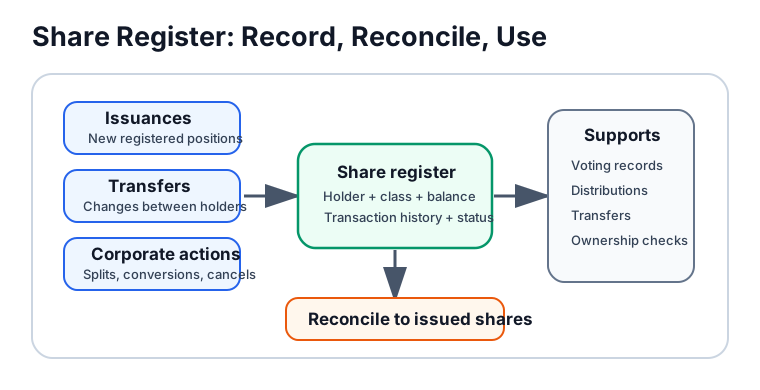
What a Share Register Typically Contains
Required fields depend on governing law and the company’s organization. Common data includes:
- registered holder’s legal name
- address or other permitted contact information
- account or holder identifier
- number and class of shares registered
- date and source of issuance or transfer
- certificate numbers or book-entry position details, where applicable
- restrictions, legends, liens, or stop-transfer notations
- cancellation, conversion, split, consolidation, or redemption history
Tax identifiers, payment instructions, beneficial-owner data, and identity documents may be maintained in related systems rather than in the core legal register.
Worked Example: Reconciling the Share Register
Assume a company has issued:
8,000,000Class A common shares2,000,000Class B common shares
The total issued shares are:
The register contains:
| Registered position | Class A | Class B |
|---|---|---|
| Depository nominee | 7,200,000 | 1,400,000 |
| Directly registered investors | 600,000 | 500,000 |
| Founders and other registered holders | 200,000 | 100,000 |
| Total registered | 8,000,000 | 2,000,000 |
The register reconciles by class to the company’s issued-share control records. It still does not list every customer behind the depository nominee’s 8,600,000 aggregate shares. Those beneficial positions are maintained on depository, broker, bank, and custodian records.
If the register instead totaled 8,000,100 Class A shares, the 100-share excess would be a record difference requiring investigation. It should not be dismissed merely because the difference is small.
Share Register vs. Other Ownership Records
| Record | Primary purpose | Usually shows |
|---|---|---|
| Share register or stock ledger | Issuer-level registered ownership | Registered holders, classes, balances, issuances, transfers |
| Cap table | Capital structure and dilution analysis | Founders, investors, options, convertibles, ownership percentages |
| Brokerage account | Customer-level custody and beneficial ownership | Securities and cash attributed to the customer |
| Depository position listing | Aggregate participant positions | Broker, bank, or participant-level balances |
| Beneficial-owner list | Event-specific or compliance ownership information | Underlying owners identified under applicable procedures |
| General ledger | Financial accounting | Share capital, additional paid-in capital, treasury stock, and related accounts |
A private-company cap table and share register may contain overlapping data, but they are not automatically interchangeable. A cap table can model unexercised options and convertibles that are not yet issued shares. The legal register ordinarily records actual registered holdings.
Who Maintains the Register
The register may be maintained by:
- the company itself
- an appointed transfer agent
- a registrar or corporate-services provider
- a central securities depository or connected market infrastructure
The operational model depends on the jurisdiction and security. In U.S. public markets, transfer agents commonly maintain issuer security-holder records, process ownership changes, cancel and issue certificates, and support distributions.
An issuer can change transfer agents. Investors should confirm the current agent through the issuer’s investor-relations site or a recent regulatory filing before sending documents or relying on old account instructions.
How the Register Changes
Entries can change through:
- issuance of new shares
- transfer between registered holders
- movement between street name and direct registration
- conversion, exercise, redemption, or cancellation
- stock splits, consolidations, mergers, and reorganizations
- estate, trust, gift, court-order, or entity-name changes
An ordinary exchange trade may not change the issuer-level registered holder if both buyer and seller hold through the same nominee structure. The beneficial-owner records can change while the aggregate nominee position on the share register remains the same.
Record Dates, Voting, and Distributions
The share register helps establish the starting record for:
- shareholder meeting notices
- voting and proxy processing
- dividend and distribution allocation
- rights offerings
- tender offers and exchanges
- mergers and other corporate actions
For street-name holdings, event information and entitlements are passed through intermediaries. A register’s record-date snapshot therefore should not be interpreted as a complete list of the people making ultimate investment decisions.
As one jurisdiction-specific example, Section 219 of the Delaware General Corporation Law defines a stock ledger for purposes of that statute and addresses the list of stockholders entitled to vote. Other jurisdictions can define the register, access rights, and evidentiary effect differently.
Controls for an Accurate Share Register
Strong controls include:
- unique holder and security identifiers
- authorization for new issuances and cancellations
- dual review of sensitive transfers
- reconciliation by security class and status
- certificate inventory and book-entry controls
- restriction and stop-transfer monitoring
- audit trails for every record change
- backup, recovery, and tamper-detection procedures
- reconciliation with depository and transfer-agent records
- controlled access to personal and payment information
The register should reconcile not only in total but also by share class, voting rights, restriction status, and transaction history.
Ownership Percentage and Its Limits
For an issued-share calculation:
The denominator must match the question. Analysts may need common shares, a specific voting class, all voting power, fully diluted shares, or another basis. A registered percentage may also differ from a beneficial-ownership percentage when nominees, trusts, derivatives, or attribution rules apply.
Privacy and Inspection
Share registers contain personal and commercially sensitive information. Corporate law may give specified shareholders, regulators, courts, or other parties inspection rights for defined purposes, while privacy and data-security rules can limit use and disclosure.
The existence of a legal inspection right does not make unrestricted publication appropriate. Requests should be evaluated under the law governing the company and the stated purpose.
Common Mistakes and Risks
Assuming the register lists every investor. Nominee positions can aggregate many beneficial owners.
Using a cap table as the legal register without reconciliation. Forecast dilution and actual issued ownership are different.
Ignoring share classes. Equal share counts can carry different voting, dividend, conversion, or liquidation rights.
Failing to reconcile transfers and cancellations. Record differences can cause incorrect voting, distributions, or ownership confirmations.
Treating the register as proof of market value. It establishes recorded positions, not price or investment merit.
Publishing personal data too broadly. Inspection and disclosure must follow applicable corporate and privacy rules.
Official Source Checks
- SEC: Transfer Agents describes ownership-record, transfer, certificate, and distribution functions.
- SEC: Recordkeeping Requirements for Transfer Agents explains why accurate, secure, and recoverable ownership records matter.
- Delaware Code, Title 8, Section 219 provides one jurisdiction-specific stock-ledger definition and voting-list framework.
Related Terms
- Registered Holder: The person or nominee whose name appears in the issuer-level ownership record.
- Beneficial Ownership: Economic ownership or control that may sit behind a nominee position.
- Stock Transfer Agent: An issuer-appointed party that may maintain the register and process transfers.
- Cap Table: A capital-structure model that can include actual and potential dilution.
- Issued Shares: Shares created and issued by the company that must reconcile to ownership records.
- Record Date: A date used to identify holders relevant to a specified event.
- Street Name: A nominee registration structure common in brokerage accounts.
FAQs
This article is educational and does not provide corporate, securities, privacy, tax, or legal advice. Apply the law governing the specific company and transaction.