Float-Adjusted Market Capitalization
Float-adjusted market capitalization values shares available to public investors. Learn the formula, free-float methodology, index weights, and limits.
Float-adjusted market capitalization, also called free-float market capitalization, is a company’s share price multiplied by the shares an index provider considers available to public investors. It is commonly used to determine company weights in market-capitalization-weighted indexes.
Key Takeaways
- Float-adjusted and free-float market capitalization are two names for the same general measure.
- The calculation uses float shares, or total shares multiplied by an investable weight factor.
- Index providers can exclude strategic, controlling, restricted, or foreign-ownership-limited holdings differently.
- Float adjustment can make a company’s index weight much smaller than its share of total market capitalization.
- Float-adjusted market cap is an index-construction measure, not a direct estimate of liquidity or intrinsic value.
Formula
The direct formula is:
If the methodology publishes an investable weight factor (IWF):
where:
Worked Example
Suppose a company has:
- share price:
$25 - shares outstanding:
100 million - investable weight factor:
65%
Its total market capitalization is:
Its float-adjusted market cap is:
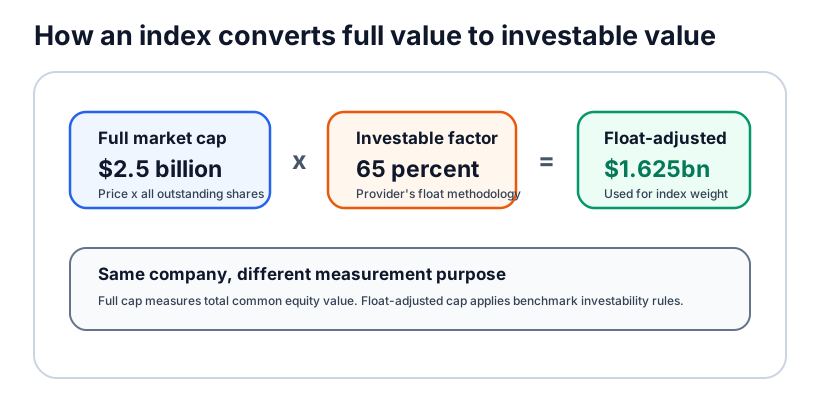
The company has $2.5 billion of total equity market value, but an index using this float methodology recognizes $1.625 billion when calculating its weight.
How Float Adjustment Changes Index Weight
Consider a two-company index:
| Company | Full market cap | IWF | Float-adjusted market cap |
|---|---|---|---|
| Alpha | $2.5 billion | 100% | $2.5 billion |
| Beta | $2.5 billion | 40% | $1.0 billion |
Their total float-adjusted value is $3.5 billion. The resulting weights are:
Without float adjustment, the two companies would each receive a 50% weight. The methodology reduces Beta’s weight because most of its shares are not considered available to public investors.
What a Free-Float Methodology Does
A free-float methodology generally:
- starts with the eligible shares outstanding for each security or share class
- identifies holdings treated as strategic, controlling, restricted, or unavailable
- applies foreign ownership or other investability limits where relevant
- converts the available proportion into an IWF or similar adjustment factor
- multiplies price, shares, and the adjustment factor
- updates the factor under the provider’s review and corporate-action rules
S&P Dow Jones Indices describes this process in its Float Adjustment Methodology. The methodology defines available float as total shares less specified strategic holdings and applies an IWF to the index share count.
FTSE Russell publishes separate free-float restriction rules. Its approach can also reflect foreign ownership limits and lockup restrictions. These examples show why a generic float estimate should not be substituted for the actual benchmark methodology.
Full Market Cap vs. Float-Adjusted Market Cap
Full-market capitalization is simply ordinary market capitalization based on all outstanding shares. It is not a separate company-valuation concept.
| Measure | Share base | Common use |
|---|---|---|
| Full or total market cap | All shares outstanding | Company size and total common equity market value |
| Float-adjusted market cap | Shares included under a float methodology | Index eligibility, ranking, and weighting |
| Float percentage or IWF | Float shares divided by outstanding shares | Adjustment factor applied by the provider |
| SEC public float | Common equity held by non-affiliates under SEC rules | Specified filing and issuer-status tests |
Some benchmark families use full market cap for a size-ranking step and float-adjusted market cap for constituent weighting. Do not assume every screen and calculation uses the same share base.
Why Index Providers Use Float Adjustment
Float adjustment aims to align index weights more closely with the shares public investors can potentially hold. Without it, a company with a large strategic or government stake could receive a large benchmark weight even though relatively few shares are available to outside investors.
The approach can:
- reduce the weight assigned to controlling or strategic holdings
- improve the investability of a benchmark-tracking portfolio
- account for foreign ownership restrictions
- distinguish multiple share classes with different available floats
- make index weights more representative of the provider’s eligible public market
MSCI, for example, describes the MSCI World 100 Index as free-float-adjusted market-capitalization weighted. The phrase identifies both the constituent value measure and the weighting method.
Float-Adjusted Does Not Mean Liquid
Float adjustment estimates availability, not actual trading capacity.
A security with a high IWF may still have:
- low trading volume
- a wide bid-ask spread
- concentrated passive ownership
- limited order-book depth
- market-access or settlement constraints
Likewise, an excluded strategic block might later enter the market, while shares counted as float may rarely trade. Liquidity analysis therefore needs volume, turnover, spread, depth, and market-impact evidence in addition to stock float.
Multiple Share Classes and Ownership Limits
Multiple share classes complicate the calculation. A provider may:
- include each eligible listed class separately
- assign different IWFs to different classes
- aggregate classes for company-level capping
- exclude a class that fails liquidity or investability screens
Foreign ownership limits can reduce the investable factor below the ordinary free-float percentage. An index may also require minimum foreign headroom, voting rights, or public float before a security is eligible.
These rules are benchmark-specific. The provider’s current methodology and review notice are the controlling sources for index analysis.
Corporate Actions and Updates
Float-adjusted market cap changes when:
- the share price changes
- shares are issued or repurchased
- a lockup expires
- a founder, government, or strategic owner changes its stake
- a foreign ownership limit changes
- a merger, conversion, or share-class event occurs
- the provider updates or bands the IWF
An index provider may implement major corporate actions promptly but defer smaller ownership changes until a scheduled review. A current market price multiplied by a stale IWF can therefore differ from the provider’s next official weight.
How to Verify a Float-Adjusted Figure
Before using the number:
- Name the index provider and benchmark. Float rules are not interchangeable.
- Confirm the effective date. Use the IWF and share count applicable to the index calculation date.
- Check the share class. Price, shares, and IWF must refer to the same security.
- Review excluded holdings. Identify strategic, insider, government, cross-held, and restricted stakes.
- Check ownership limits. Foreign ownership restrictions may be more binding than ordinary free float.
- Reconcile corporate actions. Offerings, repurchases, lockup expirations, and conversions may change the inputs.
- Separate selection from weighting. A provider may rank companies by one capitalization measure and weight them by another.
Common Mistakes and Limitations
- Treating free-float and float-adjusted market cap as different concepts: They are generally alternate labels; provider rules create the differences.
- Subtracting only restricted stock: Strategic and ownership-limited holdings can also be excluded.
- Assuming the IWF is real-time: Providers update factors under scheduled and event-driven rules.
- Calling float-adjusted value the company’s total value: It intentionally excludes part of outstanding equity.
- Equating float with liquidity: Available shares do not establish spread, depth, volume, or market impact.
- Comparing indexes without reading their methods: Different float rules can change membership, weight, concentration, and performance.
- Treating an index weight as a recommendation: The weight follows methodology; it does not establish expected return or suitability.
Related Terms
- Market Capitalization: Total market value based on all outstanding common shares.
- Stock Float: The available share count used in the adjustment.
- Capitalization-Weighted Index: An index whose constituent weights depend on market capitalization.
- Outstanding Shares: The total share count before float exclusions.
- Liquidity: Actual ability to trade without excessive cost or price impact.
FAQs
Are free-float and float-adjusted market capitalization the same?
Can float-adjusted market cap exceed total market cap?
Why can two providers report different free-float values?
Does an IWF of 100 percent guarantee high liquidity?
This article is educational and does not provide investment, index, securities, legal, or trading advice. Benchmark rules and constituent data change; consult the provider’s current methodology before relying on an index weight.