Yield to Maturity
Yield to maturity is the price-implied annualized rate for a bond's scheduled coupons and principal through final maturity.
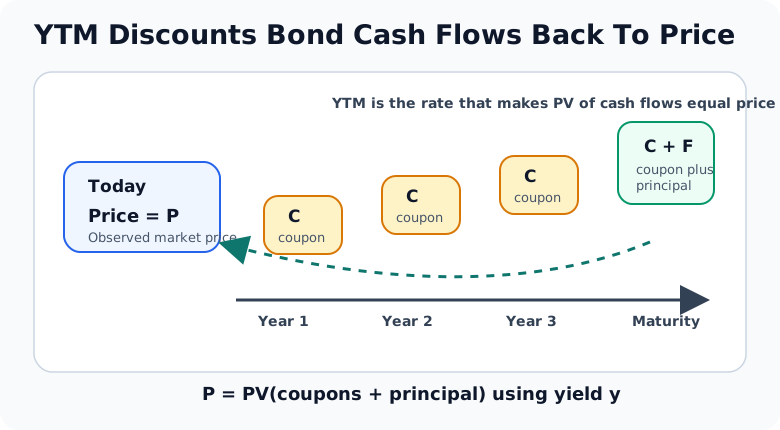
Yield to maturity (YTM) is the discount rate that makes a bond’s full settlement price equal to the present value of its scheduled coupon and principal payments through final maturity. It combines coupon income, cash-flow timing, and the gain or loss between purchase price and maturity value into one annualized quotation.
YTM is a model output, not a guaranteed return. It assumes the issuer makes the scheduled payments and the bond remains outstanding to maturity. Realized return can differ because of sale price, default, calls, reinvestment rates, costs, taxes, or other events.
Key Takeaways
- YTM uses the bond’s price and every scheduled cash flow through final maturity.
- Coupon rate is based on face value; YTM is based on price and cash-flow timing.
- A discount bond normally has YTM above its coupon rate, while a premium bond normally has YTM below its coupon rate.
- The calculation is an internal rate of return, so the periodic rate must be converted using the market’s quotation convention.
- Interpreting YTM as a realized compound return requires all promised payments and reinvestment of interim coupons at the calculated rate.
- Callable, amortizing, floating-rate, defaulted, and prepayable securities often require measures beyond a single YTM.
- Clean price, accrued interest, settlement date, day count, coupon frequency, and transaction costs can change a quoted result.
Price Equation and Quotation
For a plain fixed-rate bond with N remaining coupon periods:
where:
P_fullis the full or dirty settlement price;Cis coupon cash per period;Fis principal paid at maturity;ris yield per coupon period; andNis the number of remaining coupon periods.
The equation is solved for r; there is generally no simple closed-form formula for a coupon bond. For m coupon periods per year:
A U.S. bond paying semiannually commonly reports nominal bond-equivalent YTM as 2r, not the effective annual rate. Other markets and instruments can use different conventions.
Worked Example: Semiannual Bond
Assume a noncallable bond has:
$1,000face value;- four years remaining;
- a 5% annual coupon paid semiannually;
- eight remaining coupon payments of
$25; and - a full price of
$950immediately after a coupon date, so accrued interest is zero.
The six-month yield r solves:
The solution is approximately 3.2189% per half-year. Therefore:
The bond’s annual coupon is $50, so its current yield is:
| Measure | Result | What drives it |
|---|---|---|
| Coupon rate | 5.00% | $50 coupon divided by $1,000 face value |
| Current yield | 5.26% | $50 coupon divided by $950 price |
| Nominal semiannual YTM | 6.44% | Coupons plus discount accretion through maturity |
| Effective annual equivalent | 6.54% | Compounds the six-month periodic rate |
YTM is highest because the modeled cash flows include both coupon income and the $50 gain from $950 to $1,000. That gain still depends on the issuer paying principal at maturity.
What YTM Includes and Omits
| Included in the price equation | Not automatically included |
|---|---|
| Current full price | Probability of default or recovery amount |
| Scheduled coupon dates and amounts | Sale price before maturity |
| Contractual principal at maturity | Calls, puts, or prepayments unless modeled |
| Cash-flow timing | Brokerage markups, bid-ask spread, custody, or financing |
| Stated day-count and compounding convention | Investor-specific taxes and inflation |
| Reinvestment assumption used to interpret compound return | A forecast of future market yields |
The distinction matters most when a high quoted YTM reflects a very low price. The calculation treats promised payments as cash flows in the equation; it does not estimate the probability that they will be paid.
Coupon Reinvestment and Realized Return
YTM can be calculated without knowing what the investor will do with coupon cash. However, earning the YTM as a compound horizon return requires interim coupons to be reinvested at the calculated periodic yield until maturity.
If reinvestment rates are lower, the accumulated coupon value will be lower than the YTM path. If rates are higher, it can be higher. This is reinvestment risk.
For a zero-coupon bond held to maturity with payment as promised, there are no interim coupons to reinvest. Its realized annualized return is therefore less exposed to reinvestment assumptions, although credit, tax, and holding-period risks remain.
YTM Is Not Holding-Period Return
Suppose the example bond is sold after one year rather than held for four years. The investor receives two $25 coupons, but the one-year result also depends on the sale price:
1One-year holding-period return
2= (coupon cash + sale price - purchase price) / purchase price
If the sale price is $930, the simple one-year return before reinvestment, costs, and taxes is:
That is not the original 6.44% YTM. The sale price reflects the remaining cash flows and market yield after one year.
Premium, Par, and Discount Relationships
For a plain fixed-rate bond with payment as promised:
| Price state | Typical relationship |
|---|---|
| Discount | YTM > current yield > coupon rate |
| Par | YTM = current yield = coupon rate |
| Premium | Coupon rate > current yield > YTM |
These relationships can break when the bond has unusual cash flows, floating coupons, default risk, embedded options, negative yields, or mismatched quotation bases.
Callable and Structured Bonds
YTM assumes the bond reaches final maturity. That can be too favorable for a premium callable bond because the issuer may redeem it earlier at a lower yield.
- Yield to Call replaces maturity with a specified call date and call price.
- Yield to Worst selects the lowest applicable non-default contractual yield.
- Yield to Average Life addresses principal repayment before final maturity under an average-life assumption.
Mortgage-backed and asset-backed securities require projected prepayments. Floating-rate notes require assumptions about future index resets. Convertible, putable, perpetual, and distressed securities need scenario-specific measures rather than mechanical reliance on one YTM.
Clean Price, Accrued Interest, and Settlement
Bond screens often show a clean price excluding accrued interest. The buyer normally pays the dirty price, which equals clean price plus accrued interest. The yield calculation also depends on settlement date, next coupon date, coupon frequency, and day-count convention.
A manual calculation that discounts cash flows to a coupon date while using an off-cycle clean price can be materially wrong. For an actual trade, use the full settlement cash amount and the governing market convention.
How To Evaluate a Quoted YTM
- Identify the security and verify the price timestamp, quote size, and whether it is executable.
- Confirm clean price, accrued interest, full price, and settlement date.
- Reconstruct coupon dates, coupon amounts, principal, and maturity from the offering documents.
- Check coupon frequency, day count, business-day treatment, compounding, and annualization.
- Determine whether calls, puts, sinking funds, amortization, prepayment, or conversion can change the cash flows.
- Compare YTM with current yield, YTC, YTW, spread, duration, and expected holding-period return.
- Assess issuer payment capacity, seniority, collateral, covenants, and recovery rather than treating promised cash flows as certain.
- Include bid-ask cost, markup, financing, taxes, inflation, currency, and reinvestment where relevant.
Common Mistakes
- Calling coupon rate or current yield YTM.
- Treating YTM as a guaranteed one-year return.
- Using clean price without accrued interest in a full-price equation.
- Multiplying a periodic yield without stating the annual quotation convention.
- Ignoring reinvestment when interpreting YTM as compound return.
- Using maturity cash flows for a bond likely to be called or prepaid.
- Comparing two YTMs calculated with different day counts or compounding.
- Assuming a high YTM means a bond is undervalued rather than risky.
- Ignoring transaction costs and a stale or non-executable price.
- Treating promised principal as a probability-adjusted recovery estimate.
Authoritative Sources
- FINRA’s bond yield and return guide defines YTM as the discount rate equating price with future coupon and principal cash flows and explains its assumptions.
- MSRB’s bond prices and yields guide explains the relationship among price, coupon, maturity value, and municipal bond yields.
- Investor.gov bond education explains bond payments, maturity, price, and major risks.
- FINRA’s corporate and agency bond data glossary explains when market data may display yield to worst rather than a standalone YTM.
This article provides general financial education, not individualized investment, legal, tax, or accounting advice. Evaluate an actual bond using its offering documents, current market record, and relevant professional guidance.
Related Terms
- Bond Yield: Umbrella concept covering income, maturity, call, worst, and realized-return measures.
- Current Yield: Coupon-income ratio that excludes the maturity gain or loss.
- Yield to Call: Price-implied yield through one specified call date.
- Yield to Worst: Lowest applicable non-default contractual redemption yield.
- Duration: Price sensitivity that complements, but does not replace, yield.
- Credit Spread: Yield difference above a benchmark associated with credit, liquidity, and risk premia.